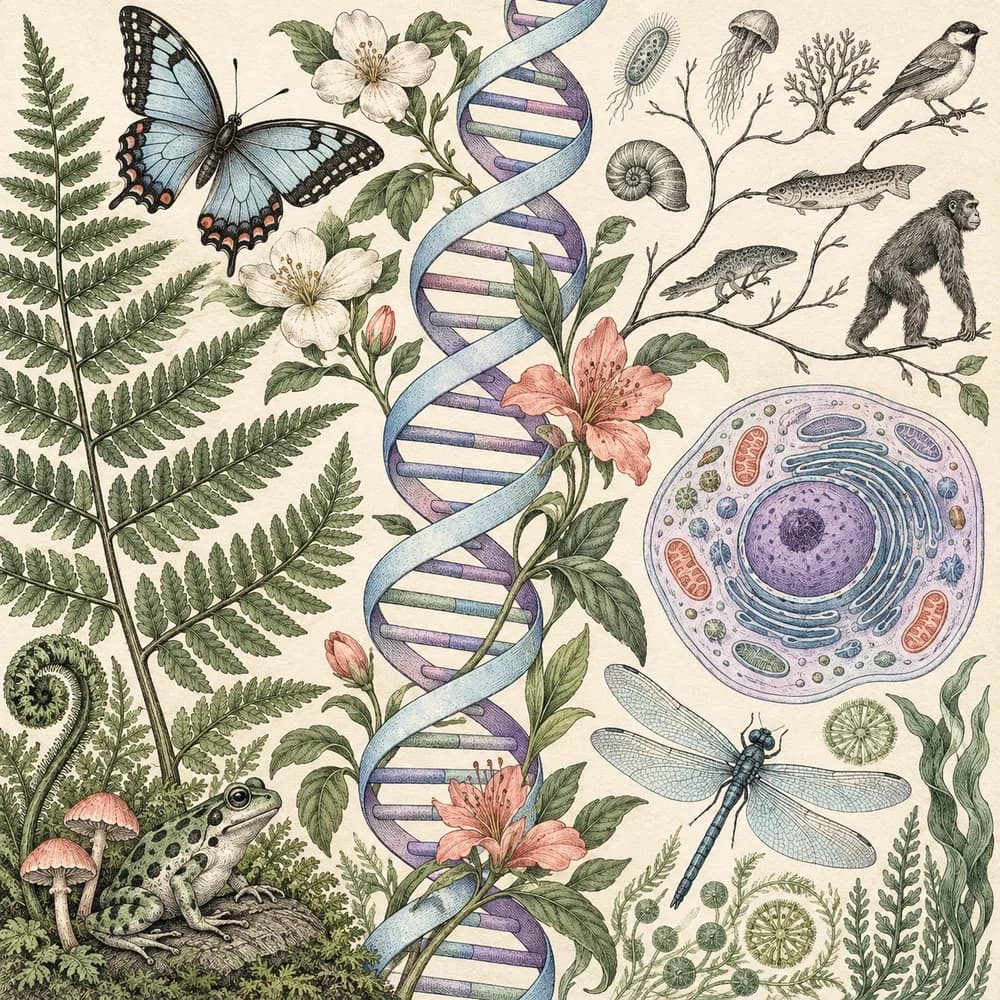
Natural selection is the process by which organisms adapt to their environment over generations. This fundamental concept in biology explains how populations evolve, with traits that enhance survival and reproduction becoming more common over time. Darwin's observations during his voyage on the HMS Beagle led to the development of this theory. Evidence from fossils, comparative anatomy, and molecular biology supports natural selection as the driving force behind the diversity of life on Earth.
What is AP Bio Unit 7 about?
Unit 7 is Natural Selection — the AP Bio unit on mechanisms and evidence of evolution. It walks through natural and artificial selection, population genetics, Hardy–Weinberg equilibrium, phylogeny and speciation, evidence for common ancestry, continuing evolution (like antibiotic resistance), and origins of life. You’ll focus on how allele frequencies change and how to use tools like cladograms and Hardy–Weinberg models to analyze populations. Expect about 13–20% of the exam weight and roughly 19–21 class periods of content. For details and Fiveable’s official study guide, check the unit page (https://library.fiveable.me/ap-bio/unit-7). For focused practice, Fiveable also has cheatsheets, cram videos, and 1000+ practice items in the practice bank (https://library.fiveable.me/practice/bio).
What topics are covered in AP Bio Unit 7 (Natural Selection)?
You’ll find the full Unit 7 topic list at https://library.fiveable.me/ap-bio/unit-7. The unit covers topics 7.1–7.12: Introduction to Natural Selection. Natural Selection. Artificial Selection. Population Genetics. Hardy‑Weinberg Equilibrium (including p/q and p2+2pq+q2). Evidence of Evolution. Common Ancestry. Continuing Evolution (resistance and emergent diseases). Phylogeny (trees and cladograms). Speciation (allopatric/sympatric, isolating mechanisms, rates). Variations in Populations (genetic diversity, bottlenecks, founder effect). Origins of Life on Earth (RNA world hypothesis and early fossil dates). These align with the CED and make up about 13–20% of the AP exam. For concise review, Fiveable’s Unit 7 study guide, cheatsheets, cram videos, and practice questions are available at the same link.
How much of the AP Biology exam is Unit 7?
About 13–20% of the AP Biology exam focuses on Unit 7 (Natural Selection). The unit includes natural and artificial selection, population genetics, Hardy–Weinberg calculations, phylogeny, speciation, and evidence for evolution. It’s usually taught over roughly 19–21 class periods. On the test you’ll see both multiple-choice and free-response items tied to these concepts, so practice interpreting data, doing Hardy–Weinberg math, and explaining evolutionary mechanisms clearly. For a focused review, Fiveable’s Unit 7 study guide, cheatsheets, and cram videos can help (https://library.fiveable.me/ap-bio/unit-7). Use practice questions to build speed and accuracy before test day.
What's the hardest part of AP Bio Unit 7?
Students often struggle with applying Hardy–Weinberg math and tying population-genetics concepts to natural selection (see Unit 7 at https://library.fiveable.me/ap-bio/unit-7). Many understand selection in words but trip up on setting up HWE problems, calculating genotype and allele frequencies, knowing when HWE assumptions are violated, and interpreting how selection, drift, migration, and nonrandom mating change frequencies. Translating phylogeny and speciation ideas into evidence-based FRQ explanations (like reproductive isolation mechanisms and branching patterns) is also tricky. Practice timed HWE calculations and use stepwise reasoning for selection and phylogeny problems to build speed and accuracy. Fiveable’s study guide, cheatsheets, and practice questions target those exact pain points.
How should I study for AP Bio Unit 7 (study guide, Quizlet, and practice FRQs)?
Yes — start with a Quizlet set (try “AP Bio Evolution Terms”) to drill vocabulary and core concepts fast. Then work through the Unit 7 study guide to learn ideas in order: natural selection, Hardy‑Weinberg, phylogeny, speciation, and evidence of evolution (https://library.fiveable.me/ap-bio/unit-7). After that, do targeted practice FRQs: pick 4–6 past evolution FRQs, time yourself, grade with College Board rubrics, then redo missed parts. Spend extra time on Hardy‑Weinberg and chi‑square — aim for at least 8–10 problems. Finish with mixed practice questions to simulate exam retrieval. For concise review and extra practice, Fiveable’s cram videos and practice bank are solid resources (https://library.fiveable.me/practice/bio).