5.5 Jade and other precious materials

🦜Mayan Civilization History Unit 5 Review
5.5 Jade and other precious materials
🦜 Mayan Civilization History
Jade in Mayan culture
Jade was the most valued material in the Mayan world, surpassing even gold in importance. It carried deep spiritual meaning, marked social rank, and connected the living to the divine. Understanding jade's role gives you a window into how the Maya linked material wealth, religious belief, and political power.
The Maya used jade to create a wide range of objects: jewelry, ornaments, ceremonial masks, figurines, and funerary offerings. Its green color tied it to water, vegetation, and life itself, making it central to both art and ritual.

Top images from around the web for Spiritual significance of jade
Architectural Medallion Depicting the Maize God | Accession … | Flickr View original
Is this image relevant?
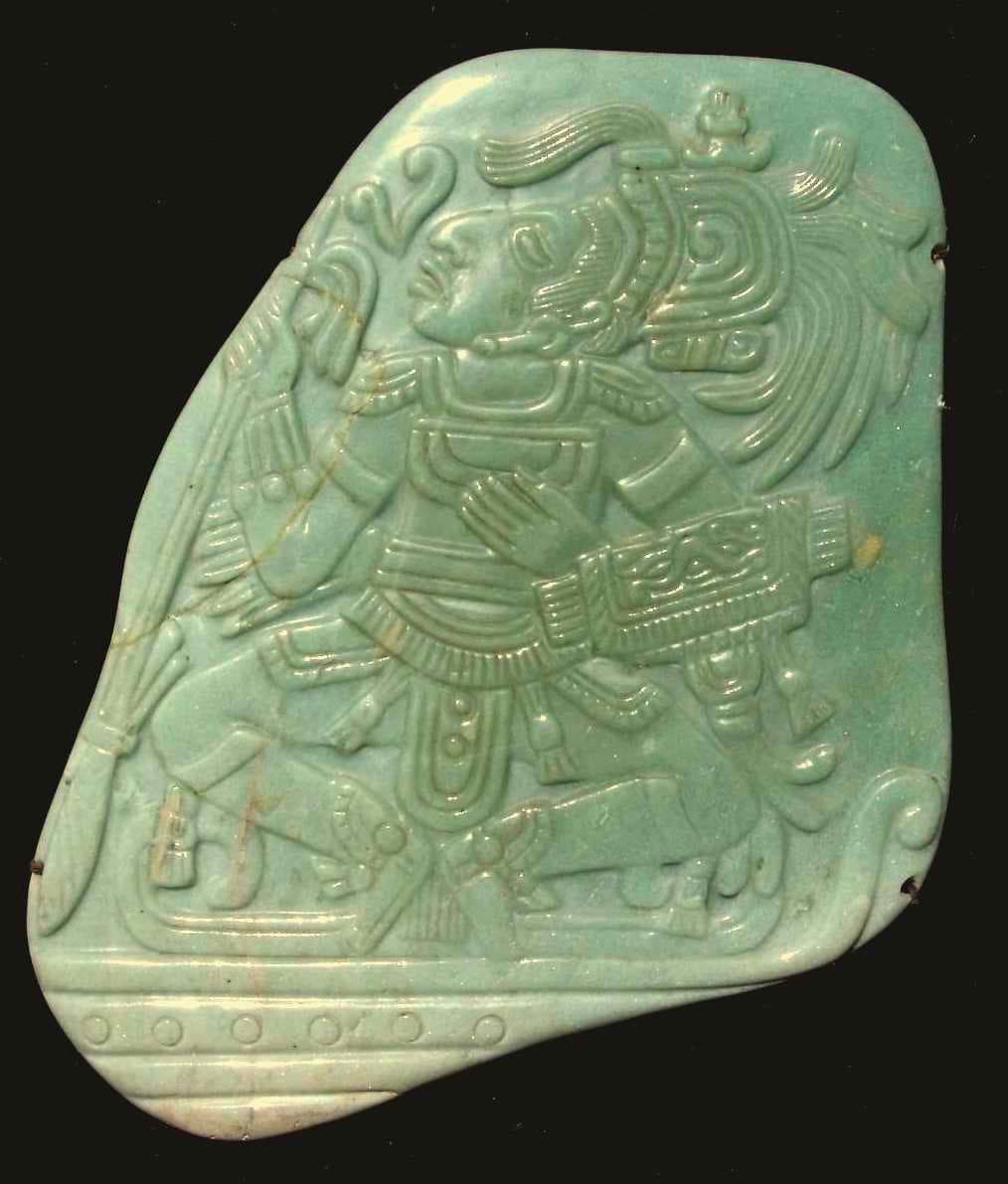
File:Mayan Jade.jpg - Wikipedia View original
Is this image relevant?
The jade jaguar throne inside the Chichen Itza pyramid, Me… | Flickr View original
Is this image relevant?
Architectural Medallion Depicting the Maize God | Accession … | Flickr View original
Is this image relevant?
File:Mayan Jade.jpg - Wikipedia View original
Is this image relevant?
Spiritual significance of jade
The Maya believed jade could protect the wearer from harm and ensure a favorable afterlife. This wasn't just superstition for them; it was tied to their understanding of the soul.
- Jade was associated with the breath soul, one of several souls the Maya believed each person possessed. The breath soul was thought to reside in the heart and was linked to the life force.
- Jade also connected to the Maize God, a central deity in Mayan religion (covered more in the "Symbolism in Mayan art" section below).
- Rulers and shamans used jade objects in religious ceremonies and rituals to communicate with the gods. A jade pectoral or mask wasn't just decoration; it was a spiritual tool.
Jade and social status
Jade functioned as a clear marker of rank in Mayan society. Only the elite, including rulers, nobles, and high-ranking warriors, had access to jade objects. Commoners were not permitted to own or wear it.
- The quality, size, and intricacy of a jade piece directly reflected the owner's position. Rulers wore elaborate jade mosaic masks and large pectorals, while lower-ranking elites might own simpler earspools or pendants.
- The Maya often buried their dead with jade objects, both to signify the deceased's high status and to protect them in the afterlife. A jade bead placed in the mouth of the dead was a common funerary practice, symbolizing the breath soul's continuation.
Sources of jade in Mesoamerica
The Maya obtained jade primarily from present-day Guatemala and Honduras. The most important source was the Motagua Valley in Guatemala, which produced high-quality jadeite, a harder and more valuable form of jade than nephrite (the other type found in Mesoamerica). Jadeite ranks between 6.5 and 7 on the Mohs hardness scale.
- Other notable sources included the Copán Valley in Honduras and the Sierra de las Minas in Guatemala.
- The Maya also acquired jade through trade with other Mesoamerican cultures, including the Olmecs, who had been working jade centuries before the Maya Classic period.
Jade carving techniques
Because jadeite is exceptionally hard, carving it required specialized tools and considerable skill. The Maya had no metal tools for most of their history, so they relied on abrasion-based methods.
- Cutting: Carvers used string saws, thin cords coated with abrasive materials like crushed quartz or sand, to slowly cut jade into desired shapes.
- Shaping and grinding: Abrasives such as sand, crushed quartz, and corundum were used to grind the jade into its final form.
- Drilling: Hollow bird bones or reeds, rotated with abrasive sand, served as drills to create holes and fine details.
- Polishing: Leather, wood, or clay was used to bring out jade's characteristic lustrous finish.
This process was painstaking. A single elaborate mask could take months of labor, which is part of why jade objects carried such prestige.
Other precious materials
Beyond jade, the Maya valued several other materials for art, tools, trade, and ritual. Each served different purposes and carried its own cultural weight.
Obsidian tools and weapons
Obsidian, a volcanic glass, was prized for its sharpness and versatility. When fractured correctly, obsidian produces edges sharper than modern surgical steel, making it ideal for cutting, shaving, and the bloodletting rituals that were central to Mayan religious practice.
- Mayan craftsmen shaped obsidian into knives, arrowheads, scrapers, daggers, and spearheads.
- Major obsidian sources included the El Chayal and Ixtepeque quarries in Guatemala. Control over these quarries gave nearby city-states significant economic leverage.

Gold and silver metalworking
The Maya began working with gold and silver relatively late, around 800 CE, well into the Late Classic and Postclassic periods. Much of their metalworking knowledge likely came through contact with cultures in lower Central America and Colombia.
- Gold and silver were used for elite jewelry, ornaments, and ceremonial objects such as earspools, pendants, and pectorals.
- Techniques included lost-wax casting (creating a wax model, encasing it in clay, melting the wax out, then pouring in molten metal), hammering, and gilding.
- Metalworkers often combined gold or silver with jade and shell to create composite pieces with layered symbolism.
Quetzal feathers for adornment
Feathers from the resplendent quetzal bird were among the most coveted adornment materials in Mesoamerica. The bird's brilliant green and blue tail feathers, which can reach over 60 cm in length, were used to create elaborate headdresses, fans, and capes for rulers and priests.
- Quetzal feathers were associated with royalty, divinity, and the feathered serpent deity (known to the Aztecs as Quetzalcoatl, though the Maya had their own versions of this figure, such as Kukulkan).
- The resplendent quetzal was considered sacred. Killing one was prohibited; feathers were collected from captured birds that were then released, or from captive-bred populations.
Spondylus shells as currency
Spondylus shells (thorny oysters) served as both currency and sacred objects in Mayan society. These shells range in color from vivid orange to deep red and were considered sacred, associated with fertility and the underworld.
- Spondylus shells were crafted into jewelry, ornaments, and ceremonial objects.
- Ground into powder, they served as a pigment for painting and dyeing textiles.
- Remarkably, the Maya traded for spondylus over enormous distances. Many shells came from coastal regions as far away as present-day Ecuador and Peru, highlighting just how extensive Mesoamerican and South American trade connections were.
Jade and precious materials trade
Trade in jade and other precious materials shaped the political and economic landscape of Mayan civilization. City-states rose and fell based on their ability to control these resources and the routes that carried them.
Long-distance trade networks
The Maya developed complex trade routes, both overland and by sea, to move jade and other valuable goods across Mesoamerica.
- Overland routes connected Mayan cities and regions. The Maya built raised limestone roads called sacbeob (singular: sacbe) to facilitate trade and communication between cities.
- Sea routes used large canoes to link Maya traders with other cultures along the Caribbean and Gulf coasts. Spanish accounts from first contact describe encountering large Mayan trading canoes carrying diverse cargoes.
- Through these networks, the Maya exchanged goods and ideas with the Olmecs, Aztecs, and other Mesoamerican peoples.
Merchants and marketplaces
Mayan merchants, known as ppolom, were key figures in the trade system. They traveled long distances to procure goods and often doubled as diplomats and intelligence gatherers for their city-states.
- Marketplaces in most Mayan cities served as centers for exchanging goods and information. Among the largest and most famous was the marketplace at Chichen Itza.
- Common forms of currency in these markets included cacao beans, spondylus shells, and other standardized trade items.

Jade trade and the rise of city-states
Control over jade sources or major trade routes translated directly into political power.
- Kaminaljuyu, located near the Motagua Valley jade source, became a major center of jade production and trade, growing wealthy and influential as a result.
- The revenue from jade trade allowed city-states to finance monumental architecture, support specialized craftspeople, and sustain large populations.
- Competition for jade sources and trade routes fueled both alliances and armed conflicts between city-states.
Control over precious material sources
Rulers and elites actively sought to secure access to jade quarries and other resource sites, sometimes sending military expeditions to protect or seize them.
- Cancuen, positioned along the Pasión River trade route, grew wealthy through its control of jade commerce. But that prosperity also made it a target; Cancuen was eventually conquered by rival city-states.
- This pattern repeated across the Mayan world: controlling precious materials brought power, but also painted a target on a city-state's back.
Symbolism in Mayan art
Jade and other precious materials weren't just valuable; they carried specific symbolic meanings that the Maya wove into their art to convey religious, political, and social messages.
Jade masks and figurines
Jade masks and figurines rank among the most iconic forms of Mayan art. Masks were often carved in the likeness of gods, rulers, or ancestors and played central roles in religious ceremonies and funerary rites.
- The famous jade mosaic mask of K'inich Janaab Pakal from Palenque depicts the ruler as the Maize God, linking his identity to themes of agricultural abundance and divine rebirth.
- Jade figurines depicting deities or important individuals were placed as offerings in temples and burials.
- Jade's green color reinforced its symbolic connection to water, vegetation, and life, making it a natural choice for representing gods and themes of renewal.
Jade and the Maize God
The Maize God was central to Mayan religion, embodying agriculture, fertility, and the cycle of life, death, and rebirth. Because jade's green color echoed growing maize and living vegetation, it became the ideal material for depicting this deity.
Mayan rulers frequently portrayed themselves as the Maize God in jade masks and artworks. This wasn't vanity; it was a deliberate political strategy to legitimize their rule by associating themselves with divine power and the life-sustaining cycle of corn.
Jade and the underworld
Jade also carried strong associations with Xibalba, the Mayan underworld. The Maya believed jade could protect the deceased during their journey through the afterlife and help ensure their rebirth.
- Jade objects such as masks, figurines, beads, and jewelry were placed in elite burials to accompany the dead into Xibalba.
- Pakal's jade death mask is the most famous example: it depicts the ruler's transition into the underworld, combining themes of death, protection, and eventual renewal.
Precious materials in elite burials
Elite Mayan burials combined multiple precious materials to reflect the deceased's status and equip them for the afterlife.
- The tomb of the Red Queen of Palenque (likely Tz'akbu Ajaw, Pakal's wife) contained a jade mask, jade jewelry, and spondylus shell offerings. Her remains and the entire tomb interior were covered in red cinnabar pigment.
- Quetzal feathers and jaguar pelts, both symbols of royalty and power, also appeared in elite burials.
- This practice reflects a core Mayan belief: social status didn't end at death. The materials you were buried with mattered for your standing in the afterlife.
See Fiveable more often in Google
Mark Fiveable as a preferred source and Google is more likely to show you our guides in Top Stories, with a "preferred" badge in AI Mode and AI Overviews.