9.3 How the U.S. and Other Countries Experience Inflation

💵Principles of Macroeconomics Unit 9 Review
9.3 How the U.S. and Other Countries Experience Inflation
💵 Principles of Macroeconomics
Inflation Trends and Comparisons

Top images from around the web for Historical US inflation trends
United States Consumer Price Index - Wikipedia View original
Is this image relevant?
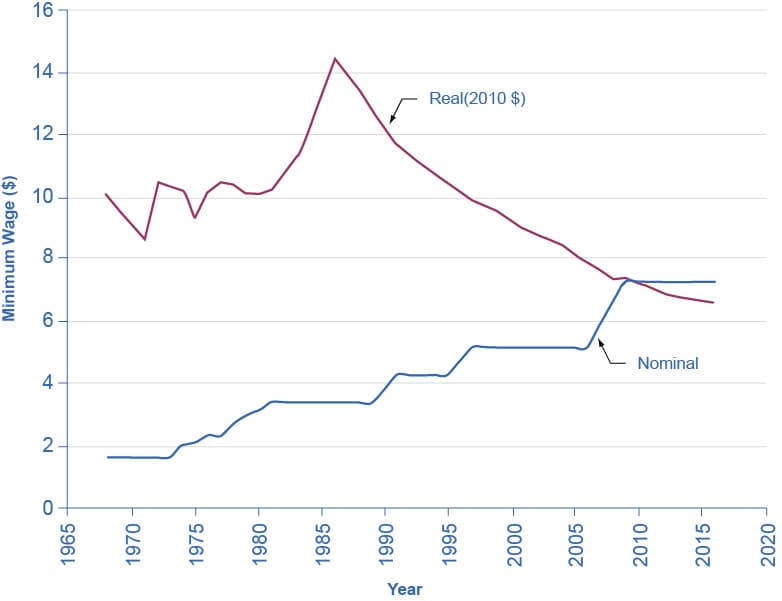
The Confusion Over Inflation | OpenStax Macroeconomics 2e View original
Is this image relevant?
Monetary Policy and Economic Outcomes · Economics View original
Is this image relevant?
United States Consumer Price Index - Wikipedia View original
Is this image relevant?
The Confusion Over Inflation | OpenStax Macroeconomics 2e View original
Is this image relevant?
Historical US inflation trends
The Consumer Price Index (CPI) measures the average change in prices paid by urban consumers for a basket of goods and services. It's the most widely used measure of inflation in the US and is calculated by the Bureau of Labor Statistics (BLS).
Looking at CPI data over the decades reveals clear shifts in US inflation:
- 1970s: High inflation, with CPI increasing over 10% in some years, driven largely by oil price shocks and loose monetary policy
- 1980s and 1990s: The Federal Reserve, under Paul Volcker, aggressively raised interest rates to break inflation. Rates came down to an average of 3–4% per year
- 2000s and 2010s: Inflation stayed relatively low, with CPI increasing an average of about 1–2% per year
- Early 2020s: Inflation surged again, with CPI hitting 9.1% in June 2022 before gradually declining as the Fed tightened monetary policy
The key takeaway: US inflation hasn't followed a straight line. It responds to policy decisions, supply shocks, and shifts in demand.

Cross-country inflation comparisons
Inflation rates vary widely across countries and time periods. Developing countries tend to experience higher inflation than developed ones, often because of less independent central banks, weaker currencies, and greater reliance on imported goods.
Some extreme examples help illustrate the range:
- Venezuela had an inflation rate exceeding 2,000% in 2020, while the US had just 1.4% that same year
- Germany experienced hyperinflation in the 1920s, with prices doubling every few days after the government printed money to pay war debts
- Zimbabwe experienced hyperinflation in the late 2000s, with prices doubling every few hours at its peak
Hyperinflation is when prices rise so rapidly and uncontrollably that money essentially loses its function as a store of value. It's rare, but it tends to happen when governments print excessive amounts of money, often to cover large budget deficits.
Factors that contribute to differences in inflation rates across countries include monetary policy, fiscal policy, exchange rates, political stability, and economic structure. Many central banks now practice inflation targeting, setting a specific inflation rate (often around 2%) as their goal to maintain price stability.

Inflation, Growth, and Unemployment
Inflation's economic relationships
Inflation, economic growth, and unemployment are closely connected, and understanding how they interact is central to macroeconomic policy.
The Phillips Curve illustrates an inverse relationship between unemployment and inflation. When unemployment is low, workers have more bargaining power, wages rise, and businesses pass those costs on as higher prices. When unemployment is high, there's less upward pressure on wages and prices.
Economic growth can also fuel inflation. As the economy grows, demand for goods and services increases, putting upward pressure on prices. This is demand-pull inflation: too much money chasing too few goods.
On the flip side, high inflation can hurt growth and employment:
- It erodes the purchasing power of money, reducing consumer spending and investment
- It can lead to higher interest rates, which slow borrowing, economic growth, and hiring
Central banks use monetary policy to balance these forces:
- Contractionary monetary policy (raising interest rates) reduces spending and borrowing, which helps bring down high inflation
- Expansionary monetary policy (lowering interest rates or using tools like quantitative easing) stimulates spending, economic growth, and job creation
- Policy decisions focus on real interest rates (the nominal rate minus inflation), since that's what actually affects borrowing and saving behavior
Types of inflation and economic challenges
Not all inflation has the same cause, and the cause matters for how policymakers respond.
- Demand-pull inflation results from increased consumer demand outpacing supply. Think of an economy where everyone has more money to spend but production hasn't kept up.
- Cost-push inflation occurs when production costs rise (higher oil prices, supply chain disruptions, rising wages), and businesses pass those costs on to consumers through higher prices.
- Stagflation combines high inflation, slow economic growth, and high unemployment all at once. This is particularly difficult for policymakers because the usual tools conflict: fighting inflation with higher interest rates would worsen unemployment, while stimulating growth could make inflation worse. The US experienced stagflation in the 1970s, which is part of what made that decade's inflation so hard to address.
See Fiveable more often in Google
Mark Fiveable as a preferred source and Google is more likely to show you our guides in Top Stories, with a "preferred" badge in AI Mode and AI Overviews.