2.2 The Production Possibilities Frontier and Social Choices

💵Principles of Macroeconomics Unit 2 Review
2.2 The Production Possibilities Frontier and Social Choices
💵 Principles of Macroeconomics
The Production Possibilities Frontier

Top images from around the web for Production possibilities frontier interpretation
2.2 Production Possibility Frontier – Principles of Microeconomics View original
Is this image relevant?
Production–possibility frontier - Wikipedia View original
Is this image relevant?
Production–possibility frontier - Wikipedia View original
Is this image relevant?
2.2 Production Possibility Frontier – Principles of Microeconomics View original
Is this image relevant?
Production–possibility frontier - Wikipedia View original
Is this image relevant?
Production possibilities frontier interpretation
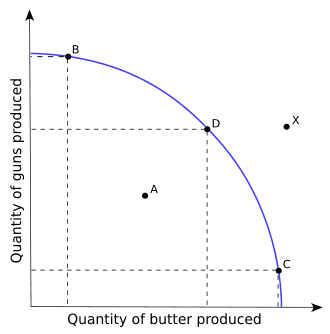
The Production Possibilities Frontier (PPF) is a graph showing every maximum combination of two goods an economy can produce with its current resources and technology. It's one of the most fundamental models in economics because it captures scarcity, trade-offs, and opportunity cost in a single picture.
Where a point falls relative to the curve tells you a lot:
- On the curve: The economy is producing efficiently. All resources are fully employed and nothing is going to waste. You can't make more of one good without giving up some of the other.
- Inside the curve: The economy is underperforming. Resources are being wasted or sitting idle (think unemployment or factories running below capacity).
- Outside the curve: These combinations are unattainable with current resources and technology. Reaching them would require economic growth.
The slope of the PPF at any point represents the opportunity cost of producing one more unit of a good, measured in how much of the other good you have to give up. This is sometimes called the marginal rate of transformation. The classic example is "guns vs. butter": every additional unit of military goods (guns) means sacrificing some consumer goods (butter), and vice versa.
Budget constraints vs. production frontiers
Budget constraints and PPFs look similar on a graph, but they describe different things.
A budget constraint shows the combinations of goods a consumer can afford given their income and the prices of goods.
- Its slope is determined by the price ratio of the two goods.
- A change in income shifts the line in or out (parallel shift). A change in the price of one good pivots the line around the other axis.
A production possibilities frontier shows the combinations of goods an economy can produce given its resources and technology.
- Its slope is determined by the opportunity cost of one good in terms of the other.
- An increase in resources or better technology shifts the PPF outward. Loss of resources or technological regression shifts it inward.
The key distinction: budget constraints are about what you can buy, while PPFs are about what you can make.

Diminishing returns and frontier shape
Most PPFs are bowed outward (concave to the origin), and the reason comes down to the law of diminishing returns: as you keep adding more of a variable input to a fixed input, each additional unit contributes less and less to total output.
This matters for the PPF's shape because resources aren't perfectly adaptable between different types of production. Some workers, land, and capital are better suited for making one good than the other.
Consider an economy that produces wheat and steel. If you start shifting resources from steel to wheat:
- The first workers reassigned are those best suited for farming. They move to the most fertile land and produce a lot of wheat for relatively little steel given up.
- As you keep shifting workers, you're pulling people less suited for farming onto less fertile land. Each additional worker adds less wheat.
- Meanwhile, the steel you're giving up per extra unit of wheat keeps rising.
This pattern of increasing opportunity cost is what gives the PPF its characteristic outward bow. If resources were perfectly interchangeable between goods, the PPF would be a straight line with a constant opportunity cost.
Efficiency and Comparative Advantage

Productive vs. allocative efficiency
There are two distinct types of efficiency to keep straight, and they don't automatically come together.
Productive efficiency means the economy is operating on its PPF. All resources are fully utilized, and there's no way to produce more of one good without producing less of the other. This is about how you produce.
Allocative efficiency means the economy is producing the right mix of goods, the combination that maximizes society's well-being. Technically, this happens when the marginal benefit of each good equals its marginal cost (in a competitive market, this is where price equals marginal cost).
The relationship between them: allocative efficiency requires productive efficiency (you can't have the optimal mix if you're wasting resources), but productive efficiency alone doesn't guarantee allocative efficiency. An economy could be on its PPF producing enormous quantities of something nobody wants. It would be productively efficient but allocatively inefficient.
Full economic efficiency is achieved only when both conditions are met.
Comparative advantage and specialization
Comparative advantage means a producer can make a good at a lower opportunity cost than another producer. This is different from absolute advantage (just being better at making something). What matters for trade is relative cost.
Here's how specialization based on comparative advantage works:
- Each producer identifies which good they can produce at the lowest opportunity cost.
- Each specializes in that good and trades for the rest.
- Total production across all producers increases, and everyone can consume more than they could alone.
For example, suppose Country A gives up 2 cars for every 10 bananas it produces, while Country B gives up 5 cars for every 10 bananas. Country A has a lower opportunity cost for bananas, so it has the comparative advantage there. Country B, by the same logic, has the comparative advantage in cars. If each country specializes and they trade, both can end up with more bananas and more cars than if each tried to produce both independently.
This is why trade expands the consumption possibilities frontier beyond each country's individual PPF. Through specialization and exchange, resources get allocated more efficiently, and overall welfare increases.
See Fiveable more often in Google
Mark Fiveable as a preferred source and Google is more likely to show you our guides in Top Stories, with a "preferred" badge in AI Mode and AI Overviews.