5.1 Price Elasticity of Demand and Price Elasticity of Supply

💵Principles of Macroeconomics Unit 5 Review
5.1 Price Elasticity of Demand and Price Elasticity of Supply
💵 Principles of Macroeconomics
Price elasticity of demand measures how sensitive buyers are to price changes, while price elasticity of supply measures how sensitive producers are. These concepts are calculated using the midpoint method, which gives consistent results regardless of which direction the price moves. Together, they help explain consumer behavior, producer decisions, and how markets respond to shocks.
Elasticity concepts extend beyond basic demand and supply. Cross-price elasticity and income elasticity reveal how goods relate to each other and how consumer income shapes purchasing decisions. Businesses use these tools for pricing strategy, and policymakers use them to predict who actually bears the burden of a tax.
Price Elasticity of Demand
Calculate price elasticity of demand using the midpoint method
Price elasticity of demand (PED) measures how responsive quantity demanded is to a change in price. A standard percentage change calculation would give you different answers depending on whether the price goes up or down, so economists use the midpoint method instead. It averages the starting and ending values to create a consistent base.
The formula:
- and are the initial and final quantities demanded
- and are the initial and final prices
Here's how to work through a calculation step by step:
-
Find the change in quantity:
-
Find the average quantity:
-
Calculate the percentage change in quantity:
-
Find the change in price:
-
Find the average price:
-
Calculate the percentage change in price:
-
Divide:
So . The negative sign reflects the law of demand: price and quantity demanded move in opposite directions. When interpreting PED, you typically use the absolute value, so this would be classified as elastic (since ).
PED also connects directly to total revenue. If demand is elastic, raising the price actually decreases total revenue because you lose more in quantity than you gain from the higher price. If demand is inelastic, raising the price increases total revenue.
Interpretation of supply elasticity
Price elasticity of supply (PES) measures how responsive quantity supplied is to a change in price. It uses the same midpoint method:
Unlike PED, PES is typically positive because the law of supply says price and quantity supplied move in the same direction.
Here's how to interpret PES values:
- PES > 1 (elastic supply): Quantity supplied is highly responsive to price changes. Producers can ramp up output quickly. Example: mass-produced goods like t-shirts, where factories can increase shifts.
- PES = 1 (unitary elastic): Quantity supplied changes in exact proportion to price.
- 0 < PES < 1 (inelastic supply): Quantity supplied responds only slightly to price changes. Production is hard to scale up quickly. Example: housing, because building new homes takes time.
- PES = 0 (perfectly inelastic): Quantity supplied doesn't change at all regardless of price. Example: land, since you can't produce more of it.
- PES = ∞ (perfectly elastic): Any price decrease causes quantity supplied to drop to zero, and producers will supply any quantity at the given price.
The key factor driving supply elasticity is time. In the short run, supply tends to be more inelastic because firms can't easily change their production capacity. In the long run, firms can build new factories, hire workers, and source new inputs, making supply more elastic.
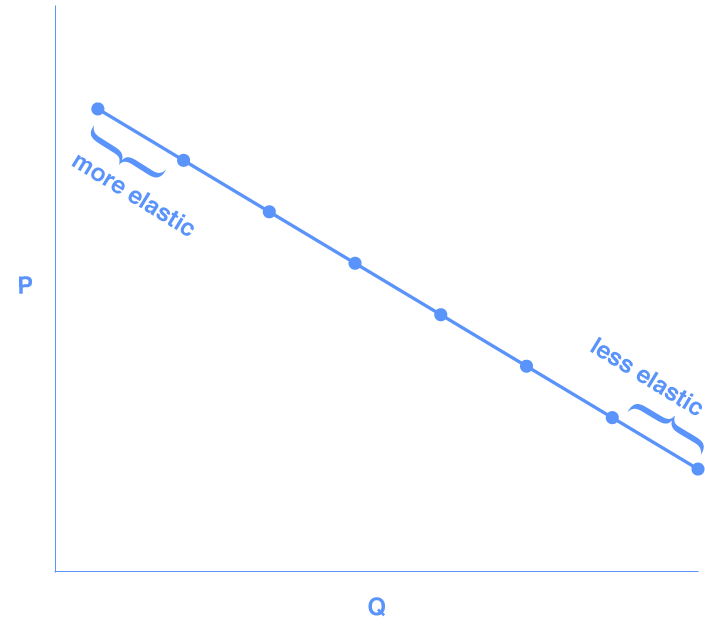
Elastic and Inelastic Demand/Supply
Elastic vs inelastic scenarios
Elastic demand (): A small price change causes a proportionally larger change in quantity demanded.
- Typical for luxury goods (designer clothing), goods with many close substitutes (one brand of cereal vs. another), and goods that take up a large share of a consumer's budget
- Producers have less pricing power here. Raise your price, and customers switch to a competitor.
Inelastic demand (): A large price change causes only a small change in quantity demanded.
- Typical for necessities (insulin for diabetics), goods with few substitutes (gasoline in rural areas), and addictive goods (cigarettes)
- Producers can raise prices without losing many customers, which is why gas stations can charge more and still sell roughly the same volume.
Elastic supply (): Producers can quickly adjust output when prices change.
- Typical for goods with readily available inputs and flexible production processes (mass-produced electronics, fast fashion)
- Markets with elastic supply return to equilibrium faster after a demand shock because producers adjust quickly.
Inelastic supply (): Producers struggle to adjust output even when prices change significantly.
- Typical for goods with scarce inputs, long production timelines, or limited capacity (rare earth metals, fine wine, agricultural crops in a single growing season)
- Markets with inelastic supply experience larger price swings when demand shifts, because quantity can't adjust much.

Related Elasticity Concepts
Cross-price and income elasticity
Cross-price elasticity of demand (XED) measures how the quantity demanded of one good responds to a price change in a different good. The sign tells you the relationship:
- Positive XED means the goods are substitutes. When the price of Coca-Cola rises, demand for Pepsi increases.
- Negative XED means the goods are complements. When the price of printers rises, demand for ink cartridges falls.
Income elasticity of demand (YED) measures how quantity demanded responds to changes in consumer income:
- Positive YED means the good is a normal good (demand rises as income rises). Most goods fall here.
- Negative YED means the good is an inferior good (demand falls as income rises). Example: instant ramen, which people buy less of as they can afford better food.
- YED > 1 means the good is a luxury. Demand grows faster than income. Example: vacations, high-end restaurants.
Applications of elasticity
- Total revenue analysis: If demand is elastic, a price cut increases total revenue. If demand is inelastic, a price increase does. This is one of the most tested applications on exams.
- Price discrimination: Firms charge higher prices to consumers with inelastic demand (business travelers buying last-minute flights) and lower prices to those with elastic demand (leisure travelers booking months ahead).
- Tax incidence: The side of the market with more inelastic behavior bears more of the tax burden. If demand is inelastic and supply is elastic, consumers end up paying most of the tax. If supply is inelastic and demand is elastic, producers absorb most of it.
See Fiveable more often in Google
Mark Fiveable as a preferred source and Google is more likely to show you our guides in Top Stories, with a "preferred" badge in AI Mode and AI Overviews.