9.2 How to Measure Changes in the Cost of Living

💵Principles of Macroeconomics Unit 9 Review
9.2 How to Measure Changes in the Cost of Living
💵 Principles of Macroeconomics
Measuring Changes in the Cost of Living

Top images from around the web for Calculation of inflation rates
Measuring Inflation | Marginal Revolution University View original
Is this image relevant?
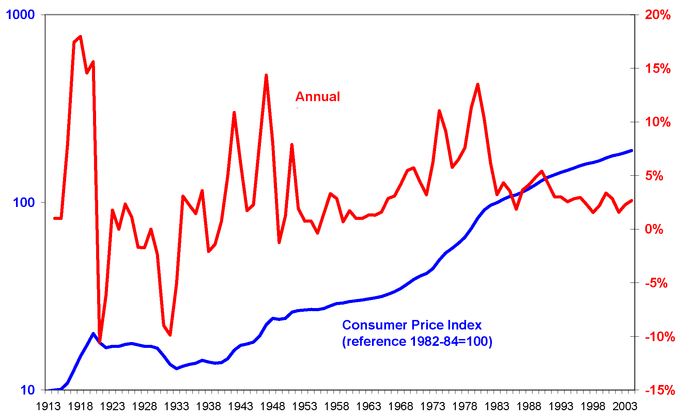
Cost of Living | Boundless Economics View original
Is this image relevant?
Cost of Living | Boundless Economics View original
Is this image relevant?
Measuring Inflation | Marginal Revolution University View original
Is this image relevant?
Cost of Living | Boundless Economics View original
Is this image relevant?
Calculation of Inflation Rates
The Consumer Price Index (CPI) measures the average change in prices paid by urban consumers for a fixed set of goods and services over time. It's the most commonly cited measure of inflation in the U.S.
A few key terms to know:
- Market basket (also called a basket of goods): a fixed set of items representing typical consumer purchases, including food, housing, transportation, medical care, and more.
- Reference base period: the time period the CPI is measured against. The base period is 1982–1984, and the CPI is set to 100 for that period. Any CPI above 100 means prices have risen since then.
To calculate the CPI for a given year:
Once you have CPI values for two periods, you can find the inflation rate, which is just the percentage change in the CPI:
For example, if the CPI rose from 200 to 210, the inflation rate would be:
That 5% tells you the overall price level increased by 5% over that period.

Minimizing CPI Biases
Because the CPI relies on a fixed market basket, it doesn't perfectly capture how consumers actually behave. This creates several known biases, and the Bureau of Labor Statistics (BLS) takes steps to address each one.
- Substitution bias: When one good gets more expensive, consumers tend to switch to cheaper alternatives (buying chicken instead of beef, for instance). A fixed basket misses this shift and overstates the cost increase. The BLS addresses this by periodically updating the market basket to reflect current spending patterns.
- Quality bias: Sometimes a product's price stays the same, but its quality improves significantly (think of how much faster computers get each year at the same price point). Without adjustment, the CPI would miss this hidden "price decrease." The BLS makes quality adjustments to account for these improvements.
- New product bias: Brand-new products aren't included in the basket right away. Smartphones, for example, weren't captured in the early 2000s even though they were becoming a major consumer purchase. The BLS regularly updates the basket to include new products over time.
- Outlet bias: When consumers shift from traditional retailers to discount stores or online shopping, they're effectively paying lower prices. If the CPI only sampled high-cost outlets, it would overstate inflation. The BLS now samples prices from a variety of outlets, including discount stores and online retailers.
All four biases tend to push the CPI upward, meaning the CPI likely overstates the true rate of inflation by a small amount.

Price Indices for Economic Measurement
The CPI isn't the only way to track price changes. Three major price indices each capture a different slice of the economy:
- Consumer Price Index (CPI): Tracks prices of goods and services purchased by households, covering food, housing, apparel, transportation, medical care, and recreation. It does not include prices of imported goods or goods produced for export.
- Producer Price Index (PPI): Measures changes in prices received by domestic producers for their output. It covers raw materials, intermediate goods, and finished goods (crude oil, lumber, tires, computers). Because changes in producer costs often get passed along to consumers, the PPI can serve as an early indicator of future CPI changes. Like the CPI, it excludes imported goods.
- GDP deflator: Measures price changes for all goods and services produced within a country's borders. It includes exported goods but not imported goods, and it covers categories the CPI and PPI miss, like government services and capital goods. Unlike the CPI, the GDP deflator is not based on a fixed market basket. Its weights shift automatically as the composition of GDP changes, which means it avoids substitution bias.
Cost of Living and Purchasing Power
These terms come up frequently when discussing inflation's real-world effects:
- Cost of living: the amount of money needed to maintain a certain standard of living. When prices rise and incomes don't keep up, your cost of living effectively increases.
- Price level: the average of current prices across the entire spectrum of goods and services in the economy.
- Real income: your income adjusted for changes in the price level. If your nominal income rises 3% but inflation is 5%, your real income actually fell. This is what determines your actual purchasing power.
- Purchasing power: the quantity of goods and services you can buy with a unit of currency. As the price level rises, each dollar buys less.
- Indexation: the practice of automatically adjusting wages, Social Security payments, or other payments based on changes in a price index. This protects recipients from losing purchasing power to inflation.
See Fiveable more often in Google
Mark Fiveable as a preferred source and Google is more likely to show you our guides in Top Stories, with a "preferred" badge in AI Mode and AI Overviews.