9.1 Tracking Inflation

💵Principles of Macroeconomics Unit 9 Review
9.1 Tracking Inflation
💵 Principles of Macroeconomics
Inflation is a key economic indicator that measures how fast prices are rising. By tracking changes in price levels over time, you can gauge the overall health of an economy and understand how rising (or falling) prices affect consumers' purchasing power.
Calculating inflation rates involves comparing price indices across different periods. These indices, like the Consumer Price Index (CPI), provide a standardized way to measure price changes for a typical basket of goods and services that households regularly purchase.
Measuring and Tracking Inflation

Top images from around the web for Calculation of inflation rate
How the AD/AS Model Incorporates Unemployment and Inflation – Principles of Economics: Scarcity ... View original
Is this image relevant?
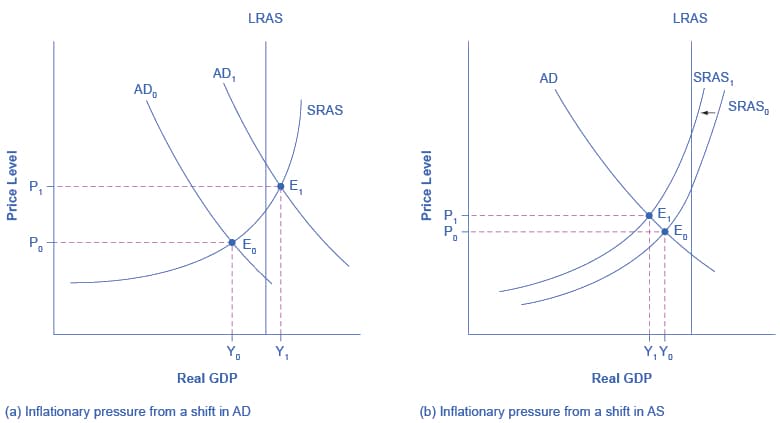
How the AD/AS Model Incorporates Growth, Unemployment, and Inflation | OpenStax Macroeconomics 2e View original
Is this image relevant?
The Relationship Between Inflation and Unemployment | Boundless Economics View original
Is this image relevant?
How the AD/AS Model Incorporates Unemployment and Inflation – Principles of Economics: Scarcity ... View original
Is this image relevant?
How the AD/AS Model Incorporates Growth, Unemployment, and Inflation | OpenStax Macroeconomics 2e View original
Is this image relevant?
Calculation of inflation rate
The inflation rate measures the percentage change in the average price level from one period to another. It tells you how much more (or less) expensive things have gotten.
Example: If the price level increases from 100 to 105, the inflation rate is:
A few things to keep in mind when interpreting the result:
- A positive rate means prices have increased on average (inflation)
- A negative rate means prices have decreased on average (deflation)
- The size of the rate tells you how fast prices are moving. Around 2% is considered slow and stable. At 10%, prices are climbing quickly. In extreme cases, prices can spiral into hyperinflation, where they rise at an exceptionally high and accelerating rate.

Purpose of price indices
Price indices track changes in the average price level over time. The two most common are:
- Consumer Price Index (CPI): Measures the average price of a typical basket of household goods and services, including food, housing, and transportation. This is the one you'll see cited most often when people talk about inflation.
- Producer Price Index (PPI): Measures the average price of goods and services from the seller's side, covering raw materials and intermediate goods. Changes in PPI often signal future changes in CPI, since higher production costs tend to get passed on to consumers.
Both indices work by holding the basket of goods and services constant over time. That way, when the index value changes, you know it reflects actual price changes rather than a shift in what's being measured.
Index values are normalized to a base period, which is assigned a value of 100. Every value after that is expressed relative to that starting point, making it easy to see how much prices have changed. These indices are also used to measure changes in the cost of living for consumers.

Comparison of inflation rates
Index numbers express the price level relative to a base period using this formula:
Example: If the current price level is 110 and the base period price level was 100, the index number is:
An index number above 100 means prices have risen since the base period. Below 100 means they've fallen.
To find the inflation rate between any two periods, you compare their index numbers:
Example: If the current index is 110 and the previous period's index was 105:
Notice that you divide by the previous period's index, not the base period. This is a common mistake on exams. Using index numbers this way lets you make direct, apples-to-apples comparisons of inflation across different time periods, because the base-period differences are already accounted for.
Types of Inflation Measures
- Core inflation strips out food and energy prices, which tend to swing up and down a lot in the short term. By excluding those volatile categories, core inflation gives a cleaner picture of long-term price trends. Policymakers at the Federal Reserve pay close attention to core inflation when making decisions about interest rates.
- Stagflation isn't a type of inflation measure but rather a specific economic condition: high inflation combined with slow economic growth and high unemployment. It's worth knowing because standard policy tools create a tradeoff. Fighting inflation usually means slowing the economy further, and stimulating growth risks pushing inflation even higher.
See Fiveable more often in Google
Mark Fiveable as a preferred source and Google is more likely to show you our guides in Top Stories, with a "preferred" badge in AI Mode and AI Overviews.