
Physics covers vast scales, from tiny atoms to massive galaxies. It's split into areas like mechanics, thermodynamics, and quantum mechanics. These fields connect, giving us a fuller picture of how the universe works.
Scientists use tools like order of magnitude estimation to grasp huge numbers. They also create models, theories, and laws to explain what they see. The scientific method helps test ideas through experiments and analysis.
Fundamental Areas and Scales in Physics
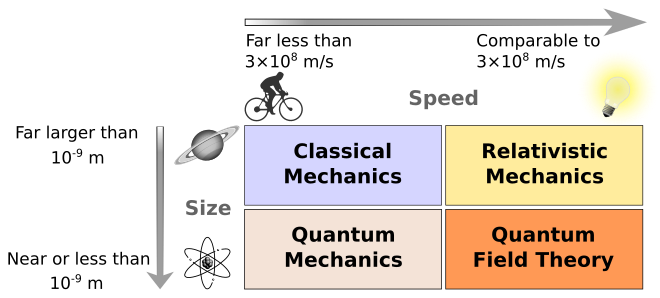
Areas of physics and interconnections
- Classical mechanics studies the motion of macroscopic objects, including concepts such as force, energy, and momentum, providing the foundation for other branches of physics
- Thermodynamics and statistical mechanics deals with heat, temperature, and the behavior of systems with many particles, explaining the relationship between microscopic properties and macroscopic behavior
- Electromagnetism studies electric and magnetic fields and their interactions with matter, describing phenomena such as light, radio waves, and electrical circuits
- Quantum mechanics describes the behavior of matter and energy at the atomic and subatomic scales, explaining wave-particle duality and the uncertainty principle
- Relativity includes special relativity, dealing with the behavior of space and time at high speeds, and general relativity, describing gravity as a curvature of spacetime
- Interconnections: thermodynamics and statistical mechanics rely on classical mechanics principles; electromagnetism and classical mechanics connect through force; quantum mechanics explains particle behavior in atoms and molecules; relativity is essential for understanding objects at high speeds or in strong gravitational fields
Order of magnitude estimation
- Involves determining the approximate value of a quantity by expressing it as a power of 10 (Earth's radius: )
- Helps understand the relative scales of different quantities (electron mass: , Earth mass: )
- Utilizes scientific notation to represent very large or small numbers concisely
![Areas of physics and interconnections, Theories [The Physics Travel Guide]](https://storage.googleapis.com/static.prod.fiveable.me/search-images%2F%22Areas_of_physics_interconnections_classical_mechanics_thermodynamics_electromagnetism_quantum_mechanics_relativity_visual_diagram%22-history.jpg%3Fw%3D1277%26tok%3D99029e.jpg)
Scales across physical phenomena
- Length scales range from subatomic particles ( to ), atoms and molecules ( to ), everyday objects ( to ), to astronomical objects ( to )
- Mass scales span from elementary particles ( to ), everyday objects ( to ), to astronomical objects ( to )
- Time scales range from atomic and subatomic processes ( to ), human perception ( to ), to geological processes ( to )
Models vs theories vs laws
- Scientific models are simplified representations of complex systems or phenomena, used to make predictions and understand behavior (Bohr model of the atom)
- Scientific theories are well-substantiated explanations of natural phenomena based on evidence from multiple sources, used to make predictions (quantum theory)
- Scientific laws are concise, universal statements describing the fundamental behavior of a system, often expressed mathematically for precise predictions (Newton's laws of motion)
Scientific Method and Experimentation
- The scientific method is a systematic approach to investigating phenomena and acquiring knowledge
- It begins with observation of natural phenomena or existing scientific knowledge
- Formulation of a hypothesis to explain the observed phenomena
- Design and conduct experiments to test the hypothesis
- Analyze results through measurement and data collection
- Draw conclusions and refine or revise the hypothesis based on experimental outcomes
- Dimensional analysis is used to check the consistency of equations and convert between different units of measurement