14.3 Applications of the central limit theorem

🎲Intro to Probability Unit 14 Review
14.3 Applications of the central limit theorem
🎲 Intro to Probability
Approximating Probabilities with CLT
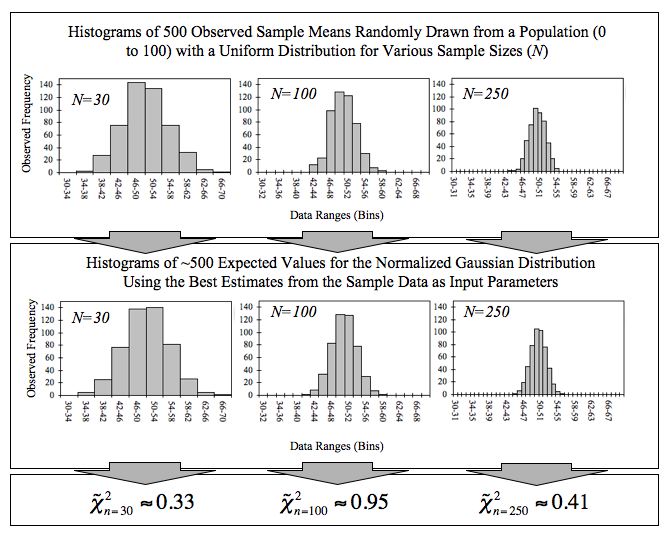
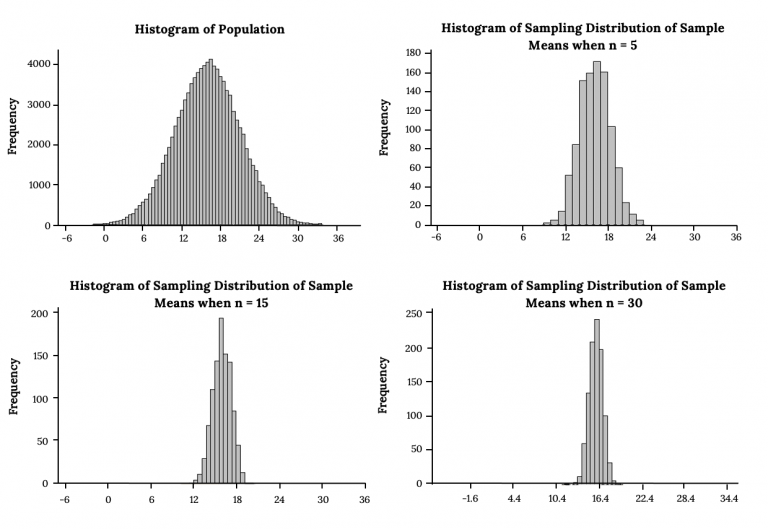
The Central Limit Theorem (CLT) says that when you take the mean of a large enough sample, that mean will follow an approximately normal distribution, regardless of what the original population looks like. This is powerful because it lets you use normal distribution tools (z-tables, standard normal calculations) on data that isn't normal at all.

Top images from around the web for Fundamentals of CLT
6.2 The Sampling Distribution of the Sample Mean (σ Known) – Significant Statistics View original
Is this image relevant?
The Central Limit Theorem for Sample Means (Averages) | Introduction to Statistics – Gravina View original
Is this image relevant?
Teorema del límite central - Central limit theorem - xcv.wiki View original
Is this image relevant?
6.2 The Sampling Distribution of the Sample Mean (σ Known) – Significant Statistics View original
Is this image relevant?
The Central Limit Theorem for Sample Means (Averages) | Introduction to Statistics – Gravina View original
Is this image relevant?
Fundamentals of CLT
As sample size increases, the sampling distribution of the sample mean approaches a normal distribution with:
- Mean equal to the population mean
- Standard error equal to
The conventional guideline is that is "large enough" for the CLT to kick in, though populations that are already close to normal need smaller samples, and heavily skewed populations may need larger ones.
To find probabilities involving sample means, you convert to a z-score:
where is the sample mean, is the population mean, is the population standard deviation, and is the sample size.
This works even when the underlying population is uniform, exponential, or some other non-normal shape.
Probability Calculations
Once you have a z-score, you look up the corresponding probability using a standard normal table (or calculator).
Typical problem types:
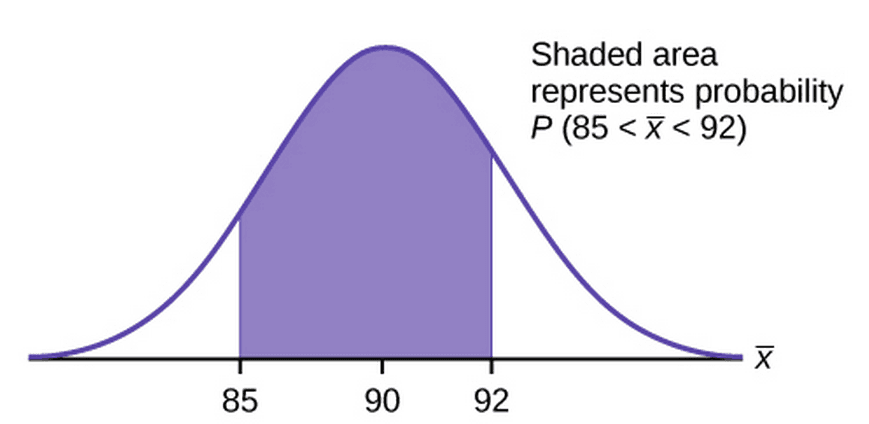
- What's the probability that the sample mean falls within a specific range? Convert both endpoints to z-scores and find the area between them.
- What's the probability that the sample mean exceeds a certain value? Convert to a z-score and find the area in the upper tail.
Example: Suppose a population has and . You draw a sample of . What's the probability that ?
- Compute the standard error:
- Compute the z-score:
- Look up
So there's about a 5.5% chance the sample mean exceeds 52.
When the population standard deviation is unknown, you substitute the sample standard deviation and use the t-distribution instead of the z-distribution. For large , the t-distribution is very close to the standard normal, so the results are similar.
Confidence Intervals with CLT
A confidence interval gives you a range of plausible values for the population mean based on your sample data.
Constructing Confidence Intervals
The general formula is:
Here's how to build one step by step:
- Compute the sample mean .
- Determine the standard error (or if is unknown).
- Choose your confidence level (common choices: 90%, 95%, 99%).
- Find the critical value. For large samples using the z-distribution, the critical values are approximately 1.645 (90%), 1.96 (95%), and 2.576 (99%).
- Calculate the margin of error: critical value standard error.
- Form the interval: to .
Three factors control how wide the interval is:
- Sample size: Larger shrinks the standard error, giving a narrower interval.
- Population variability: Higher means a wider interval.
- Confidence level: Higher confidence (say 99% vs. 95%) requires a wider interval.
Interpretation and Application
A 95% confidence interval does not mean there's a 95% chance the population mean is inside your particular interval. It means that if you repeated the sampling process many times, about 95% of the resulting intervals would contain the true mean.
The CLT is what makes these intervals approximately valid for large samples, even when the population isn't normal. Without the CLT, you'd need to know (or assume) the population's exact distribution to build a confidence interval.
Hypothesis Testing with CLT
Hypothesis testing uses sample data to evaluate a claim about a population parameter. The CLT makes this possible for means even when the population distribution is unknown.
Fundamentals of Hypothesis Testing
The setup involves two competing statements:
- Null hypothesis (): The default claim, typically "no effect" or "no difference." For example, .
- Alternative hypothesis (): What you're trying to find evidence for. This can be one-sided ( or ) or two-sided ().
The test statistic measures how far your sample result is from what predicts:
where is the hypothesized population mean. Thanks to the CLT, this statistic is approximately standard normal for large , so you can use z-tables to assess the result.
Testing Approaches and Considerations
There are two common ways to make a decision:
P-value approach:
- Calculate the test statistic .
- Find the p-value: the probability of observing a result at least as extreme as yours, assuming is true.
- If the p-value (your significance level, often 0.05), reject .
Critical value approach:
- Calculate the test statistic .
- Determine the critical value(s) from the significance level and test type (one-tailed or two-tailed).
- If falls in the rejection region, reject .
Both approaches give the same conclusion. The p-value approach is more common because it tells you how much evidence you have against , not just whether you crossed a threshold.
Two types of errors to watch for:
- Type I error: Rejecting when it's actually true. The probability of this equals .
- Type II error: Failing to reject when it's actually false. Harder to control, and depends on the true parameter value and sample size.
Limitations of CLT
Assumptions and Sample Size Considerations
The CLT requires that the random variables be independent and identically distributed (i.i.d.). This assumption breaks down with time series data (where observations are correlated) or clustered data (where observations within groups are more similar).
Sample size matters more than the rule suggests:
- For symmetric or mildly skewed populations, usually works fine.
- For heavily skewed distributions (exponential, Pareto), you may need in the hundreds before the sampling distribution looks normal.
- For distributions with very heavy tails, like the Cauchy distribution, the CLT doesn't apply at all because the population mean and variance don't exist.
One common misconception: the CLT does not say that your data becomes normal as you collect more of it. It says the distribution of the sample mean (across many hypothetical samples) becomes normal.
Scope and Alternative Methods
The CLT applies to sums and means of random variables. It does not automatically extend to other statistics like medians, ranges, or variances.
For other types of data, different tools are more appropriate:
- Proportions: The CLT can approximate binomial proportions when and are both at least 5 or 10 (depending on the convention). Outside that range, use the binomial distribution directly.
- Counts of rare events: The Poisson distribution is typically a better model than a normal approximation.
- Small samples from skewed populations: Consider exact methods, bootstrapping, or non-parametric tests rather than relying on the CLT.
See Fiveable more often in Google
Mark Fiveable as a preferred source and Google is more likely to show you our guides in Top Stories, with a "preferred" badge in AI Mode and AI Overviews.