7.4 Writing for clarity and conciseness

📰Intro to Journalism Unit 7 Review
7.4 Writing for clarity and conciseness
📰 Intro to Journalism
Writing Techniques for Clear and Concise News Stories
Clear writing is the foundation of good journalism. If readers have to re-read a sentence to understand it, you've already lost them. The goal is to deliver information as quickly and accurately as possible, stripping away anything that slows the reader down.

Top images from around the web for Techniques for clear news writing
Channels of Business Communication | Principles of Management View original
Is this image relevant?
Types of Reading Material | Basic Reading and Writing View original
Is this image relevant?
Inverted Pyramid | Asylum for Thoughts View original
Is this image relevant?
Channels of Business Communication | Principles of Management View original
Is this image relevant?
Types of Reading Material | Basic Reading and Writing View original
Is this image relevant?
Techniques for clear news writing
Use simple, straightforward language. Your audience is the general public, not specialists. Choose words that a wide range of readers will understand on the first pass. If a technical term is unavoidable, define it briefly the first time it appears. For example, write "heart attack" instead of "myocardial infarction" unless you're quoting a medical source.
Keep sentences short and focused. Each sentence should carry one main idea. When a sentence tries to do too much, it gets confusing. Compare these two versions:
Cluttered: "The city council, which met Tuesday evening in a session that lasted over three hours, voted to approve the new budget, which includes funding for road repairs and a new community center."
Clear: "The city council approved the new budget Tuesday after a three-hour session. The budget includes funding for road repairs and a new community center."
The second version splits one overloaded sentence into two focused ones. Each is easier to follow.
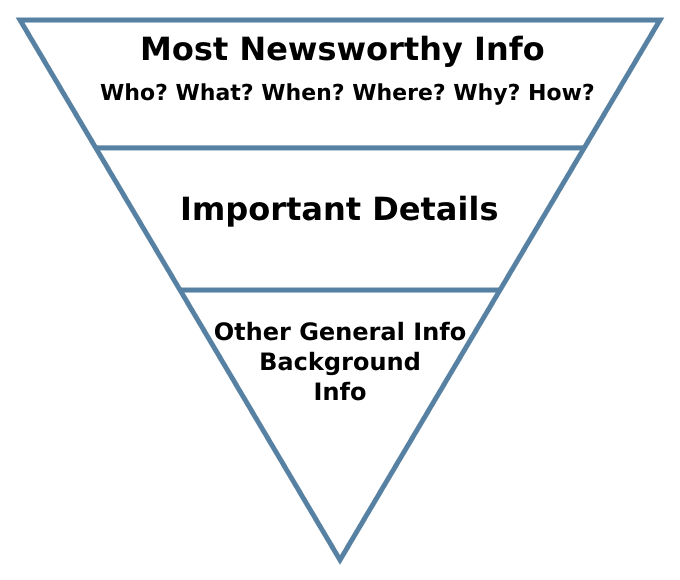
Organize information using the inverted pyramid. Start with the most newsworthy facts in your lead, then present supporting details in order of decreasing importance. This structure lets editors cut from the bottom without losing critical information, and it gives readers the key points right away. Use subheadings in longer pieces to guide readers through sections.

Eliminating unnecessary language
Tight writing means cutting words that don't earn their place. Here are the main categories to watch for:
- Redundancies: Phrases where multiple words say the same thing. "Completely destroyed" can just be "destroyed." "Past history" is just "history." "Armed gunman" is just "gunman."
- Empty modifiers: Words like "very," "really," "quite," and "extremely" rarely add meaning. "The fire was very large" is weaker than "The fire burned 12 acres."
- Filler phrases: Constructions like "due to the fact that" (use "because"), "at this point in time" (use "now"), or "in order to" (use "to") add bulk without adding information.
When you encounter jargon you can't avoid, translate it. Don't write "The defendant filed a motion for summary judgment." Instead, try: "The defendant asked the judge to dismiss the case without a trial, a legal move called summary judgment."

Editing and Adapting News Stories
Editing for clarity and brevity
Good writing is really rewriting. Use this process when revising a draft:
- Read the whole piece aloud. If you stumble over a sentence, your reader will too. Break long sentences into shorter ones.
- Check for active voice. "The mayor announced the plan" is stronger than "The plan was announced by the mayor." Active voice is more direct and usually shorter.
- Verify every fact. Double-check names, dates, titles, and statistics. Confirm that quotes are accurate and properly attributed. One factual error can undermine an entire story's credibility.
- Cut ruthlessly. Remove any sentence that doesn't advance the story. Condense background information to only what the reader needs. If a detail is interesting but not relevant, it goes.
- Read it one more time with fresh eyes, checking that the piece flows logically from one point to the next.
Adapting style for audiences
The same story might need to be written differently depending on where it's published and who's reading it.
- Audience awareness: A story for a local newspaper might need more neighborhood-level context, while a national outlet's version would focus on broader significance. Writing for younger readers might mean shorter paragraphs and less assumed background knowledge.
- Platform differences: A 800-word article for print doesn't work as a 150-word web brief. Online stories often use shorter paragraphs, hyperlinks for background, and multimedia like photos or embedded video. Social media posts distill the story to its most essential point.
- Publication guidelines: Most news organizations follow a style guide, with AP Style being the most common in American journalism. This covers everything from how you write numbers (spell out one through nine, use numerals for 10 and above) to how you format dates and titles. Consistency with your publication's style makes the final product look professional and polished.
See Fiveable more often in Google
Mark Fiveable as a preferred source and Google is more likely to show you our guides in Top Stories, with a "preferred" badge in AI Mode and AI Overviews.