
The Root Locus Technique is a powerful tool for analyzing and designing control systems. It shows how a system's stability and response change as you adjust the controller gain. This method helps engineers create better controllers for everything from robots to airplanes.
Root Locus plots the paths of a system's poles in the complex plane as gain changes. By following simple rules, you can sketch these plots and find the perfect gain for your desired system performance. It's a visual way to balance stability and speed.
Root Locus Technique
Overview and Applications
- The root locus is a graphical technique used to analyze the stability and transient response of a closed-loop control system as a function of a system parameter, typically the controller gain
- It is used to design controllers, such as proportional (P), proportional-integral (PI), or proportional-integral-derivative (PID) controllers, to achieve desired system performance specifications
- Applications of the root locus technique include analyzing and designing control systems for various engineering domains (aerospace, robotics, process control, automotive systems)
Closed-Loop System Poles and System Parameter
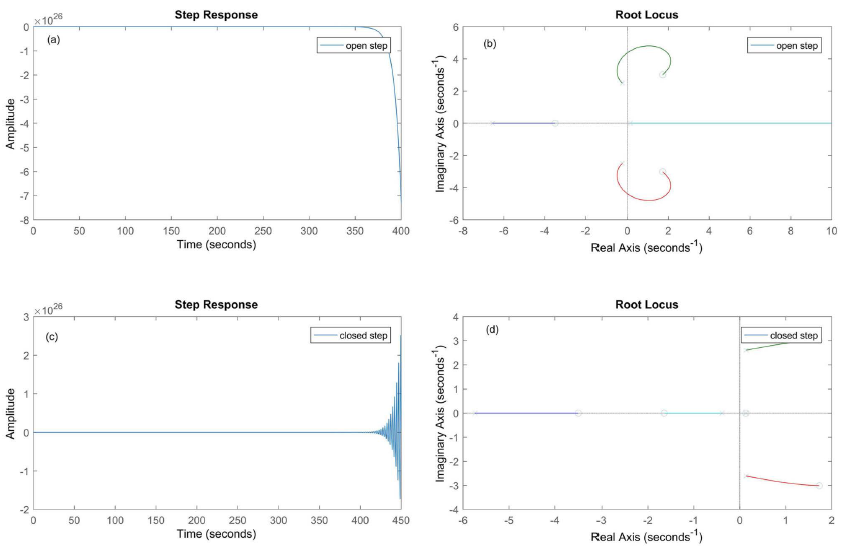
- The root locus plot shows the trajectories of the closed-loop system poles in the complex s-plane as the system parameter varies from zero to infinity
- The system parameter is typically the controller gain, which affects the location of the closed-loop poles and, consequently, the system's stability and transient response characteristics
Root Locus Plot
Sketching the Root Locus
- To sketch the root locus plot, first determine the open-loop transfer function of the system, which is the product of the controller transfer function and the plant transfer function
- Identify the poles and zeros of the open-loop transfer function and plot them on the complex s-plane
- Determine the number of branches of the root locus plot based on the number of poles and zeros of the open-loop transfer function

Rules for Sketching the Root Locus
- The root locus starts at the open-loop poles and ends at the open-loop zeros or extends to infinity
- The root locus is symmetric about the real axis
- The root locus exists on the real axis to the left of an odd number of poles and zeros
- The root locus approaches asymptotes centered on the centroid and with angles determined by the number of poles and zeros as the gain approaches infinity
- The root locus crosses the imaginary axis at points determined by the Routh-Hurwitz stability criterion
- Determine the breakaway and break-in points on the real axis, if any, using the angle condition or the magnitude condition
Stability Regions and Critical Points
Stability Regions
- The stability of the closed-loop system can be determined from the location of the poles on the root locus plot
- The system is stable if all the poles lie in the left-half of the complex s-plane (LHP) and unstable if any pole lies in the right-half of the complex s-plane (RHP)
- The imaginary axis is the boundary between the stable and unstable regions
- The system is marginally stable if any pole lies on the imaginary axis
Critical Points
- Identify the critical points on the root locus plot, such as the breakaway and break-in points, which indicate the transition between different types of system responses (overdamped, underdamped, undamped)
- Determine the gain values corresponding to the critical points using the magnitude condition or by solving the characteristic equation
- These critical points help in understanding the system's behavior and selecting appropriate gain values for desired performance
Controller Design with Root Locus
Specifying Desired Performance
- Specify the desired system performance in terms of transient response characteristics (settling time, overshoot, steady-state error)
- Choose a suitable controller structure (P, PI, PID) based on the system requirements and the type of response desired
Determining Controller Gain
- Use the root locus plot to determine the controller gain that places the dominant closed-loop poles at the desired location to achieve the specified performance
- The dominant poles are the pair of complex conjugate poles closest to the imaginary axis, which have the greatest influence on the system response
- The damping ratio and natural frequency of the dominant poles determine the transient response characteristics
Reshaping the Root Locus
- If the desired performance cannot be achieved with the chosen controller structure, consider adding poles, zeros, or lead/lag compensators to reshape the root locus and meet the design requirements
- Adding poles, zeros, or compensators can help in achieving the desired transient response characteristics or improving the system's stability
Verifying Controller Performance
- Verify the designed controller's performance using time-domain simulations and frequency-domain analysis techniques (step response, Bode plots)
- Time-domain simulations help in assessing the system's transient response, while frequency-domain analysis provides insights into the system's stability margins and robustness