4.2 Sengoku period: warring states and daimyō power

🎎History of Japan Unit 4 Review
4.2 Sengoku period: warring states and daimyō power
🎎 History of Japan
Political Landscape of Sengoku Japan
The Sengoku period (1467–1615) was an era of near-constant warfare that shattered central authority in Japan. The Ashikaga shogunate, already weakened by internal disputes, lost its grip on the country as regional warlords carved out independent domains and fought each other for supremacy. Understanding this period is essential because it set the stage for Japan's eventual reunification and the political structures that would define the Tokugawa era.

Top images from around the web for Characteristics of Sengoku period
Oda Nobunaga - Wikipedia View original
Is this image relevant?
Military history of Japan - Wikipedia View original
Is this image relevant?
Category:Ōnin War - Wikimedia Commons View original
Is this image relevant?
Oda Nobunaga - Wikipedia View original
Is this image relevant?
Military history of Japan - Wikipedia View original
Is this image relevant?
Characteristics of the Sengoku Period
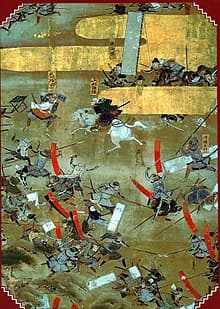
The Ōnin War (1467–1477) is typically cited as the trigger for the Sengoku era. It started as a succession dispute within the Ashikaga shogunate but spiraled into a decade of fighting that devastated Kyoto and proved the shogunate could no longer keep order. After the war, regional daimyō stopped looking to the central government for legitimacy and started acting on their own.
A defining feature of this era was gekokujō (下克上), which translates roughly to "the low overcome the high." Lower-ranking samurai, local strongmen, and even commoners could overthrow their superiors and seize power. Traditional hierarchies broke down. A person's birth mattered less than their ability to win battles and hold territory.
Other major developments during this period:
- Firearms arrived in 1543 when Portuguese traders landed on Tanegashima island. Japanese smiths quickly began producing their own guns, and within decades, firearms transformed battlefield tactics.
- Merchant classes grew in power, especially in cities like Sakai, which operated with a degree of self-governance and profited from both domestic and foreign trade.
- European contact brought not only muskets but also Christianity. Jesuit missionaries like Francis Xavier (arrived 1549) gained converts, particularly in Kyushu, while European traders opened new commercial networks.

Rise of Powerful Daimyō
With the shogunate effectively powerless, daimyō became the real rulers of Japan. Each controlled an autonomous domain and governed it like a small state, collecting taxes, administering justice, and maintaining their own armies.
To hold power, daimyō built sophisticated local governments. They conducted cadastral surveys to measure the productive capacity of their land, which let them set tax rates and allocate resources for military campaigns. They also issued domain-specific law codes to regulate everything from land disputes to the behavior of samurai retainers. Some of the most notable examples include the Takeda clan's legal codes and the Imagawa clan's Imagawa Kana Mokuroku, which formalized rules for vassals and dispute resolution.
Castle construction became a hallmark of daimyō power. Castles served as military strongholds, administrative headquarters, and symbols of authority. Towns grew up around them, attracting merchants, artisans, and laborers. Notable examples like Himeji Castle and Osaka Castle, though completed or expanded later, reflect this castle-building trend that took root during the Sengoku period.
The political landscape was defined by a constantly shifting web of alliances and betrayals. Daimyō secured partnerships through strategic marriages, hostage exchanges, and mutual defense pacts, but these agreements could dissolve overnight if the balance of power shifted. Some daimyō also minted local currencies and actively encouraged trade within their domains to build economic strength.
Cultural patronage mattered too. Daimyō supported arts like the tea ceremony and Noh theater, partly out of genuine interest and partly to project sophistication and legitimacy. Religious policy varied widely: some daimyō backed powerful Buddhist sects, others welcomed Christian missionaries for the trade advantages they brought, and still others suppressed religious groups they saw as political threats.

Strategies for Unification
Three figures are credited with reunifying Japan, though this unit focuses on the first two: Oda Nobunaga and Toyotomi Hideyoshi. (The third, Tokugawa Ieyasu, completed the process and established the Tokugawa shogunate in 1603.)
Oda Nobunaga rose from a minor daimyō family in Owari Province to become the most powerful warlord in Japan. His key strategies:
- Surprise and boldness. His career-defining early victory came at the Battle of Okehazama (1560), where his small force ambushed and killed Imagawa Yoshimoto, a far more powerful rival marching toward Kyoto with an army that vastly outnumbered Nobunaga's.
- Seizing the capital. In 1568, Nobunaga marched into Kyoto and installed Ashikaga Yoshiaki as shogun, using him as a puppet to legitimize his own authority. He later expelled Yoshiaki in 1573, ending the Ashikaga shogunate entirely.
- Military innovation. Nobunaga was among the first commanders to use massed firearms effectively. At the Battle of Nagashino (1575), his arquebusiers fired in rotating volleys behind wooden palisades, devastating the cavalry charges of the Takeda clan. This battle is often cited as a turning point in Japanese military history.
- Crushing religious opposition. Nobunaga saw militant Buddhist institutions as political rivals. He destroyed the Enryakuji monastery complex on Mount Hiei in 1571, killing thousands, and waged a decade-long campaign against the Ikkō-ikki, armed Buddhist leagues centered on the True Pure Land sect that controlled entire provinces and resisted secular authority.
- Economic consolidation. Nobunaga promoted rakuichi-rakuza (free markets and open guilds) policies, abolishing monopolistic trade guilds in his territories to stimulate commerce and increase tax revenue.
After Nobunaga was assassinated in 1582 during the Honnō-ji Incident (betrayed by his vassal Akechi Mitsuhide), Toyotomi Hideyoshi took up the unification effort:
- Avenging Nobunaga and seizing leadership. Hideyoshi quickly defeated Akechi Mitsuhide at the Battle of Yamazaki, then outmaneuvered Nobunaga's other generals to position himself as the successor.
- Completing military conquest. Hideyoshi defeated remaining rivals, culminating in the Siege of Odawara (1590) against the Hōjō clan, which brought all of Japan under his control.
- Disarming the populace. His sword hunt (katanagari, 1588) confiscated weapons from peasants, enforcing a rigid separation between the warrior and farming classes. This was a deliberate move to prevent the kind of gekokujō that had defined the Sengoku era.
- Land surveys. Hideyoshi conducted nationwide cadastral surveys (the Taikō kenchi) to standardize land measurement and tax assessment, strengthening central control over resources.
- Projecting power abroad. He launched two invasions of Korea (1592 and 1597), which ultimately failed but demonstrated his ambition to extend Japanese influence beyond the home islands.
Both leaders redistributed conquered territories to loyal retainers, breaking up the power bases of defeated rivals. They also used diplomatic marriages and strategic negotiations alongside military force.
Impact on Common People
Constant warfare reshaped daily life for ordinary Japanese. Rural populations were frequently displaced by fighting, and many migrated to the growing castle towns (jōkamachi) that sprang up around daimyō strongholds. This accelerated urbanization across Japan.
Agriculture evolved under pressure. Daimyō pushed for intensified rice cultivation to fund their armies, and new irrigation techniques spread. (Note: sweet potatoes and corn, often associated with this era, were actually introduced somewhat later and became widespread mainly in the Edo period.)
The era created unusual social mobility. Because daimyō desperately needed capable soldiers and administrators, people of humble origin could rise through military service. Hideyoshi himself is the most famous example: born a peasant, he became the ruler of all Japan. Ironically, his own policies like the sword hunt and rigid class distinctions then worked to close the very path he had taken.
In rural areas, some communities organized themselves through sō (惣) organizations, village councils that managed local affairs, resolved disputes, and sometimes negotiated collectively with daimyō over tax burdens. These represented a form of grassroots self-governance that gave commoners a degree of collective bargaining power even in a militarized society.
Other effects on daily life:
- A wealthy merchant class emerged in cities like Sakai and Hakata, gaining economic influence that sometimes rivaled the samurai. Sakai in particular functioned almost like a self-governing city-state, run by a council of wealthy merchants.
- Literacy and cultural practices spread beyond the elite. The tea ceremony, flower arrangement (ikebana), and popular forms of storytelling reached broader audiences.
- Taxation increased as daimyō needed revenue for military campaigns, creating real economic hardship for farming communities.
- New religious movements appealed to commoners. Pure Land Buddhism and Nichiren Buddhism gained large followings, while Christianity attracted a smaller but significant number of converts, especially in western Japan.
- Women's roles shifted in some contexts. With men away at war, women sometimes managed household affairs, family businesses, or even defended fortifications, though these expanded roles did not become permanent social changes.
See Fiveable more often in Google
Mark Fiveable as a preferred source and Google is more likely to show you our guides in Top Stories, with a "preferred" badge in AI Mode and AI Overviews.