11.1 Economic bubble burst and "Lost Decades"

🎎History of Japan Unit 11 Review
11.1 Economic bubble burst and "Lost Decades"
🎎 History of Japan
Economic Bubble and Its Collapse
Japan's economic bubble burst at the end of the 1980s, triggering what became known as the "Lost Decades" of economic stagnation. Understanding this period is essential because it reshaped Japanese society, politics, and daily life in ways that persist today. It also became a cautionary tale studied by economists worldwide.

Top images from around the web for Factors behind Japan's economic bubble burst
File:Real GDP growth rate in Japan (1956-2008).png - Wikimedia Commons View original
Is this image relevant?
Abenomics: Progress, prospects and how the 2020 Tokyo Olympics can help solve Japan's debt ... View original
Is this image relevant?
日本泡沫经济 - 维基百科,自由的百科全书 View original
Is this image relevant?
File:Real GDP growth rate in Japan (1956-2008).png - Wikimedia Commons View original
Is this image relevant?
Abenomics: Progress, prospects and how the 2020 Tokyo Olympics can help solve Japan's debt ... View original
Is this image relevant?
Factors behind Japan's economic bubble burst
Several forces combined to inflate Japan's bubble through the mid-to-late 1980s, and each one made the eventual crash worse.
Asset overvaluation reached absurd levels. Real estate and stock prices climbed far beyond what the underlying economy could justify. At the peak, the land beneath Tokyo's Imperial Palace was famously estimated to be worth more than all the real estate in California. The Nikkei 225 stock index hit nearly 39,000 in December 1989, a level it would not approach again for over three decades.
Excessive bank lending fueled the frenzy. Banks extended easy credit with inadequate risk assessment, often using inflated land values as collateral. When land prices fell, those loans turned toxic. This created a vicious cycle: banks couldn't lend, businesses couldn't borrow, and the economy couldn't grow.
Speculative investment (zaitech) became widespread. Companies poured money into stocks, real estate, and other financial instruments unrelated to their core business. Even ordinary individuals took on risky investments, expecting prices to keep rising indefinitely.
The Plaza Accord of 1985 set the stage. This agreement among the G5 nations (the U.S., Japan, West Germany, France, and the UK) deliberately drove up the value of the yen against the dollar to reduce America's trade deficit. A stronger yen hurt Japanese exporters, so the Bank of Japan responded by cutting interest rates aggressively. Cheap money then flooded into speculative assets rather than productive industry.
Domestic policy choices added fuel. The government deregulated financial markets and maintained tax policies that favored land transactions, making real estate speculation even more attractive.
Global competition also squeezed Japan. Other Asian economies, particularly South Korea and the emerging economies of Southeast Asia, were becoming serious manufacturing rivals, putting pressure on Japan's export-driven growth model. (China's rise as a major competitor accelerated somewhat later, through the 1990s and 2000s.)
How the bubble burst
When the Bank of Japan finally raised interest rates in late 1989 to cool speculation, asset prices collapsed. The Nikkei lost roughly half its value by the end of 1990. Real estate prices followed, falling steadily through the 1990s and not bottoming out until the early 2000s in many areas. Banks were left holding massive amounts of bad debt, and the cycle of easy-money growth came to a sudden halt.
.svg.png)
Consequences and Government Response
Consequences of Japan's "Lost Decades"
The fallout from the bubble's collapse was deep and long-lasting, touching nearly every part of Japanese society.
- Economic stagnation: GDP growth averaged roughly 1% per year through the 1990s and 2000s, a dramatic drop from the high-growth postwar era. Persistent deflation (a sustained decline in the general price level) set in, discouraging spending and investment. Why spend today if things will be cheaper tomorrow?
- Banking crisis: Trillions of yen in loans went bad. Major institutions collapsed, including Yamaichi Securities in 1997, one of Japan's "Big Four" brokerages. Public trust in the financial system eroded badly.
- Employment shifts: Unemployment rose, and the traditional model of lifetime employment (shūshin koyō) at a single company began to break down. Employers increasingly hired workers on part-time or contract terms, offering less stability and fewer benefits. By the 2000s, over a third of the workforce held non-regular positions.
- Demographic pressures: Japan's aging population and declining birth rate compounded economic problems. The fertility rate dropped to around 1.26 by 2005, meaning fewer young workers were entering the economy to support a growing number of retirees. This wasn't caused by the bubble burst, but it made recovery far harder.
- Social consequences: Income inequality widened. Two new social categories entered the public vocabulary: "freeters" (young people drifting between part-time jobs, from the English "free" and the German "Arbeiter" for worker) and "NEETs" (young adults not in education, employment, or training). These reflected a generation locked out of the stable career paths their parents had enjoyed.
- Changed consumer behavior: Japanese households became cautious spenders and aggressive savers. This made sense for each individual family but deepened deflation at the national level. When everyone saves instead of spending, businesses earn less, hire less, and the cycle continues. Economists call this the paradox of thrift.
- Corporate restructuring: Companies shifted away from the old stakeholder-oriented model toward a greater focus on shareholder value, cost-cutting, and global competitiveness.
.png)
Government efforts for economic stimulation
Japan's government tried repeatedly to restart growth, but results were mixed at best.
- Fiscal stimulus packages: Starting with a 10.7 trillion yen package in 1992, the government funded massive public works projects and implemented tax cuts. These provided short-term boosts but did not produce lasting recovery, partly because spending was often directed toward politically connected construction projects rather than productive investment.
- Monetary policy experiments: The Bank of Japan introduced a zero interest rate policy (ZIRP) in 1999 and later pioneered quantitative easing (purchasing government bonds and other assets to inject money into the economy) starting in 2001. Japan was the first major economy to try these tools, which other central banks would later adopt during the 2008 global financial crisis.
- Financial system reforms: The government created the Financial Services Agency in 2000 to improve oversight and injected public funds directly into struggling banks to prevent further collapses.
- Structural reforms: Various sectors were deregulated, and major state-owned enterprises were privatized. The most notable example was the privatization of Japan Post in 2007, which had functioned as one of the world's largest savings institutions.
- Abenomics (2012): Prime Minister Shinzo Abe launched an ambitious program built on "three arrows": aggressive monetary easing, flexible fiscal stimulus, and structural reforms to boost competitiveness. Abenomics generated initial optimism and a stock market rally, but the third arrow of structural reform proved the hardest to deliver. Entrenched interests and an aging electorate made changes to labor markets and immigration policy politically difficult.
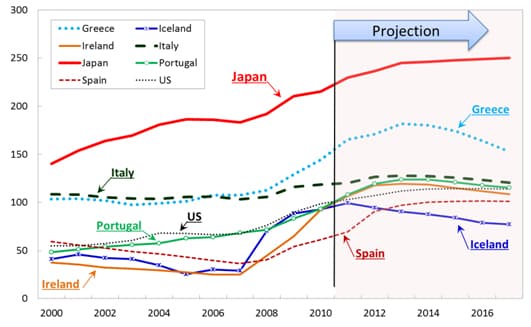
Overall effectiveness was limited. Growth remained sluggish, deflationary pressures persisted, and government debt ballooned past 200% of GDP, the highest ratio among developed nations. Japan's experience demonstrated how difficult it is to escape a deflationary trap once it takes hold.
Japan's stagnation vs historical precedents
Comparing Japan's Lost Decades to other economic crises highlights what made Japan's experience unusual.
| Crisis | Similarity to Japan | Key Difference |
|---|---|---|
| Great Depression (1930s) | Deflation, falling asset prices, high unemployment | Global in scale; far more severe initial decline |
| Post-war European reconstruction | Need for economic revitalization | Europe achieved rapid growth; Japan stagnated |
| Latin American debt crisis (1980s) | Financial sector instability, bad loans | Latin America suffered hyperinflation; Japan had deflation |
| Asian Financial Crisis (1997) | Real estate bubbles, banking failures | Shorter duration; sharper but faster-recovering downturn |
| U.S. Stagflation (1970s) | Prolonged economic stagnation | The U.S. had high inflation; Japan had the opposite |
| Global Financial Crisis (2008) | Asset bubble burst, financial instability | Most other countries recovered more quickly |
The recurring theme is that Japan's combination of deflation and prolonged stagnation was historically unusual. Most crises involve inflation or a sharp crash followed by recovery within a few years. Japan's slow, grinding decline over two decades made it a unique case that economists still debate today.
See Fiveable more often in Google
Mark Fiveable as a preferred source and Google is more likely to show you our guides in Top Stories, with a "preferred" badge in AI Mode and AI Overviews.