7.1 Subject-predicate structure

🏆Intro to English Grammar Unit 7 Review
7.1 Subject-predicate structure
🏆 Intro to English Grammar
Subject-Predicate Structure in Sentences
Every sentence in English is built on two core parts: a subject and a predicate. The subject tells you who or what the sentence is about, and the predicate tells you what that subject does or is. Once you can reliably spot these two pieces, you'll find it much easier to fix grammar errors, understand agreement rules, and write clearer sentences.
Subject and predicate identification
The subject is the noun or pronoun that performs the action or receives a description. It usually appears at the beginning of the sentence, but not always.
- A simple subject is a single noun or pronoun: She laughed.
- A compound subject joins two or more nouns: The energetic puppy and its tired owner walked home.
- In inverted sentences, the subject comes after the verb: Over the fence jumped the dog.
The predicate is everything else: the verb plus any additional information about the subject's action or state.
- A simple predicate is just the verb: The dog ran.
- A complete predicate includes the verb and all its modifiers, objects, or complements: gave her friend a book about astronomy.
How to find them:
- Locate the main verb in the sentence.
- Ask "Who or what [verb]?" The answer is your subject. (Who ran? The dog.)
- Everything that isn't the subject is part of the predicate. You can confirm by asking "What about the subject?" (What about the dog? The dog ran quickly down the street.)
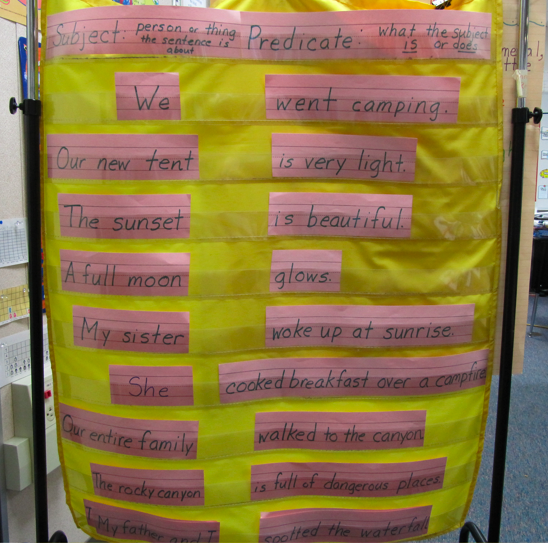
Subject-predicate relationship in clauses
These two parts aren't just sitting next to each other; they're grammatically linked in several ways.
Grammatical relationship: The subject controls verb agreement in person and number. A singular subject takes a singular verb, and a plural subject takes a plural verb: He runs vs. They run. Getting this wrong is one of the most common grammar mistakes.
Semantic relationship: The subject typically introduces the topic (often information the reader already knows), while the predicate delivers the new information. In The mysterious stranger appeared suddenly at midnight, the subject sets the scene and the predicate tells you what happened.
Structural relationship: A subject and predicate together form a complete thought. That pairing is the basic clause structure, and it's the foundation you build on when you start writing more complex sentences.

Role of subject and predicate
The subject establishes the focus of a sentence and provides context. You can shift that focus by changing what you place in the subject position. Compare:
John drove the car. (focus on John) The car was driven by John. (focus on the car, using passive voice)
The predicate carries the main information about actions or states. It also determines the sentence type: a declarative predicate makes a statement (The team won), an interrogative predicate asks a question (Did the team win?), and an imperative predicate gives a command (Win the game).
Together, subject and predicate create sentence coherence. Varying their order can add emphasis: Rarely had the town seen such excitement hits differently than The town had rarely seen such excitement. The meaning is the same, but the first version foregrounds the rarity.
Complete vs. incomplete clauses
Complete clauses contain both a subject and a predicate and express a full thought. The cat slept peacefully can stand on its own as a sentence.
Incomplete clauses (sentence fragments) are missing one or both parts. Running through the park has no subject and no finite verb. Fragments like Nice day! show up in casual writing and dialogue, but in formal writing they're usually errors.
Dependent clauses are a tricky middle ground. They have a subject and a predicate, but a subordinating word (like while, because, although) prevents them from expressing a complete thought on their own.
- While the sun was setting has a subject (the sun) and a predicate (was setting), but it feels unfinished. It needs an independent clause to complete the sentence: While the sun was setting, we enjoyed the view.
Quick test for clause completeness:
- Does it have a subject? If not, it's a fragment.
- Does it have a predicate with a finite verb? If not, it's a fragment.
- Does it start with a subordinating word (because, although, when, if)? If so, it's a dependent clause and can't stand alone.
- If it passes all three checks, it's a complete independent clause.
See Fiveable more often in Google
Mark Fiveable as a preferred source and Google is more likely to show you our guides in Top Stories, with a "preferred" badge in AI Mode and AI Overviews.