4.1 Structure and organization of the mental lexicon

🏆Intro to English Grammar Unit 4 Review
4.1 Structure and organization of the mental lexicon
🏆 Intro to English Grammar
Understanding the Mental Lexicon
The mental lexicon is your brain's internal dictionary. It stores every word you know along with a rich web of linguistic knowledge about each one. Unlike a printed dictionary sitting on a shelf, your mental lexicon is a dynamic, interconnected network that updates constantly as you encounter new words and new uses for old ones. Understanding how it works helps explain how we produce and comprehend language so quickly.
The Mental Lexicon in Language Processing
The mental lexicon does more than just store definitions. For every word you know, it holds multiple layers of information:
- Phonological information — how the word sounds (its pronunciation and stress pattern)
- Orthographic information — how the word is spelled
- Syntactic information — what part of speech it is and how it fits into sentences
- Semantic information — what the word means and what concepts it connects to
All of this information works together during language processing. When you hear a word, your brain rapidly matches the incoming sounds to a phonological entry, retrieves its meaning, and figures out its grammatical role in the sentence. When you speak or write, the process runs in reverse: you start with a meaning you want to express, and your mental lexicon supplies the right word with the right pronunciation and grammar. This all happens in milliseconds, which is what makes the mental lexicon so remarkable.
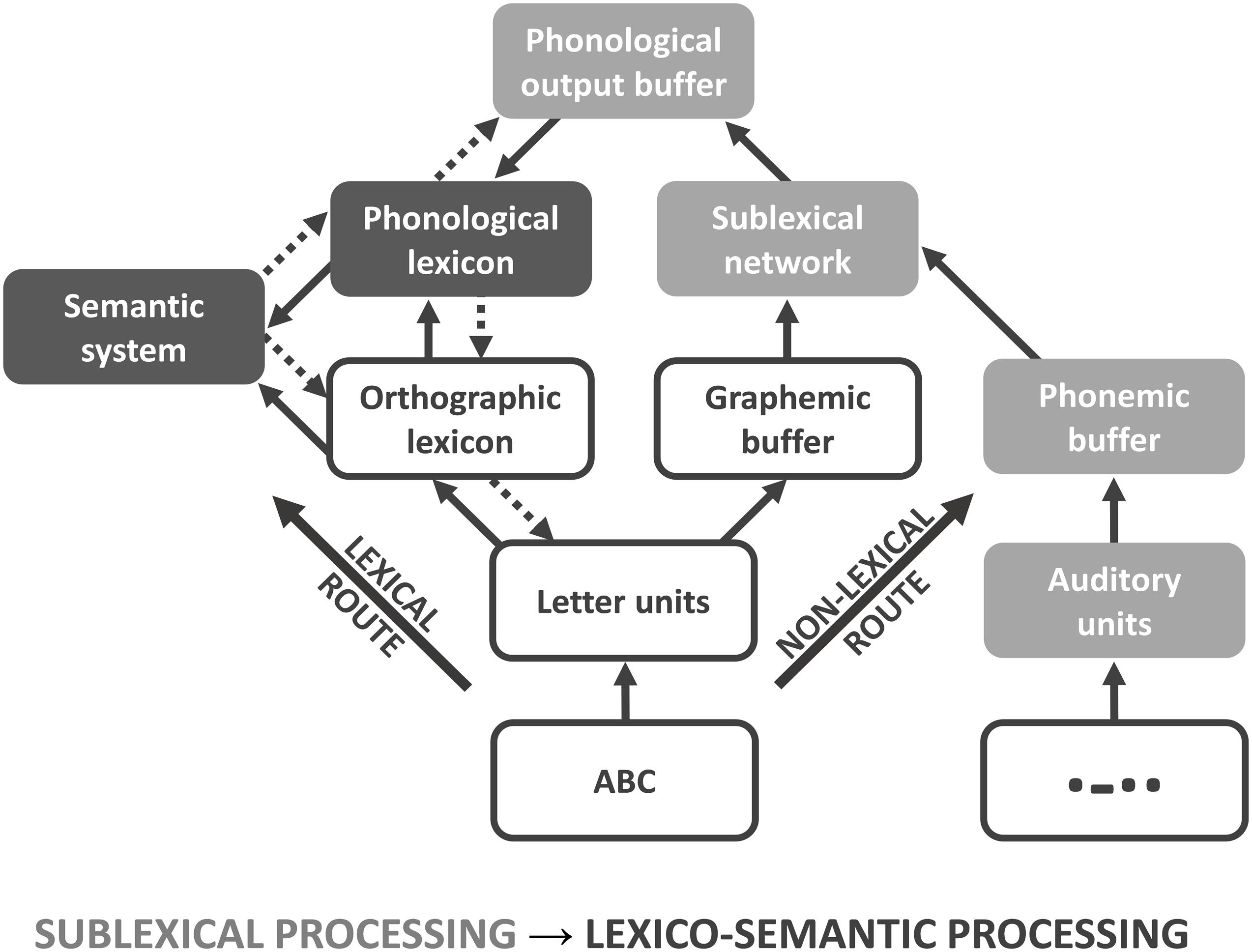
How the Mental Lexicon Is Organized
Words in the mental lexicon aren't filed alphabetically. Instead, they're organized through overlapping networks based on several types of relationships:
- Semantic networks link words by meaning, often in hierarchical structures. For example, animal > mammal > dog forms a chain from general to specific.
- Phonological similarities group words that sound alike. Words like cat, hat, and mat are stored near each other because they share sound patterns.
- Morphological relationships connect words that share roots or affixes. Happy, unhappy, and happiness are all linked through their common base.
- Syntactic categories cluster words by their grammatical role (nouns together, verbs together, and so on).
- Associative links tie words that frequently appear together or are related by experience. Hearing doctor primes you to recognize nurse faster, and salt primes pepper. This is called the priming effect.
- Frequency effects mean that high-frequency words like the, and, and to sit at the most accessible points in the network. You retrieve them almost effortlessly.
The result is that any single word connects to dozens of others through meaning, sound, structure, and association all at once.

Mental Lexicon vs. a Printed Dictionary
It's tempting to think of the mental lexicon as just a dictionary in your head, but the two differ in important ways:
| Feature | Mental Lexicon | Printed Dictionary |
|---|---|---|
| Organization | Interconnected network (by meaning, sound, grammar) | Alphabetical order |
| Content | Includes personal associations, emotions, and experiences | Standardized definitions and usage notes |
| Access | Rapid and automatic | Requires conscious, deliberate lookup |
| Flexibility | Constantly updating as you learn new words and meanings | Relatively static between editions |
| Completeness | May hold partial knowledge of some words (you might recognize a word but not define it precisely) | Aims for complete entries |
The key takeaway: a dictionary is a reference tool, while the mental lexicon is a living system shaped by your individual experience with language.
Factors That Affect Lexical Storage and Retrieval
Not all words are equally easy to access. Several factors influence how quickly and accurately you can retrieve a word:
- Frequency of use — Words you encounter often (like hello or goodbye) are retrieved faster than rare words. This is one of the strongest predictors of retrieval speed.
- Age of acquisition — Words learned early in life (like mama or water) tend to have stronger, more deeply rooted representations than words learned later.
- Emotional salience — Words tied to strong emotions (like love or fear) are often easier to retrieve because emotional significance strengthens memory traces.
- Context — The surrounding words and situation guide retrieval. The word bank activates its "riverbank" meaning near the word river but its "financial institution" meaning near the word money.
- Recency of use — A word you used five minutes ago is temporarily easier to access than one you haven't used in weeks.
- Phonological neighborhood density — Words with many similar-sounding neighbors (like cat, which sounds like hat, bat, rat, cap, can) can be both easier to activate and harder to select among, since those neighbors compete during retrieval.
- Semantic richness — Words with multiple meanings or strong associations (like run, which works as both a verb and a noun with many senses) tend to be accessed more easily because they have more connections in the network.
- Individual differences — Your vocabulary size, language proficiency, and cognitive abilities all shape how efficiently your mental lexicon operates. Two people can have quite different retrieval speeds for the same word.
See Fiveable more often in Google
Mark Fiveable as a preferred source and Google is more likely to show you our guides in Top Stories, with a "preferred" badge in AI Mode and AI Overviews.