1.2 Historical development of English grammar

🏆Intro to English Grammar Unit 1 Review
1.2 Historical development of English grammar
🏆 Intro to English Grammar
Origins and Evolution of English
English didn't appear out of nowhere. It developed over thousands of years through invasions, cultural shifts, and contact with other languages. Understanding this history helps explain why English grammar works the way it does today, from its irregular verbs to its heavy reliance on word order.
Origins of English language
English traces back to Proto-Indo-European (PIE), a reconstructed language spoken roughly 4500–2500 BCE. PIE is the common ancestor of most European and many South Asian languages. The branch that matters for English is the Germanic branch, which eventually produced West Germanic languages like Dutch, German, and English.
Here's how the major periods break down:
- Old English (450–1066 CE): Anglo-Saxon settlers brought Germanic dialects to Britain. Old English had a complex inflectional system, meaning word endings (not word order) showed a word's role in a sentence. Celtic languages influenced some vocabulary and place names, and Latin left its mark through the earlier Roman occupation, giving English words like street and wine.
- Middle English (1066–1500 CE): The Norman Conquest of 1066 was a turning point. French-speaking Normans ruled England, flooding the language with French vocabulary and reshaping syntax. During this period, the Great Vowel Shift also began, dramatically changing how long vowels were pronounced. That shift is a big reason English spelling looks so different from how words actually sound.
- Early Modern English (1500–1800 CE): Spelling and grammar started to become standardized, partly thanks to the printing press. Shakespeare wrote during this era, contributing hundreds of new words and phrases that are still in use.
- Modern English (1800–present): English spread globally through colonialism and trade, branching into many dialects and varieties. It continues to evolve through cultural exchange and technology.
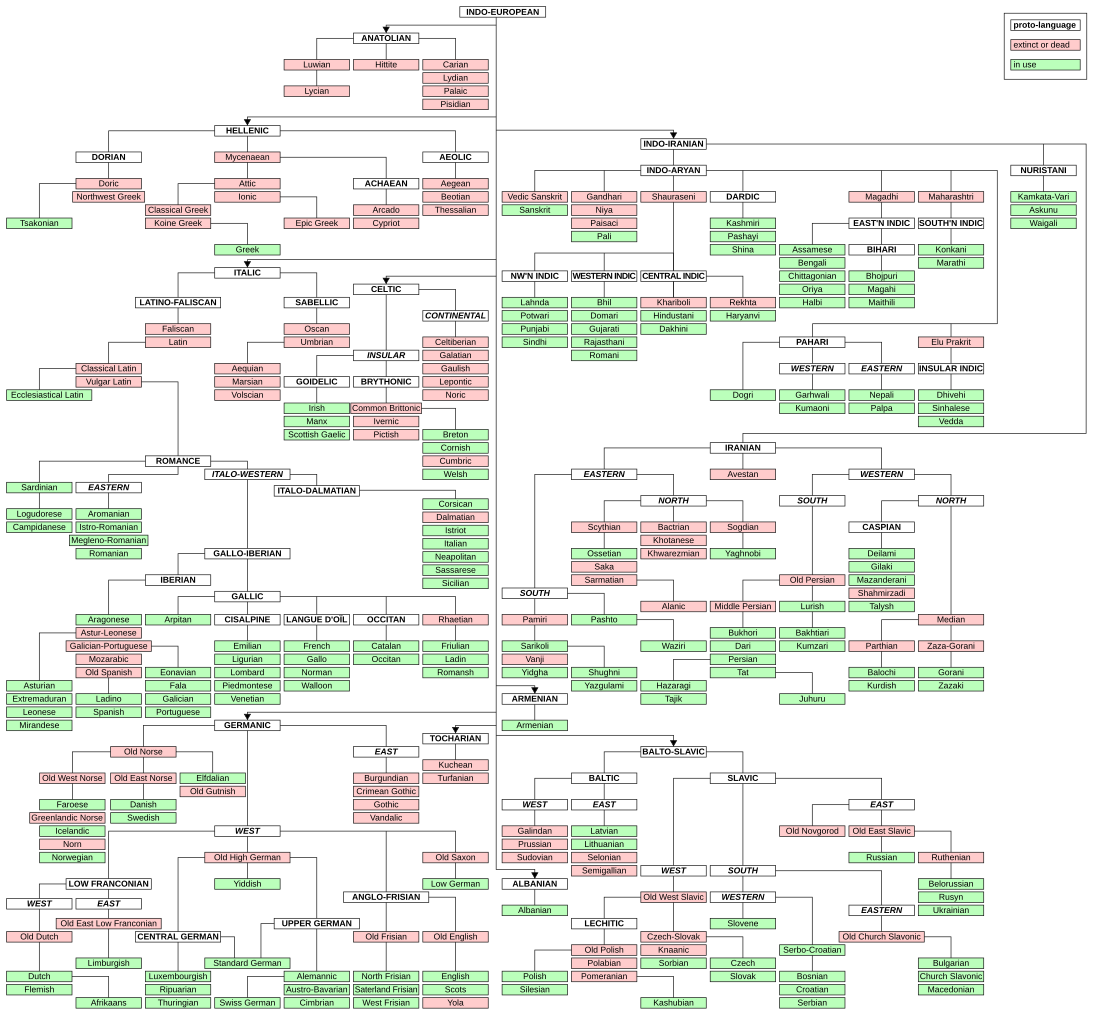
Historical influences on English grammar
Each wave of contact with other peoples and languages left a specific mark on English grammar:
- Germanic invasions (5th–6th centuries): Established Old English with its system of noun cases, gendered nouns, and complex verb endings.
- Christianization of Anglo-Saxon England: Brought Latin into religious and scholarly writing, expanding the vocabulary for abstract and intellectual concepts.
- Viking invasions (8th–11th centuries): Old Norse contributed everyday words (they, sky, egg) and, importantly, helped simplify some of Old English's grammatical complexity. When two similar but not identical languages mix, speakers tend to drop the trickier inflections.
- Norman Conquest (1066): Infused thousands of French words into English, especially in law, government, and cuisine (court, justice, beef). French influence also nudged English syntax in new directions.
- The Renaissance (14th–17th centuries): Revived interest in classical learning brought a flood of Greek and Latin terms into English, particularly in science, medicine, and philosophy.
- The printing press (introduced in England in 1476): Made books widely available for the first time, which accelerated the standardization of spelling and grammar across regions.
- British colonialism: Spread English around the world, leading to distinct varieties and creoles such as Jamaican Patois and Singlish.

Key Figures and Modern Impacts
Key figures in grammatical studies
A handful of scholars shaped how English grammar was described, taught, and argued about:
- Ælfric of Eynsham (c. 955–1010) wrote one of the earliest grammar books in Old English, laying groundwork for the formal study of the language.
- William Bullokar (1531–1609) published the first printed English grammar book in 1586 and pushed for standardized spelling.
- Robert Lowth (1710–1787) wrote a hugely influential prescriptive grammar, meaning he laid down rules for how English should be used. Many traditional rules taught in schools (like "don't end a sentence with a preposition") trace back to Lowth.
- Lindley Murray (1745–1826) authored English Grammar (1795), which became a standard textbook in both British and American schools for decades.
- Henry Sweet (1845–1912) pioneered a descriptive approach, focusing on how people actually used English rather than how they should use it. This was a major shift in thinking.
- Otto Jespersen (1860–1943) produced a comprehensive historical grammar of English, emphasizing how the language evolved and how its structures function.
The difference between prescriptive and descriptive grammar matters here. Prescriptive grammarians (like Lowth) set rules for "correct" usage. Descriptive grammarians (like Sweet) study and document how language is actually spoken and written. Both traditions still influence how grammar is taught today.
Impact of history on modern grammar
All of this history shows up in the English you use every day:
- Simplified inflections: Old English had extensive case endings on nouns and adjectives. Most of those disappeared over time, which is why modern English relies so heavily on word order to convey meaning. "The dog bit the man" means something very different from "The man bit the dog," even though the same words appear.
- Shift from synthetic to analytic structure: Instead of packing grammatical information into word endings (synthetic), English now uses separate words like prepositions and auxiliary verbs (analytic). This is why English has complex verb phrases like has been running or will have finished.
- Auxiliary verb systems: English developed elaborate tense and aspect combinations using helping verbs. Forms like the present perfect (have eaten) and future continuous (will be eating) didn't exist in Old English.
- Prescriptive rules in formal writing: Many "rules" taught in school come from 18th-century grammarians who modeled English on Latin. These rules shaped formal written English, even when they don't reflect how most people naturally speak.
- Massive borrowed vocabulary: English absorbed words and some grammatical patterns from Latin, French, Old Norse, and many other languages. This is why English often has multiple words for the same concept (begin from Germanic, commence from French).
- Dialect variation: Regional and social varieties like African American Vernacular English (AAVE) and Cockney have their own consistent grammatical systems. These aren't "broken" English; they follow distinct, rule-governed patterns.
- Digital-age changes: Texting, social media, and online communication have introduced new conventions like hashtags, acronyms (LOL, FWIW), and compressed sentence structures that continue to push the language forward.
See Fiveable more often in Google
Mark Fiveable as a preferred source and Google is more likely to show you our guides in Top Stories, with a "preferred" badge in AI Mode and AI Overviews.