ACT Science: Scientific Investigation

🎒ACT Review
ACT Science: Scientific Investigation
TL;DR
ACT Science: Scientific Investigation is about optional ACT Science, a 40-minute section with 40 questions total and 34 scored questions. Focus on data, experiments, and evaluating scientific models.
ACT Scientific Investigation
The ACT Science section doesn't test whether you've memorized biology or chemistry facts. It tests whether you can think like a scientist: read data, understand how experiments work, and draw conclusions. Scientific Investigation questions make up a significant chunk of the test, so getting comfortable with these skills pays off.
This guide covers the core concepts you need, strategies for tackling these questions efficiently, and practice problems with explanations.
Concepts to Know
Reading Graphs and Tables
Most ACT Science passages come with graphs, charts, or tables. You need to pull information from them quickly and accurately.
- Line graphs show how a variable changes over time or in response to another variable. Pay attention to the axis labels and units.
- Bar graphs compare quantities across categories. Look for which bar is tallest/shortest and by how much.
- Scatter plots show the relationship between two variables. Look for trends: positive correlation (both increase), negative correlation (one goes up, the other goes down), or no correlation.
- Tables organize numerical data in rows and columns. Scan for patterns like "as column A increases, column B decreases."
Always read the axis labels and column headers first. A common mistake is misreading what a graph actually measures.
Experimental Design
You should know the basic building blocks of a scientific experiment:
- Hypothesis: The prediction being tested.
- Independent variable: The factor the researcher deliberately changes.
- Dependent variable: The factor being measured or observed in response.
- Constants (controlled variables): Everything that stays the same so the test is fair.
- Control group: The baseline group that doesn't receive the experimental treatment.
- Experimental group: The group that receives the treatment or change being studied.
A quick way to keep independent and dependent variables straight: the independent variable is what the scientist chooses to change, and the dependent variable is what depends on that change.
Experimental Errors and Bias
The ACT may ask you to identify flaws in an experiment or explain how errors could affect results.
- Sources of error include measurement mistakes, contamination, or uncontrolled variables that sneak in.
- Bias occurs when something in the experimental design systematically skews results in one direction. For example, if a survey only samples one demographic, the results won't represent the full population.
When a question asks about improving an experiment, think about what wasn't controlled or what could introduce inconsistency.
Tips for Success
Prioritize Graphs and Figures
Many questions can be answered from the data alone, without reading every word of the passage. Go to the graphs and tables first, then refer back to the text only when you need context (like understanding what an experiment was testing).
Read Passages Strategically
Before answering questions, spend about 30 seconds skimming the passage. Note:
- What's being tested
- How many experiments or studies are described
- What the axes/columns represent in the figures
This quick overview saves time because you'll know exactly where to look when questions ask about specific data.
Practice with Variety
The best way to improve is working through many different ACT Science passages. Each one covers a different topic and data format, so exposure to variety builds the flexibility you need on test day.
Types of Questions
Below are ACT-style practice questions. For each one, focus not just on the correct answer but on how you'd find it under time pressure.
Practice Question 1
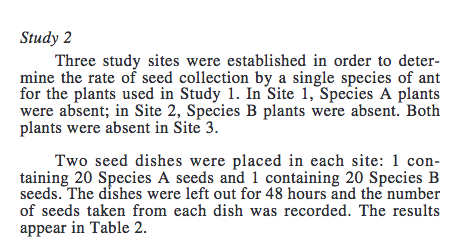
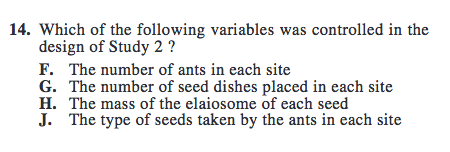
Don't get distracted by unfamiliar scientific terms (like "elaiosomes"). The question asks about a controlled variable, which is something kept constant across all trials. Reading the study description, "Two seed dishes were placed in each site" tells you the number of seed dishes was held constant.
Correct Answer: G.
Practice Question 2
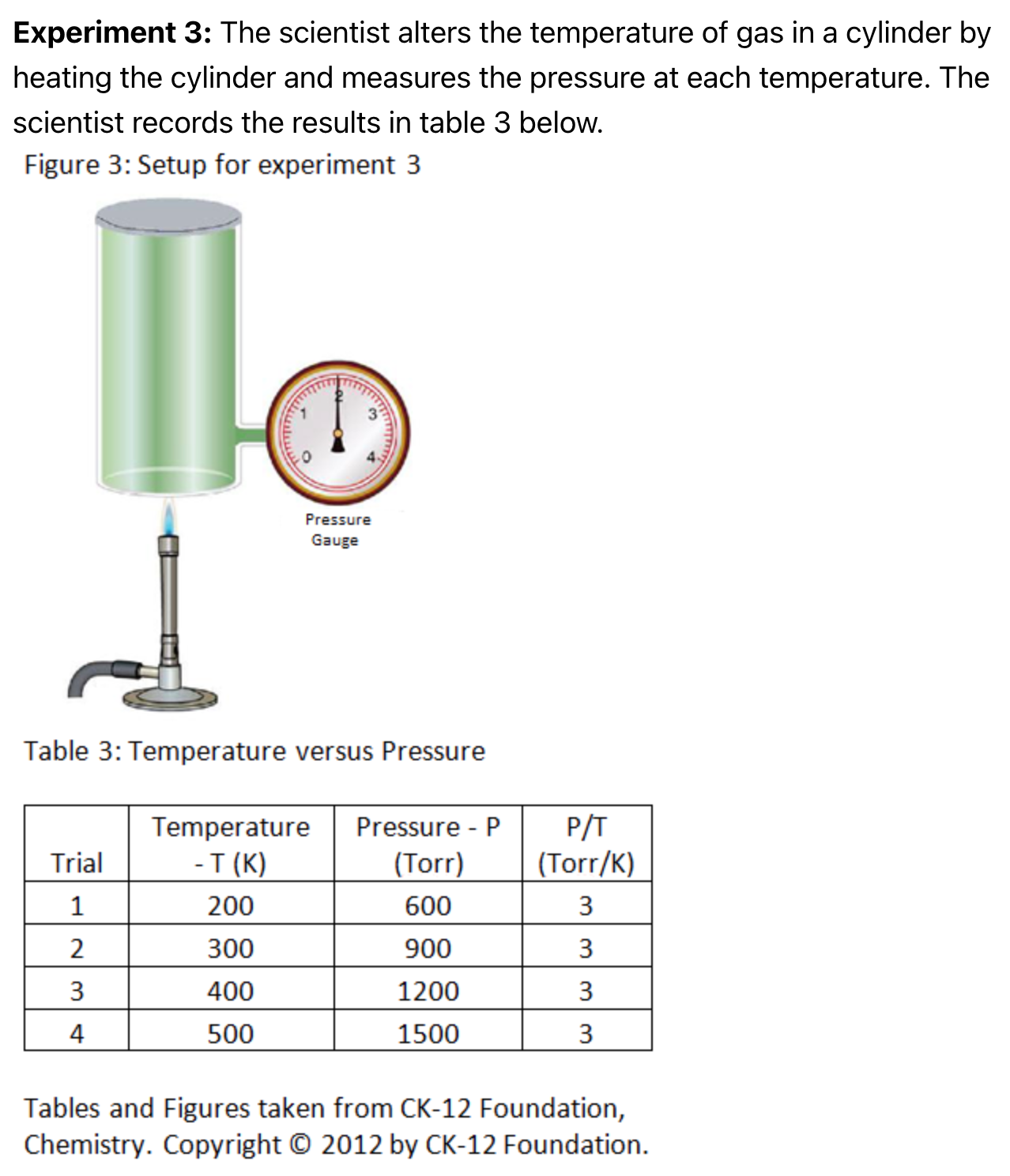
Based on the results of experiment 3, if the pressure of a gas is doubled and the volume and amount of gas in the cylinder are held constant, what will be the impact on temperature?
A. It will stay the same. B. It will double. C. It will be halved. D. It will be quadrupled.
Correct Answer: B. Looking at Table 3, as temperature increases, pressure increases proportionally. With volume and amount of gas held constant, pressure and temperature have a direct (linear) relationship. This reflects Gay-Lussac's Law: . So if pressure doubles, temperature doubles too.
Practice Question 3
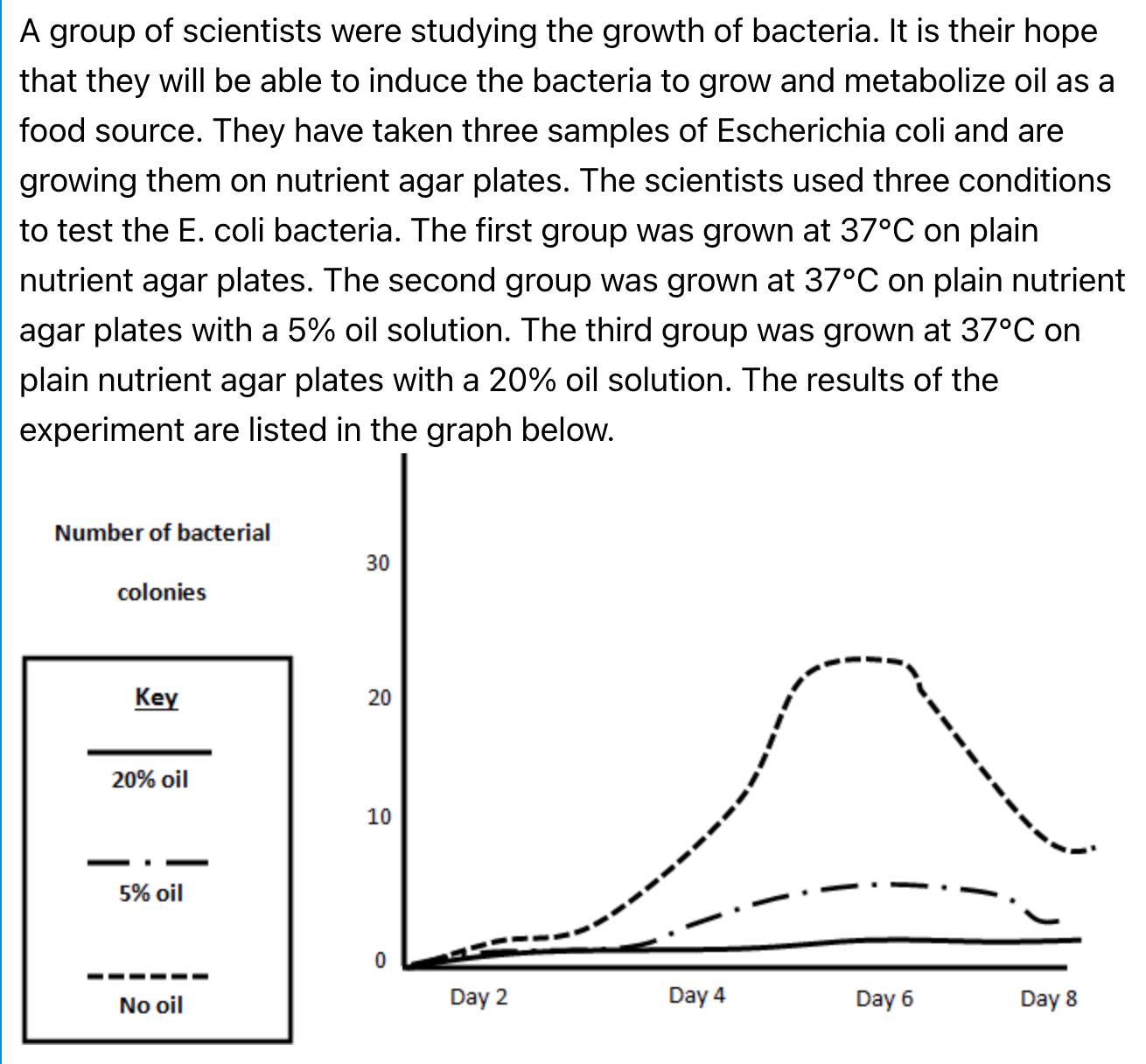
What is the dependent variable in the experiment above?
A. The number of days the bacteria grew. B. The nutrient agar. C. The nutrient agar with the oil. D. The amount of growth of the bacteria.
Correct Answer: D. The dependent variable is what gets measured as a result of the experiment. Here, the researchers are observing how much the bacteria grow in response to different conditions. The amount of bacterial growth is the outcome being measured, making it the dependent variable.
Key Takeaways
- Most ACT Science questions test data interpretation and experimental reasoning, not memorized science facts.
- Always check axis labels, units, and column headers before drawing conclusions from figures.
- Know your variables: independent (what's changed), dependent (what's measured), and controlled (what's kept constant).
- Skim passages for structure first, then dig into details as questions require.
- Consistent practice across different passage types is the most reliable way to improve your score.
See Fiveable more often in Google
Mark Fiveable as a preferred source and Google is more likely to show you our guides in Top Stories, with a "preferred" badge in AI Mode and AI Overviews.