ACT Math: Preparing for Higher Math: Functions

🎒ACT Review
ACT Math: Preparing for Higher Math: Functions
🎒 ACT
ACT Math: Integrating Essential Skills: Modeling
ACT Math: Essential Skills: Data Analysis & Representations 📈
Fiveable's ACT Math Section Overview: What's On It?
ACT Math: Preparing for Higher Math: Algebra
ACT Math: Preparing for Higher Math: Functions
ACT Math: Preparing for Higher Math: Geometry
ACT Math: Preparing for Higher Math: Number and Quantity
ACT Math: Preparing for Higher Math: Statistics & Probability
continue practicing
Multiple choice
TL;DR
Functions make up about 12–15% of ACT Math (roughly 7–9 of the 41 scored questions). You need to handle functions both algebraically—evaluating, solving, interpreting, and formulating—and graphically—graphing, identifying equations, and applying transformations. The ACT Math section has 45 questions total (41 scored) and lasts 50 minutes.
Functions Subtopics
The ACT organizes Functions into two main skill areas:
Definitions, Notations, and Applications of Functions
This is the algebraic side. You'll calculate input and output values, manipulate a function's algebraic form, interpret what parts of a function mean in context, and sometimes build a function from a word problem.
Representing Functions as Graphs
This is the visual side. You'll graph functions on a coordinate plane, identify equations from graphs, and work with transformations (shifts, stretches, reflections). You also need to understand how changing a graph affects the underlying equation, and vice versa.
Definitions, Notations, and Applications of Functions
What You Need to Know
What is a function? A function describes a relationship between inputs and outputs where each input produces exactly one output. If you plug in a value for , you get back one and only one value for .
Types of functions you should recognize:
- Linear (e.g., )
- Polynomial (e.g., )
- Radical (e.g., )
- Exponential (e.g., )
- Logarithmic (e.g., )
- Piecewise (different formulas for different intervals of )
Key skills the ACT tests:
Evaluating a function (finding the output given an input):
- Identify the input value from the problem.
- Replace the input variable (usually ) with that value in the function's formula.
- Compute the result. You should get exactly one output.
Solving a function (finding the input given an output):
- Set the given output value equal to the function's formula.
- Solve for the input variable. You may get more than one answer, since multiple inputs can produce the same output.
Interpreting a function in context: The ACT often wraps functions inside word problems. Ask yourself: what does the input represent? The output? What does the y-intercept mean in this scenario? What about the slope or rate of change?
Formulating a function: Some problems describe a situation in words and ask you to write the matching equation. Translate the relationship piece by piece into math.
Applying Your Knowledge
Interpreting and Evaluating Functions Practice
The number of fish, , in Skipper's Pond at the beginning of each year can be modeled by the equation , where represents the number of years after the beginning of the year 2000. For example, represents the beginning of the year 2000, represents the beginning of the year 2001, and so forth. According to the model, how many fish were in Skipper's Pond at the beginning of the year 2006?
A) 96 B) 192 C) 384 D) 1,458 E) 46,656
Credits: ACT, Inc — Question 7 from Preparing for the ACT Test Guide | 2023–2024
The answer is B) 192.
This problem tests both function evaluation and reading a function in context. The trap here is plugging in directly. But the problem defines as the number of years after 2000, so:
Now plug into the function:
The number of fish at the beginning of 2006 is 192.
Always read carefully how the input variable is defined. The most common mistake on problems like this is using the raw year instead of calculating the correct input.
Formulating Functions Practice
If a publisher charges $15 for the first copy of a book that is ordered and $12 for each additional copy, which of the following expressions represents the cost of books?
F) G) H) J) K)
Credits: ACT, Inc — Question 60 from Preparing for the ACT Test Guide | 2023–2024
The answer is F) 12y + 3.
The key is recognizing that not every book costs the same amount:
- The first book costs $15.
- The remaining books each cost $12.
So the total cost is:
Simplify:
A common mistake is writing for the additional books, forgetting that is the total number of books, not the number of additional books. You need to subtract 1 from to account for the first copy.
Representing Functions as Graphs
What You Need to Know
Graphing functions: You should be familiar with the general shapes of common function types. A linear function is a straight line, a quadratic is a parabola, an exponential curves steeply upward (or downward), and trig functions oscillate in waves. If you're unsure about a graph, plug in a few values of , calculate , and plot the points. A graphing calculator can help here.
Determining an equation from a graph: Look at key features: where does it cross the axes? What's its shape? What's its amplitude or period (for trig functions)? Match those features to the answer choices.
Transformations of graphs: You need to know how algebraic changes to a function affect its graph:
| Transformation | Effect on graph |
|---|---|
| Shifts up units (down if ) | |
| Shifts right units (left if ) | |
| Stretches vertically by factor $$ | |
| Compresses horizontally by factor $$ | |
| Reflects over the x-axis | |
| Reflects over the y-axis |
Applying Your Knowledge
Manipulating Graphs Practice
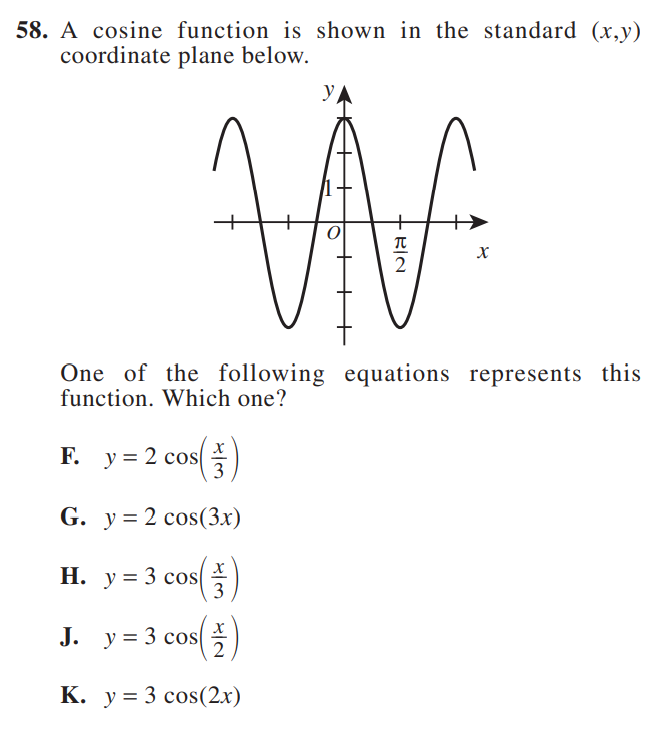
Credits: ACT, Inc — Question 58 from Preparing for the ACT Test Guide | 2023–2024
The answer is K) 3cos(2x).
The standard has an amplitude of 1 and a period of . The graph in the problem has an amplitude of 3 (the wave reaches up to 3 and down to −3) and a period of (one full cycle completes in units).
Here's how those transformations work algebraically:
- Amplitude: Multiplying the function by a constant changes the amplitude to . So has an amplitude of 3.
- Period: Multiplying by a constant changes the period to . For a period of , you need , since . So has a period of .
Combining both: gives amplitude 3 and period , which matches the graph.
When you're stuck on a trig graph problem, identify the amplitude and period from the graph first, then match them to the general form or . You can also plug in a specific -value from the graph into each answer choice to see which one gives the correct -value.
Summary
ACT Math has 45 questions total (41 scored) in 50 minutes. Functions account for roughly 7–9 of those scored questions and fall into two areas:
- Algebraic: evaluating, solving, interpreting, and formulating functions
- Graphical: graphing functions, identifying equations from graphs, and applying transformations
Practice both sides. For trig graphs, always extract amplitude and period before matching to answer choices. For word-problem functions, slow down and confirm exactly what the input variable represents before substituting.
See Fiveable more often in Google
Mark Fiveable as a preferred source and Google is more likely to show you our guides in Top Stories, with a "preferred" badge in AI Mode and AI Overviews.