ACT English: Conventions of Standard English: Punctuation

🎒ACT Review
ACT English: Conventions of Standard English: Punctuation
🎒 ACT
Fiveable's ACT English Section Overview: What's On It?
ACT English: Conventions of Standard English Overview
ACT English: Conventions of Standard English: Sentence Structure and Formation
ACT English: Conventions of Standard English: Punctuation
ACT English: Conventions of Standard English: Usage
ACT English: Knowledge of Language
ACT English: Production of Writing: Organization, Unity, and Cohesion
ACT English: Production of Writing: Topic Development
continue practicing
Multiple choice
TL;DR
ACT English: Conventions of Standard English: Punctuation is about ACT English, the required 35-minute section with 50 questions total and 40 scored questions. Focus on grammar, punctuation, sentence structure, organization, and style.
ACT Punctuation: What You Should Know
Punctuation questions show up frequently on the ACT English section, and they're some of the fastest points you can earn if you know the rules. This guide covers every punctuation mark the ACT tests, the specific patterns the test uses to trip you up, and how to approach these questions strategically.
Punctuation Symbols to Know for the ACT
| Symbol | Name | Function |
|---|---|---|
| : | Colon | To introduce a list, explanation, or elaboration |
| , | Comma | To separate words or phrases and prevent misreading |
| ... | Ellipsis | To suggest an incomplete thought or indicate omitted words |
| — | Em-dash | To show a break in thought or emphasize information |
| ! | Exclamation mark | To mark the end of an exclamation |
| . | Period | To mark the end of a declarative sentence |
| ? | Question mark | To mark the end of a question |
| " " | Quotation marks | To show direct speech or exact quotes |
| ; | Semicolon | To connect two independent clauses without a conjunction |
Ending Punctuation
Exclamation Marks
An exclamation mark (!) conveys strong emotion, surprise, or emphasis. On the ACT, exclamation marks rarely appear as correct answers because academic writing favors a neutral tone. If you see one in an answer choice, be skeptical unless the sentence clearly demands strong emotion.
- Wow! That was an amazing performance.
- I can't believe it!
Question Marks
A question mark (?) signals that a sentence is asking a question. Watch out for indirect questions on the ACT. A sentence like She asked whether he was coming is a statement about a question, not a question itself, so it ends with a period.
- Did you finish your homework?
- What time does the concert start?
Periods
A period (.) ends a declarative sentence or a simple command. Every sentence needs closing punctuation. On the ACT, a period and a semicolon both create a full stop between two independent clauses, so they often function the same way in answer choices.
- She went to the store to buy some groceries.
- The sun sets in the west.
Mid-Sentence Punctuation
Colons
A colon (:) introduces what follows: a list, an explanation, or an elaboration. The key rule is that a complete independent clause must come before the colon. If the words before the colon can't stand alone as a sentence, the colon is wrong.
- There are three primary colors: red, blue, and yellow.
- Remember this famous quote: "To be or not to be, that is the question."
A common ACT trap: placing a colon after a verb or preposition. The colors are: red, blue, and yellow is incorrect because "The colors are" isn't a complete thought.
Em-Dashes
An em-dash (—) signals a break in thought or emphasizes information within a sentence. It can replace commas, parentheses, or colons for a stronger pause. On the ACT, em-dashes often appear in pairs to set off non-essential information, just like a pair of commas would.
If you open with an em-dash, you need to close with one (unless the interruption ends the sentence). You can't mix an em-dash with a comma.
- The hiker finally reached the mountaintop—after days of exhausting travel.
- The professor—known for his expertise in quantum physics—will be giving a lecture.
Apostrophes: Possessives and Contractions
Possessives
An apostrophe (') shows ownership. Placement depends on whether the owner is singular or plural:
- Singular possessive: Add 's. The dog's collar is blue. (one dog)
- Plural possessive (regular plural): Add just an apostrophe after the s. The students' notebooks are over there. (multiple students)
- Plural possessive (irregular plural): Add 's. The children's toys were scattered everywhere.
Contractions
An apostrophe also marks where letters have been removed in a contraction. The ACT loves testing the difference between possessive pronouns and contractions:
- it's = it is. its = belonging to it.
- they're = they are. their = belonging to them. there = a place.
- who's = who is. whose = belonging to whom.
If you can substitute "it is" or "who is" into the sentence and it still makes sense, use the apostrophe version.
- I can't attend the party. (can't = cannot)
- It's raining outside. (it's = it is)
Lists and Series
Commas
Commas (,) are the most heavily tested punctuation mark on the ACT. Here are the major comma rules you need to know:
- Separating items in a list: She bought apples, oranges, and bananas.
- Before a coordinating conjunction joining two independent clauses: He studied hard, and he passed the exam.
- After introductory phrases: In addition, we need to consider other factors.
- After conjunctive adverbs: She was late; however, she still managed to catch the train. (Note the semicolon before "however" and the comma after it.)
- Around non-essential appositives: My brother, a talented musician, will perform tonight.
The biggest comma mistake the ACT tests is the comma splice: using a comma alone to connect two independent clauses. A comma by itself can never join two complete sentences. You need a comma + coordinating conjunction, a semicolon, or a period.
Semicolons
A semicolon (;) connects two related independent clauses without a conjunction. Both sides of the semicolon must be able to stand alone as complete sentences. The ACT tests this rule constantly.
Semicolons also separate items in a list when those items already contain commas. This prevents confusion:
- She loves hiking; he prefers swimming.
- The participants included Mary, a lawyer; John, a doctor; and Lisa, a teacher.
- The weather was gloomy; however, the atmosphere was cheerful.
Showing Speech
Quotation Marks
Quotation marks (" ") enclose a person's exact words. On the ACT, pay attention to where commas and periods go relative to quotation marks. In American English, commas and periods always go inside the closing quotation mark.
- She said, "I'll meet you at the park at 3 o'clock."
- "I will be late," Sarah replied. "I have a dentist appointment."
Connecting Independent Clauses with a Conjunction
A comma paired with a coordinating conjunction joins two independent clauses. The coordinating conjunctions are FANBOYS: for, and, nor, but, or, yet, so. You need both the comma and the conjunction. A conjunction alone (no comma) or a comma alone (no conjunction) won't work.
- She loves painting, and he enjoys playing the guitar.
- The rain started pouring, so we decided to stay indoors.
Introductory Phrases and Clauses
When a sentence begins with an introductory word, phrase, or dependent clause, place a comma after it to separate it from the main clause. This signals the shift from setup to main idea.
- After finishing her work, she went for a walk.
- In the morning, we usually go jogging.
Modifying Phrases and Clauses
Commas set off non-essential (also called non-restrictive) modifying phrases and clauses. If you can remove the phrase and the sentence still makes sense and keeps its core meaning, it's non-essential and needs commas. If removing it changes which specific thing you're talking about, it's essential and gets no commas.
- The dog, wearing a blue collar, barked loudly. (non-essential: we already know which dog)
- The book, which was recommended by my teacher, turned out to be fascinating. (non-essential detail)
ACT Punctuation: Types of Questions to Expect
The ACT tests punctuation in predictable patterns. Here are some practice questions that reflect what you'll see on test day.
Practice Question 1
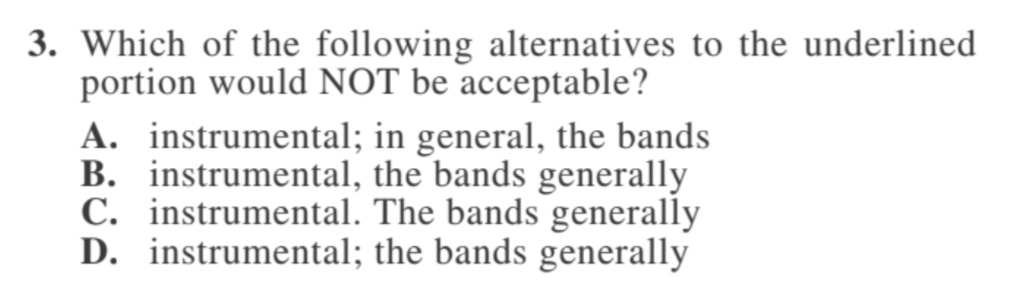
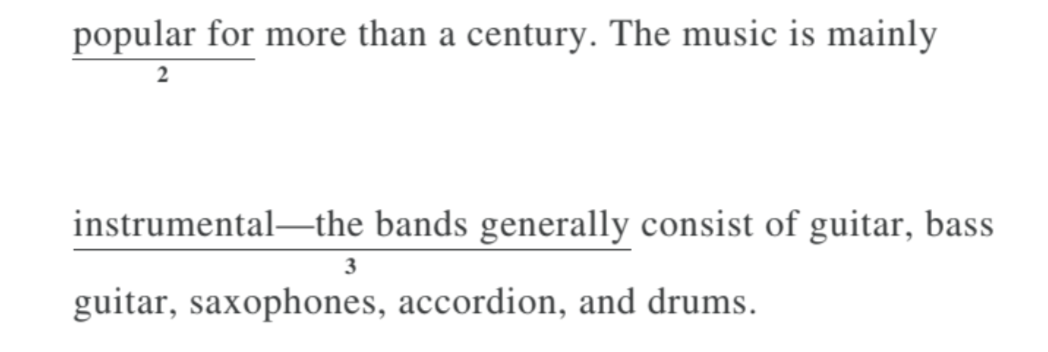
Image Courtesy of ACT, Inc Preparing for the ACT Booklet.
Correct Answer: B. The question asks which choice would NOT be acceptable. A useful ACT shortcut: if a period and a semicolon both create the same sentence split, they're doing the same job, so you can usually eliminate both as equivalent options. Option B creates a run-on sentence by failing to properly separate two independent clauses.
Practice Question 2
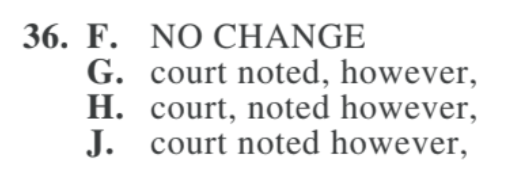

Image Courtesy of ACT, Inc Preparing for the ACT Booklet.
Correct Answer: G. Option G correctly uses commas on both sides of "however" to set it off as an interrupter. When "however" appears in the middle of a clause as a transitional word, it needs a comma before and after it.
Practice Question 3
Choose the grammatically correct sentence.
A. The trip to the amusement park was exhilarating—full of thrilling rides and delicious food.
B. The trip to the amusement park was exhilarating full of thrilling rides and delicious food.
C. The trip to the amusement park was exhilarating; full of thrilling rides and delicious food.
D. The trip to the amusement park was exhilarating: full of thrilling rides and delicious food.
Correct Answer: A. The em-dash creates a strong break that introduces the elaborating detail. Option B has no punctuation at all, creating a run-on. Option C fails because "full of thrilling rides and delicious food" is not an independent clause, so a semicolon can't be used. Option D is tempting, but the colon requires a complete independent clause before it, and some grammarians would accept it here. However, the em-dash is the strongest and clearest choice.
Practice Question 4
Choose the grammatically correct sentence.
A. The recipe listed the ingredients: flour, sugar, eggs, and vanilla.
B. The recipe listed the ingredients are flour, sugar, eggs, and vanilla.
C. The recipe listed the ingredients; flour, sugar, eggs, and vanilla.
D. The recipe listed the ingredients flour, sugar, eggs, and vanilla.
Correct Answer: A. The colon correctly introduces the list. "The recipe listed the ingredients" is a complete independent clause, so the colon works. Option B creates a grammatically broken sentence. Option C misuses a semicolon (what follows isn't an independent clause). Option D lacks any punctuation to introduce the list.
ACT Punctuation: Tips and Tricks
- ✏️ Know the independent clause test. Most ACT punctuation questions come down to one thing: is each part of the sentence an independent clause? Periods, semicolons, and comma + FANBOYS all require independent clauses on both sides. Colons require one before. If you can identify independent clauses quickly, you'll answer these questions fast.
- 🔍 Watch for matching pairs. If a non-essential phrase is set off by a comma on one side, it needs a comma on the other side too. Same goes for em-dashes. The ACT loves removing one of the pair to create an error.
- 📚 Read the whole sentence. Don't just look at the underlined portion. The punctuation before and after the underlined section affects which answer is correct. Context determines everything.
Wrapping Up
Punctuation questions are among the most rule-based on the ACT English section, which means they're very learnable. Focus on mastering independent clauses, comma rules, and the colon/semicolon distinction. Once those click, you'll move through these questions quickly and accurately.
See Fiveable more often in Google
Mark Fiveable as a preferred source and Google is more likely to show you our guides in Top Stories, with a "preferred" badge in AI Mode and AI Overviews.