9.2 QR Decomposition

🧚🏽♀️Abstract Linear Algebra I Unit 9 Review
9.2 QR Decomposition
🧚🏽♀️ Abstract Linear Algebra I
QR decomposition is a powerful tool that breaks down matrices into simpler parts. It's like taking apart a complex machine to understand how it works. This technique is closely tied to the Gram-Schmidt process, which helps create a set of perpendicular vectors.
By using QR decomposition, we can solve tricky math problems more easily. It's especially handy for dealing with systems of equations and finding the best-fit solutions. Think of it as a Swiss Army knife for tackling various linear algebra challenges.
QR Decomposition

Top images from around the web for Concept and Relation to Gram-Schmidt Process
Linear Algebra/Gram-Schmidt Orthogonalization - Wikibooks, open books for an open world View original
Is this image relevant?
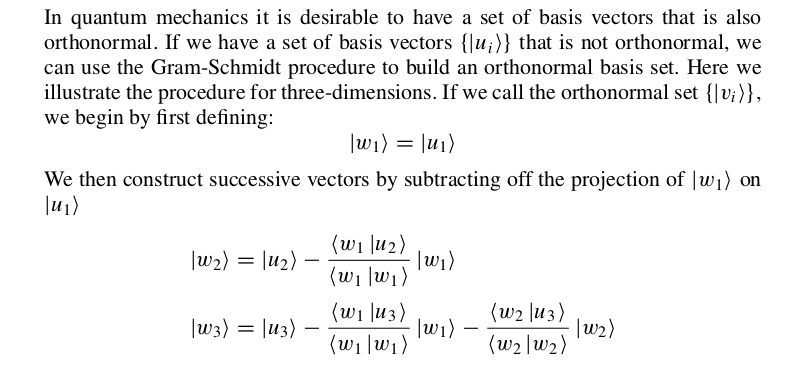
vector spaces - Orthonormal Sets and the Gram-Schmidt Procedure - Mathematics Stack Exchange View original
Is this image relevant?
Linear Algebra/Gram-Schmidt Orthogonalization - Wikibooks, open books for an open world View original
Is this image relevant?
vector spaces - Orthonormal Sets and the Gram-Schmidt Procedure - Mathematics Stack Exchange View original
Is this image relevant?
Concept and Relation to Gram-Schmidt Process
- QR decomposition factorizes a matrix A into an orthogonal matrix Q and an upper triangular matrix R, such that A = QR
- The Gram-Schmidt process constructs an orthonormal basis from a set of linearly independent vectors
- QR decomposition can be computed using the Gram-Schmidt process by:
- Orthonormalizing the columns of the matrix A to form the matrix Q
- Calculating the upper triangular matrix R using the orthonormal basis
- The columns of Q form an orthonormal basis for the column space of A
- The matrix R represents the coordinates of the columns of A with respect to the orthonormal basis formed by the columns of Q
Applications
- QR decomposition is useful in various applications:
- Solving linear systems
- Least-squares problems
- Eigenvalue computations
- QR decomposition provides a numerically stable method for solving these problems
- It avoids potential issues such as ill-conditioning that may arise in other methods (normal equations)
QR Decomposition with Gram-Schmidt
Performing QR Decomposition
- To perform QR decomposition using the Gram-Schmidt process:
- Initialize the first column of Q as the normalized first column of A
- For each subsequent column of A:
- Subtract its projection onto the previous orthonormal vectors from itself
- Normalize the resulting vector to obtain the corresponding column of Q
- Calculate the entries of the upper triangular matrix R as the dot products of the original columns of A with the corresponding orthonormal vectors in Q
- The Gram-Schmidt process ensures that the columns of Q are orthonormal (orthogonal to each other and have unit length)
- The resulting matrices Q and R satisfy the equation A = QR, where Q is an orthogonal matrix and R is an upper triangular matrix
Example
- Consider the matrix A =
- Applying the Gram-Schmidt process:
- The first column of Q is
- The second column of Q is
- The third column of Q is
- The resulting orthogonal matrix Q is
- The upper triangular matrix R is
- A = QR holds true for this decomposition
Properties of QR Decomposition

Uniqueness and Existence
- QR decomposition is unique for a given matrix A if the diagonal entries of R are chosen to be positive
- The orthogonal matrix Q in the QR decomposition is not unique, as it can be multiplied by an orthogonal matrix from the right without changing the decomposition
- If A has full column rank, then the QR decomposition exists and is unique (up to the sign of the diagonal entries of R)
Orthonormality and Rank
- The columns of Q form an orthonormal basis for the column space of A
- The rows of Q^T form an orthonormal basis for the row space of A
- The rank of A is equal to the number of non-zero diagonal entries in R
- This property can be used to determine the dimension of the column space and the null space of A
- The orthonormality of Q and the upper triangular structure of R provide useful properties for various applications
Applications of QR Decomposition
Solving Linear Systems
- QR decomposition can be used to solve linear systems of the form Ax = b:
- Compute the QR decomposition of A
- Solve the equivalent system Rx = Q^T b using back-substitution
- This approach is particularly useful for overdetermined systems (more equations than unknowns)
- QR decomposition provides a numerically stable method for solving linear systems
Least-Squares Problems
- For overdetermined systems, QR decomposition can be used to find the least-squares solution
- The least-squares solution minimizes the Euclidean norm of the residual vector
- The least-squares solution can be obtained by solving the normal equations (A^T A)x = A^T b
- QR decomposition can efficiently solve the normal equations
- QR decomposition avoids the potential ill-conditioning of the normal equations, making it a preferred method for solving least-squares problems
- When A has full column rank, the least-squares solution obtained using QR decomposition is unique and minimizes the Euclidean norm of the residual vector
Example
- Consider the overdetermined system Ax = b, where A = and b =
- Computing the QR decomposition of A:
- Q =
- R =
- Solving Rx = Q^T b:
- Q^T b =
- Back-substitution yields x =
- The least-squares solution is x = , which minimizes the Euclidean norm of the residual vector
See Fiveable more often in Google
Mark Fiveable as a preferred source and Google is more likely to show you our guides in Top Stories, with a "preferred" badge in AI Mode and AI Overviews.