3.2 Matrix Representation of Linear Transformations

🧚🏽♀️Abstract Linear Algebra I Unit 3 Review
3.2 Matrix Representation of Linear Transformations
🧚🏽♀️ Abstract Linear Algebra I
Matrix representation of linear transformations is a powerful tool in linear algebra. It allows us to convert abstract transformations into concrete matrices, making calculations easier. This connection between transformations and matrices is key to understanding how linear algebra works in practice.
By representing transformations as matrices, we can use matrix operations to study and manipulate them. This approach lets us solve complex problems in linear algebra, from finding eigenvalues to analyzing systems of equations, all through the lens of matrices.
Matrices for Linear Transformations

Top images from around the web for Definition and Representation
linear algebra - Understanding rotation matrices - Mathematics Stack Exchange View original
Is this image relevant?
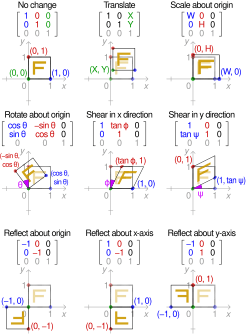
Transformation matrix - Wikipedia View original
Is this image relevant?
Matrix (mathematics) - Wikipedia View original
Is this image relevant?
linear algebra - Understanding rotation matrices - Mathematics Stack Exchange View original
Is this image relevant?
Transformation matrix - Wikipedia View original
Is this image relevant?
Definition and Representation
- A linear transformation from a vector space to a vector space preserves vector addition and scalar multiplication
- Every linear transformation can be represented by a matrix with respect to a choice of bases for the domain and codomain
- The matrix representation of a linear transformation with respect to bases for and for is the matrix such that for any vector in , , where denotes the coordinate vector of with respect to the basis
Matrix Dimensions and Entries
- The dimensions of the matrix are determined by the dimensions of the codomain (number of rows) and the domain (number of columns) of the linear transformation
- The entries of the matrix are determined by the images of the basis vectors of under the linear transformation
- For example, if and the standard basis vectors and are mapped to and , then the matrix representation of with respect to the standard bases is:
Matrix Representations of Transformations
Finding the Matrix Representation
- To find the matrix representation of a linear transformation with respect to bases for and for , first determine the images of each basis vector in under the transformation
- Express each image as a linear combination of the basis vectors in , where is the -th basis vector in
- For instance, if and , where and are basis vectors in , then the columns of the matrix representation are and
- The coefficients of these linear combinations form the columns of the matrix , with the -th column corresponding to the image of the -th basis vector in

Resulting Matrix
- The resulting matrix is the matrix representation of the linear transformation with respect to the chosen bases and
- In the previous example, the matrix representation of with respect to bases and is:
Transformations from Matrices
Uniqueness of Linear Transformation
- Given a matrix and bases for a vector space and for a vector space , there exists a unique linear transformation such that is the matrix representation of with respect to the bases and
Finding the Linear Transformation
- To find the linear transformation corresponding to a matrix , let be an arbitrary vector in and express it as a linear combination of the basis vectors in
- Multiply the matrix by the coordinate vector to obtain the coordinate vector of the image with respect to the basis
- For example, if and in the standard basis of , then and:
- The linear transformation is defined by mapping each vector in to its image obtained through matrix multiplication

Matrix Multiplication vs Composition
Composition of Linear Transformations
- Given linear transformations and , the composition of these transformations, denoted by , is a linear transformation from to defined by for all in
Matrix Representations of Compositions
- Let be the matrix representation of with respect to bases for and for , and let be the matrix representation of with respect to bases for and for
- To prove that the matrix representation of with respect to bases and is the product , consider an arbitrary vector in and its coordinate vector
- Show that by using the definitions of matrix representations and matrix multiplication
- For instance, if and , then:
Conclusion
- Conclude that the matrix representation of the composition with respect to bases and is the product of the matrix representations of and , in that order
- This relationship between matrix multiplication and composition of linear transformations allows for the study of linear transformations using matrix algebra
See Fiveable more often in Google
Mark Fiveable as a preferred source and Google is more likely to show you our guides in Top Stories, with a "preferred" badge in AI Mode and AI Overviews.