2.4 Finite-Dimensional Vector Spaces

🧚🏽♀️Abstract Linear Algebra I Unit 2 Review
2.4 Finite-Dimensional Vector Spaces
🧚🏽♀️ Abstract Linear Algebra I
Finite-dimensional vector spaces are the building blocks of linear algebra. They have a finite basis, making them easier to work with than their infinite counterparts. Understanding these spaces is key to grasping the concepts of linear independence, bases, and dimension.
In this part, we'll explore how to identify finite-dimensional spaces, find their bases, and calculate their dimensions. We'll also see how these concepts relate to linear transformations and matrices, giving us powerful tools for solving real-world problems.
Finite-dimensional Vector Spaces
Definition and Properties
- A vector space is finite-dimensional if it has a finite basis, which is a linearly independent subset of that spans
- Example: The vector space is finite-dimensional with a basis
- The dimension of a finite-dimensional vector space is the number of vectors in any basis of the vector space, and this number is the same for all bases of the vector space
- Example: The dimension of is 3, regardless of the choice of basis
- Every finite-dimensional vector space over a field is isomorphic to the vector space for some positive integer , where is the dimension of the vector space
- Example: The vector space of polynomials of degree at most 2, , is isomorphic to
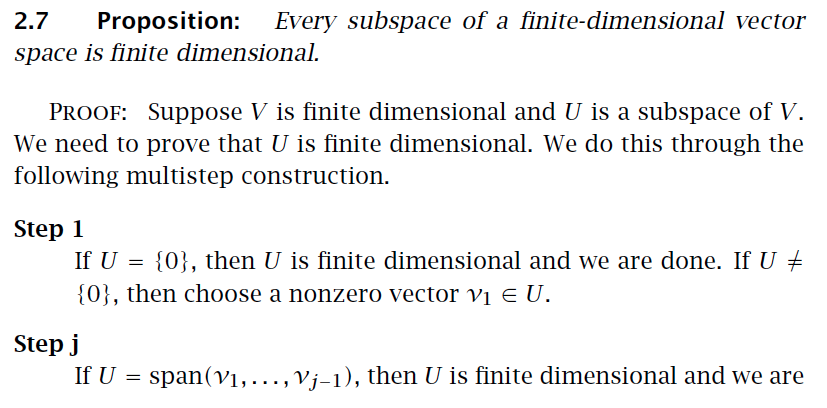
- Every subspace of a finite-dimensional vector space is also finite-dimensional, and its dimension is less than or equal to the dimension of the original vector space
- Example: The subspace of consisting of vectors with is finite-dimensional with dimension 2
- Any two finite-dimensional vector spaces over the same field with the same dimension are isomorphic
- Example: The vector space of 2x2 matrices, , is isomorphic to
Topology and Completeness
- Finite-dimensional vector spaces have a well-defined topology induced by any norm, making them complete metric spaces
- Example: The Euclidean norm on induces a topology that makes a complete metric space
- In a finite-dimensional vector space, every Cauchy sequence converges to a point in the space
- Example: In , the sequence converges to
Proving Finite Dimensionality
Sufficient Conditions
- To prove that a vector space is finite-dimensional, it is sufficient to find a finite subset of that spans
- Example: To prove that the vector space of polynomials of degree at most , , is finite-dimensional, observe that the set spans
- Alternatively, one can prove that every linearly independent subset of is finite, which implies that has a finite basis and is, therefore, finite-dimensional
- Example: To prove that the vector space of continuous functions on the interval , , is not finite-dimensional, show that the set is linearly independent
Relation to Other Vector Spaces
- If a vector space has a finite spanning set, then any linearly independent subset of can be extended to a basis of , which must be finite
- Example: If spans a vector space , and is linearly independent in , then can be extended to a basis of by adding appropriate vectors from
- If a vector space is spanned by a subset of a finite-dimensional vector space , then is also finite-dimensional, and its dimension is less than or equal to the dimension of
- Example: If is a subspace of , then is finite-dimensional, and
Implications of Finite Dimensionality
Bases and Spanning Sets
- In a finite-dimensional vector space, every linearly independent set can be extended to a basis, and every spanning set contains a basis
- Example: In , the linearly independent set can be extended to a basis by adding , and the spanning set contains the basis
- The dimension of a finite-dimensional vector space is well-defined and unique, regardless of the choice of basis
- Example: The dimension of the vector space of 2x2 matrices, , is 4, regardless of the choice of basis
Linear Transformations and Matrices
- Every linear transformation between finite-dimensional vector spaces can be represented by a matrix, and the dimension of the domain and codomain determine the size of the matrix
- Example: A linear transformation from to can be represented by a 2x3 matrix
- The rank-nullity theorem holds for linear transformations between finite-dimensional vector spaces, stating that the dimension of the kernel plus the dimension of the image equals the dimension of the domain
- Example: For a linear transformation ,

Linear Independence, Bases, and Dimension
Determining Linear Independence and Dependence
- Determine whether a given set of vectors in a finite-dimensional vector space is linearly independent or linearly dependent by solving a homogeneous system of linear equations
- Example: To determine if the set is linearly independent in , solve the equation for . If the only solution is , the set is linearly independent; otherwise, it is linearly dependent
- A set of vectors is linearly independent if and only if the only linear combination of the vectors that equals the zero vector is the trivial combination (i.e., all coefficients are zero)
- Example: The set in is linearly independent because the equation has only the trivial solution
Finding Bases and Coordinates
- Find a basis for a finite-dimensional vector space by starting with a spanning set and removing linearly dependent vectors or by extending a linearly independent set until it spans the vector space
- Example: To find a basis for the subspace of spanned by , start with this spanning set and remove linearly dependent vectors until a linearly independent set remains, such as
- Express a vector in a finite-dimensional vector space as a linear combination of basis vectors using the unique coordinates with respect to that basis
- Example: Given the basis for a subspace of , express the vector in as a linear combination of the basis vectors:
- Calculate the dimension of a finite-dimensional vector space by finding the number of vectors in any basis
- Example: The dimension of the subspace spanned by in is 3, as the given spanning set is a basis for
Linear Transformations and Their Properties
- Determine whether a given linear transformation between finite-dimensional vector spaces is injective, surjective, or bijective based on the dimensions of the kernel and image
- Example: For a linear transformation , if and , then is surjective but not injective, and thus not bijective
- Use the rank-nullity theorem to compute the dimension of the kernel or image of a linear transformation, given the dimension of the other
- Example: For a linear transformation , if , then by the rank-nullity theorem
See Fiveable more often in Google
Mark Fiveable as a preferred source and Google is more likely to show you our guides in Top Stories, with a "preferred" badge in AI Mode and AI Overviews.