3.1 Definition and Properties of Linear Transformations

🧚🏽♀️Abstract Linear Algebra I Unit 3 Review
3.1 Definition and Properties of Linear Transformations
🧚🏽♀️ Abstract Linear Algebra I
Linear transformations are functions between vector spaces that preserve addition and scalar multiplication. They're crucial in understanding how vectors behave under different operations, forming the backbone of linear algebra and its applications in various fields.
This section dives into the definition, properties, and examples of linear transformations. We'll learn how to identify and compose them, exploring their unique characteristics and how they relate to other concepts in linear algebra.
Linear Transformations: Definition and Properties

Top images from around the web for Definition and Key Concepts
Linear algebra - Wikipedia View original
Is this image relevant?
Transformation matrix - Wikipedia View original
Is this image relevant?
Vectors in Three Dimensions · Calculus View original
Is this image relevant?
Linear algebra - Wikipedia View original
Is this image relevant?
Transformation matrix - Wikipedia View original
Is this image relevant?
Definition and Key Concepts
- A linear transformation (also known as a linear map or linear operator) is a function from one vector space to another vector space that preserves the operations of vector addition and scalar multiplication
- For any vectors and in and any scalar , a linear transformation satisfies two properties: (additivity) and (homogeneity)
- The domain of a linear transformation is the vector space , and the codomain is the vector space
- The image of , denoted or , is the subset of consisting of all vectors that are outputs of
- The kernel (or null space) of a linear transformation , denoted or , is the set of all vectors in such that , where is the zero vector in
- A linear transformation maps the zero vector of to the zero vector of , i.e.,
Properties and Uniqueness
- Additivity: For any vectors and in the domain , preserves vector addition
- Homogeneity: For any vector in and any scalar , preserves scalar multiplication
- Preservation of the zero vector: , where on the left is the zero vector in and on the right is the zero vector in
- Uniqueness: A linear transformation is uniquely determined by its action on a basis of the domain vector space

Identifying Linear Transformations
Verifying Linearity
- To prove that a function is a linear transformation, verify that it satisfies the additivity and homogeneity properties for any vectors and in the domain and any scalar
- To show that a function is not a linear transformation, find a counterexample where either the additivity or homogeneity property fails to hold
- Common non-linear functions include absolute value, quadratic (), exponential (), and logarithmic () functions
- When working with functions between vector spaces of matrices or polynomials, the additivity and homogeneity properties must hold for matrix addition and multiplication or polynomial addition and multiplication, respectively

Examples of Linear Transformations
- The identity transformation , defined by for all in , is a linear transformation
- The zero transformation , defined by for all in , where is the zero vector in , is a linear transformation
- The projection onto the -axis , defined by , is a linear transformation
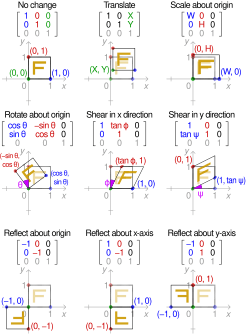
- The rotation by an angle in , defined by , is a linear transformation
Composing Linear Transformations
Composition and Linearity
- The composition of two linear transformations is a new linear transformation
- If and are linear transformations, then their composition , defined by , is also a linear transformation
- To prove that the composition of two linear transformations is linear, let and be vectors in and be a scalar
- Show that by using the linearity of and separately
- Show that by using the linearity of and separately
Properties of Composition
- The composition of linear transformations is associative: for linear transformations , , and
- For any linear transformation , and , where is the identity transformation on the appropriate vector space ( or )
- The composition of a linear transformation with the zero transformation results in the zero transformation: and , where is the zero transformation on the appropriate vector space
See Fiveable more often in Google
Mark Fiveable as a preferred source and Google is more likely to show you our guides in Top Stories, with a "preferred" badge in AI Mode and AI Overviews.