7.3 Double-Angle and Half-Angle Identities
Updated March 2026Fiveable Content Team

🔺Trigonometry Unit 7 Review
7.3 Double-Angle and Half-Angle Identities
🔺 Trigonometry
Unit 7 – Trigonometric Identities
Double-angle identities let you express trigonometric functions of 2θ in terms of θ. They're super handy for simplifying complex expressions and solving tricky equations. You'll use these a lot in trig, so get comfy with them!
Half-angle identities do the opposite, expressing trig functions of θ/2 in terms of θ. These are great for dealing with radicals and solving equations. Remember, the sign of your answer depends on which quadrant the angle's in.
Double-Angle Identities
Double-angle formulas for trigonometric functions
- expresses double angle in terms of single angle sine and cosine
- Cosine double-angle offers three equivalent forms:
- utilizes difference of squares
- eliminates sine term
- eliminates cosine term
- relates double angle tangent to single angle tangent
- Derivation methods involve sum formulas and Pythagorean identity
- Applications include simplifying complex expressions (trigonometric ratios) and solving equations (finding angle values)
Half-Angle Identities
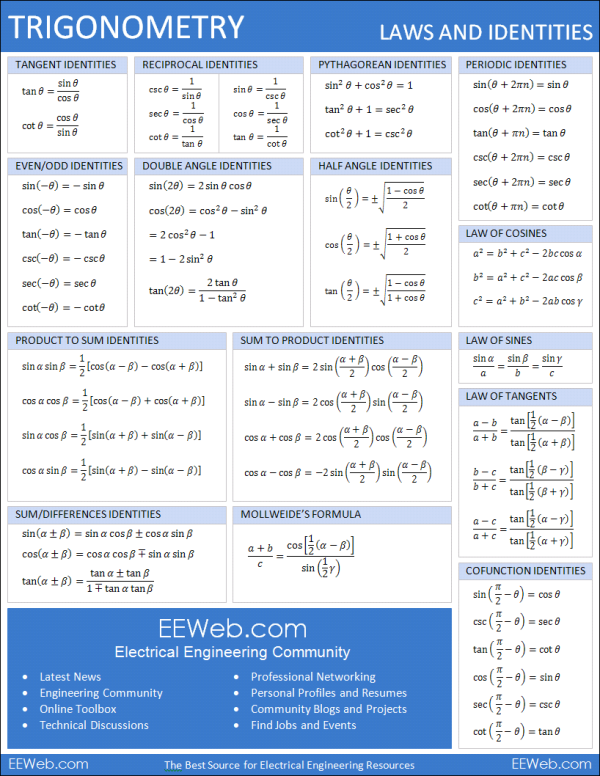
Half-angle formulas for trigonometric functions
- expresses half-angle sine in terms of cosine
- relates half-angle cosine to full angle cosine
- Tangent half-angle offers three equivalent forms:
- uses both positive and negative roots
- eliminates square root
- alternative form without square root
- Derivation methods use double-angle formulas and algebraic manipulation
- Sign selection depends on angle quadrant (positive in quadrants I and II, negative in III and IV)
Simplification with angle identities
- Strategies involve identifying identity opportunities and choosing most appropriate
- Common techniques include substituting double-angle formulas (reducing powers) and applying half-angle formulas (simplifying radicals)
- Verification requires checking domain restrictions (avoiding undefined values) and confirming equivalence (graphing or evaluating)
Equations using angle identities
- Strategies involve recognizing patterns matching formulas and substituting identities
- Solution methods:
- Algebraically manipulate equation
- Factor to isolate trigonometric term
- Solve resulting quadratic equations
- Verification includes checking solution ranges (0 to 2π or -π to π) and eliminating extraneous solutions
- Real-world applications found in physics (projectile motion) and engineering (signal processing)
See Fiveable more often in Google
Mark Fiveable as a preferred source and Google is more likely to show you our guides in Top Stories, with a "preferred" badge in AI Mode and AI Overviews.