15.1 Health and Well-being

🎠Social Psychology Unit 15 Review
15.1 Health and Well-being
🎠 Social Psychology
Health Psychology Fundamentals

Top images from around the web for Understanding Health Psychology and the Biopsychosocial Model
Multidimensional Approaches to Understanding Mental Illness | Abnormal Psychology View original
Is this image relevant?
Biopsychosocial model - Wikipedia View original
Is this image relevant?
Introduction to Health Psychology | Boundless Psychology View original
Is this image relevant?
Multidimensional Approaches to Understanding Mental Illness | Abnormal Psychology View original
Is this image relevant?
Biopsychosocial model - Wikipedia View original
Is this image relevant?
Understanding Health Psychology and the Biopsychosocial Model
Health psychology studies how psychological factors influence health, illness, and healthcare. It covers a wide range of goals: promoting healthy behavior, preventing and treating illness, and improving healthcare systems.
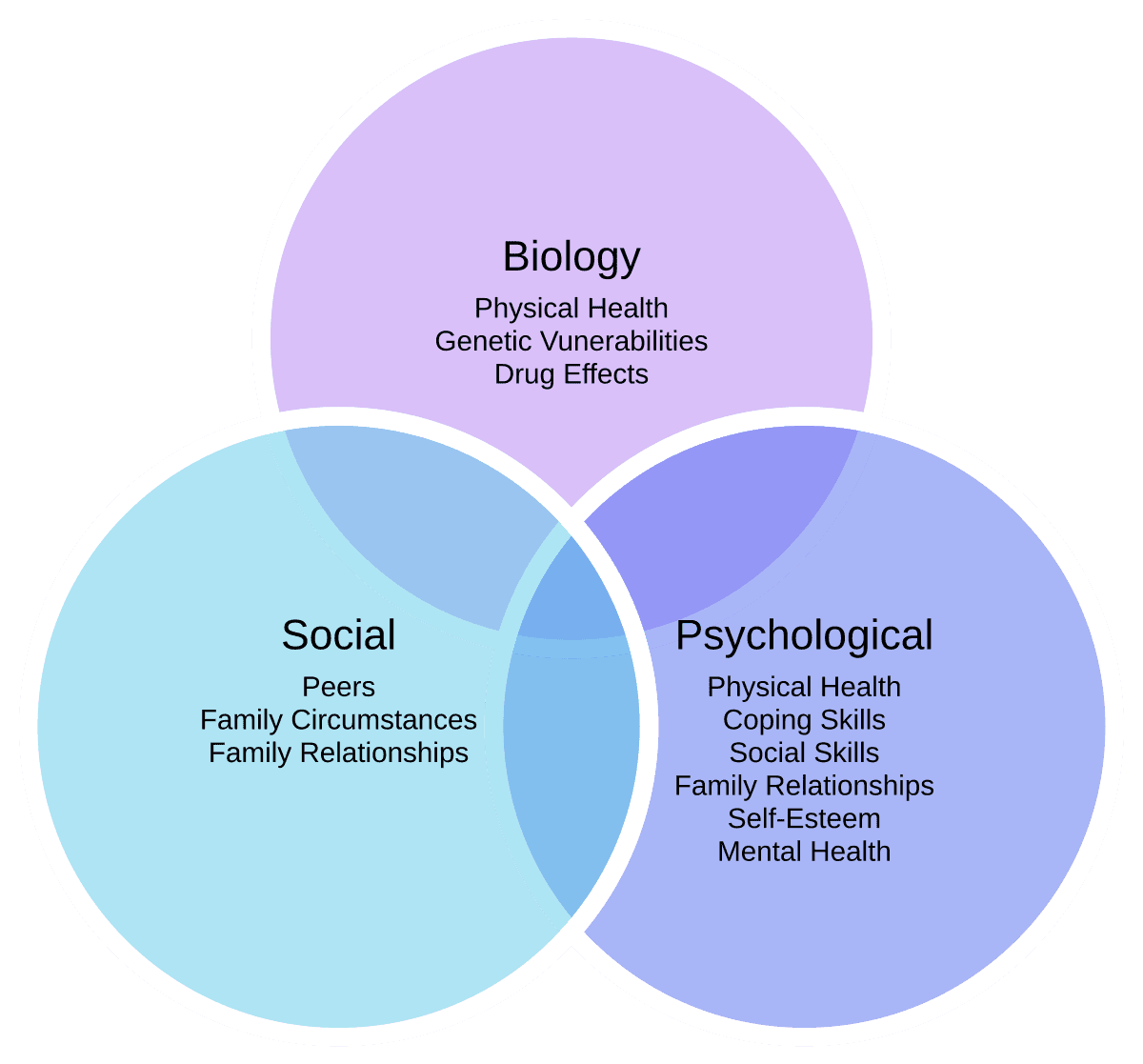
The dominant framework in health psychology is the biopsychosocial model, which says that health outcomes result from the interaction of three types of factors:
- Biological factors — genetics, physiology, immune system function
- Psychological factors — emotions, beliefs, stress levels, and behaviors
- Social factors — relationships, cultural norms, and socioeconomic status
The key idea here is that these three categories don't operate in isolation. They constantly influence each other. Consider chronic pain: the biological damage matters, but so do a patient's beliefs about their pain (psychological) and whether they have a supportive family or access to care (social). Treatment that addresses only one dimension often falls short.
This model replaced the older biomedical model, which treated health as purely a biological matter. The biopsychosocial approach gives a much more complete picture of why people get sick and what helps them recover.
Health Behaviors and Quality of Life
Health behaviors are the actions people take that affect their health, for better or worse. Diet, exercise, sleep habits, and substance use all fall into this category.
These behaviors don't happen in a vacuum. They're shaped by personal beliefs (e.g., "exercise won't really help me"), social norms (e.g., drinking culture among peers), and environmental factors (e.g., whether your neighborhood has safe places to walk). That's why changing health behaviors is harder than just telling someone what to do.
- Positive health behaviors like regular physical activity reduce disease risk and improve well-being. People who exercise 150+ minutes per week have significantly lower rates of cardiovascular disease and depression.
- Negative health behaviors like smoking or excessive alcohol use increase illness risk and shorten life expectancy. Smoking alone accounts for roughly 480,000 deaths per year in the U.S.
Quality of life refers to a person's overall well-being and life satisfaction. It encompasses physical health, psychological state, social relationships, and environment. Researchers measure it through self-report questionnaires (like the SF-36) and objective health indicators. Health psychologists design interventions and lifestyle modifications aimed at improving quality of life across all these dimensions.

Stress, Coping, and Social Support
Understanding Stress and Coping Mechanisms
Stress is the psychological and physiological response to perceived threats or challenges. Two important distinctions:
- Acute stress is a short-term reaction to an immediate stressor, like giving a speech or narrowly avoiding a car accident.
- Chronic stress results from prolonged exposure to stressors, like ongoing financial hardship or a demanding caregiving role. Chronic stress is far more damaging to long-term health.
Stress affects the body through a specific biological pathway:
- The brain perceives a threat and activates the hypothalamic-pituitary-adrenal (HPA) axis.
- This triggers the release of stress hormones, primarily cortisol and adrenaline.
- These hormones increase heart rate, blood pressure, and blood sugar to prepare for action.
- If the stress response stays activated over time, it suppresses immune function, increases inflammation, and raises the risk of cardiovascular disease.
Coping mechanisms are the strategies people use to manage stress. They fall into two broad categories:
- Problem-focused coping targets the source of stress directly. If you're stressed about a deadline, making a study schedule is problem-focused coping.
- Emotion-focused coping targets your emotional reaction to the stressor. Practices like mindfulness meditation or talking through your feelings with a friend fall here.
Neither type is inherently better. Problem-focused coping works well when you have some control over the situation. Emotion-focused coping is more useful when the stressor is outside your control (like grieving a loss).
Maladaptive coping strategies, like substance abuse or avoidance, may reduce stress temporarily but tend to make things worse over time.

Social Support and Its Impact on Health
Social support is the emotional, informational, and practical assistance you receive from others. It comes in three main forms:
- Emotional support — empathy, care, and reassurance (a friend listening after a bad day)
- Instrumental support — tangible help and services (a neighbor driving you to a doctor's appointment)
- Informational support — advice, guidance, and useful knowledge (a peer explaining how to navigate insurance paperwork)
Social support has well-documented health benefits. It buffers against the effects of stress, enhances immune function, and improves cardiovascular health. People with strong social networks have lower rates of depression and anxiety and are more likely to stick with medical treatments.
The stress-buffering hypothesis explains one reason why: social support doesn't necessarily improve health on its own, but it protects you when stress hits. Someone facing a major life stressor with a strong support network will typically fare much better than someone facing the same stressor alone.
Sources of social support include family, friends, coworkers, and organized support groups. Health psychologists study how to strengthen these networks, especially for people who are socially isolated or managing chronic illness.
Healthcare and Health Promotion
Health Promotion Strategies and Interventions
Health promotion focuses on empowering individuals and communities to take control of their health. Rather than just treating disease after it appears, health promotion aims to prevent disease, prolong life, and support physical and mental well-being.
It works through several approaches:
- Health education programs — structured efforts to teach specific skills, like smoking cessation workshops that combine information about health risks with behavioral strategies for quitting
- Community-based interventions — programs embedded in everyday settings, like workplace wellness programs that offer exercise facilities or stress management training
- Public health campaigns — large-scale messaging efforts, like vaccination awareness campaigns that use media to shift public behavior
Two concepts are central to effective health promotion. Health literacy is a person's ability to find, understand, and use health information to make good decisions. Low health literacy is surprisingly common and is linked to worse health outcomes. Social determinants of health are the broader conditions (income, education, housing, neighborhood safety) that shape health behaviors and access to care. Effective health promotion targets both individual behavior and these structural factors.
Programs are evaluated through outcome measures (did health improve?) and cost-benefit analyses (was the intervention worth the resources?).
Patient-Provider Communication and Health Disparities
Good communication between patients and healthcare providers is one of the strongest predictors of positive healthcare experiences. Effective patient-provider communication involves:
- Clear exchange of information in both directions
- Shared decision-making, where the provider and patient collaborate on treatment plans
- Building trust and rapport
When communication works well, patients are more satisfied, more likely to follow treatment plans, and achieve better health outcomes. Common barriers include language differences, low health literacy, cultural beliefs about medicine, and time pressure during appointments. Health psychologists work to train providers in communication skills that address these barriers.
Health disparities are differences in health outcomes across population groups. These are not random. They result from a complex mix of social, economic, and environmental factors, including:
- Unequal access to healthcare (rural communities may lack nearby providers)
- Differences in quality of care received (studies show racial and ethnic minorities often receive less aggressive treatment for the same conditions)
- Variation in exposure to environmental health risks
Factors like race, ethnicity, socioeconomic status, and geographic location all predict health disparities. For example, life expectancy in the U.S. can vary by more than 20 years between the wealthiest and poorest counties.
Addressing these disparities requires action at multiple levels:
- Policy interventions — expanding healthcare access through insurance reform or funding community health centers
- Community-based programs — culturally tailored health education that respects and works within a community's values
- Research — identifying root causes and testing solutions that target structural inequities, not just individual behavior
See Fiveable more often in Google
Mark Fiveable as a preferred source and Google is more likely to show you our guides in Top Stories, with a "preferred" badge in AI Mode and AI Overviews.