
👋 Overview: Standard English Conventions
The SAT Writing and Language section tests your ability to recognize and fix errors in grammar, sentence structure, and punctuation. Standard English Conventions makes up a significant chunk of these questions, so getting comfortable with the rules here can seriously boost your score.
This section breaks down into three main categories:
- ✏️ Sentence Structure
- 📓 Conventions of Usage
- ⁉️ Conventions of Punctuation
This guide covers each category with explanations, strategies, and sample questions.
✏️ Sentence Structure
Sentence structure questions ask you to spot problems with how a sentence is built and choose the best fix. Here are the main features the SAT targets:
- Completion of a sentence: The sentence should be complete, not a fragment or a run-on.
- Parallel structure: When a sentence repeats a pattern (especially in a list), that pattern should stay consistent.
- Modifier placement: Modifiers like adjectives, adverbs, and descriptive phrases need to sit close to whatever they're describing.
- Verb tense consistency: Verb tenses (past, present, future) should stay consistent within a sentence or passage unless there's a reason to shift.
- Pronoun consistency: Pronouns should match in number and person throughout a sentence.
Most of these are fairly intuitive, but parallel structure and modifier placement trip people up the most. Here's a closer look at both.
🔄 Parallel Structure
Parallel structure means keeping a consistent grammatical pattern within a sentence, especially in lists or paired phrases. It makes sentences flow smoothly and sound natural.
Example of correct parallel structure:
Mina likes jogging, biking, and hiking around her neighborhood.
All three verbs are in the gerund form (ending in "-ing"), so the list flows naturally.
Example of broken parallel structure:
Mina likes jogging, to bike, and hiking around her neighborhood.
"To bike" breaks the pattern. It sounds clunky because it doesn't match the other two items.
Parallel structure questions often show up when a sentence contains a list, especially a list of verbs or actions. If you see a list in the passage, check whether every item follows the same grammatical form.
📚 Modifier Placement
Modifiers are words or phrases that describe another part of the sentence. Adjectives and adverbs are the most common, but longer phrases can act as modifiers too.
You don't need to memorize every type of modifier for the SAT. What matters is recognizing when a modifier is too far from the word it describes, which creates confusion.
The general rule: Keep modifiers as close as possible to the noun or phrase they modify.
Compare these two sentences:
Writing quickly, Cooper tried to finish his test before his time ran out.
Writing quickly, before time ran out, Cooper tried to finish his test.
The first sentence is clearer. "Writing quickly" sits right next to "Cooper," so you immediately know who was writing quickly. In the second sentence, the extra phrase between the modifier and the noun muddies the meaning.
When a modifier is placed next to the wrong noun, it's called a misplaced modifier. When the noun it's supposed to modify is missing entirely, it's a dangling modifier. Both show up on the SAT.
❄️ Strategies for Sentence Structure Questions
Use ICE to remember these key steps:
- 👁 Identify what the question is testing. Is it about parallel structure? Verb tense? Modifiers? Narrowing your focus helps you zero in on the relevant part of the sentence.
- ✅ Check each answer choice by reading it into the sentence. Listen for which option sounds the smoothest and follows correct grammar.
- 🔍 Examine the surrounding text for patterns. If the rest of the paragraph uses past tense, the underlined portion probably should too. If a list uses a certain verb form, the missing item should match.
📝 Sentence Structure: Practice Questions
Sentence Structure Question 1

Image and Question Courtesy of Khan Academy
Answer: D) their
- Identify 👁: This is a pronoun consistency question. The pronoun we need to evaluate is "it's."
- Examine 🔍: The sentence is talking about ice and snow not being able to reflect the Sun's rays due to soot. "Ice and snow" is plural.
- Check ✅: Since the pronoun needs to be plural and possessive, we need "their." D is the only choice that gives us a correctly spelled plural possessive pronoun.
Sentence Structure Question 2
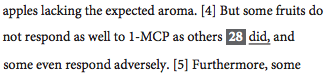
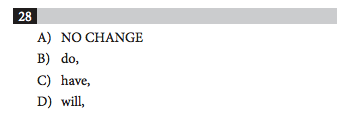
Images Courtesy of Khan Academy
Answer: B
- Identify 👁: This is a verb tense consistency question.
- Examine 🔍: The other verbs in the sentence use present tense.
- Check ✅: Pick the answer choice that matches present tense. That's B.
📓 Conventions of Usage
This category is a catch-all for grammar rules beyond sentence structure. Here's what it covers:
- Pronoun clarity: Making sure it's obvious which noun a pronoun refers to. If "they" could refer to two different groups, the sentence needs to be rewritten.
- Possessives vs. contractions: Telling apart words like its vs. it's, their vs. they're, and your vs. you're. The apostrophe version is always the contraction. If you have trouble with these, check out this resource.
- Agreement: Subjects and verbs must agree in number. Pronouns must match the nouns they replace. Nouns in the same sentence must agree with each other.
- Frequently confused words: Homophones like affect/effect, than/then, and cite/site/sight show up regularly. For a list of common ones, check this out.
- Logical comparisons: Comparisons must be between two like things (apples to apples, not apples to people).
- Conventional expression: Choosing the phrasing that follows standard English idiom, even when multiple options are technically grammatical.
Here's a deeper look at a few of these.
🧩 Pronoun Clarity
Pronoun clarity means making sure every pronoun clearly points to one specific noun. The SAT will test this by giving you sentences where a pronoun could refer to more than one thing, or where it has no clear reference at all.
Example with multiple possible antecedents:
⛅️ Omar, Rachel, and Chris always got along well. Omar and Chris are cousins, and they are siblings.
Who are "they"? It could be Chris and Rachel, or Omar and Rachel. The pronoun is ambiguous.
☀️ Omar, Rachel, and Chris always got along well. Omar and Chris are cousins, and Rachel and Chris are siblings.
Replacing the pronoun with specific names makes the meaning clear.
Example with no antecedent:
⛅️ On Nina's birthday, they threw her a huge surprise party.
Who is "they"? There's no noun in the sentence for it to refer to.
☀️ On Nina's birthday, her friends threw her a huge surprise party.
Now the sentence makes sense. When you see these questions, identify what noun the pronoun is supposed to refer to, then pick the answer that makes that connection unmistakable.
🔗 Agreement
Agreement covers subject-verb, noun-noun, and pronoun-noun matching. Here's an example of each type.
Subject-Verb Agreement
✅ Liza likes going to the beach.
"Liza" is singular, so the verb "likes" (third-person singular) is correct.
❌ Liza like going to the beach.
The verb form doesn't match the singular subject.
Strategy: Strip away extra phrases between the subject and verb. Sometimes the SAT buries the subject under prepositional phrases or parenthetical info to make it harder to spot the mismatch.
Noun-Noun Agreement
❌ Samar and Macy want to be athlete.
Two people, but "athlete" is singular. It should be plural.
✅ Samar and Macy want to be athletes.
Pronoun-Noun Agreement
❌ Kiersten and Ryan liked to decorate her shared room.
"Her" is singular and only refers to one person. Two people need a plural pronoun.
✅ Kiersten and Ryan liked to decorate their shared room.
Although SAT examples will be more complex, the approach stays the same: identify the subject, then check that verbs and pronouns match it in number.
⚖️ Logical Comparison
Logical comparison questions test whether a sentence compares two things that are actually comparable.
Incorrect:
I prefer my grandma's food to my aunt.
This compares food to a person, which doesn't make sense.
Correct:
I prefer my grandma's food to my aunt's food.
I prefer my grandma's food to my aunt's.
Both versions compare food to food. The second works because "aunt's" implies "aunt's food."
To approach these questions:
- Identify 👁 what two things are being compared and what quality is being measured.
- Check ⚖️ whether the sentence structure actually compares those two things, or whether it accidentally compares mismatched items.
🍀 Strategies for Conventions of Usage
Before the exam:
- 👀 Review common grammar rules that appear on the SAT, like subject-verb agreement and commonly confused homophones. Focus your study time on the concepts that give you the most trouble rather than trying to cover everything.
- 😉 Create personal mnemonics for rules you keep forgetting. Even a silly one can stick.
- 💭 Practice with targeted questions on the specific grammar concepts you struggle with.
During the exam:
- 🤔 Read each answer choice into the sentence and listen for which one sounds most natural and grammatically correct.
- ✍🏼 If you have a quick memory trick for a tricky grammar rule, jot it down on your scratch paper at the start of the test so you can reference it later.
📝 Conventions of Usage: Practice Questions
Conventions of Usage Question 1
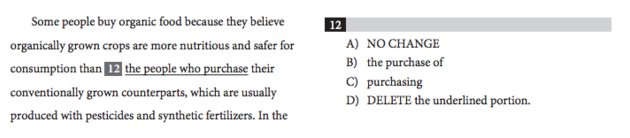
Image Courtesy of Khan Academy
This is a logical comparison ⚖️ question. The sentence is comparing the safety of organically grown crops to conventionally grown crops.
Once you identify the comparison, check which answer choice makes it the clearest. Deleting the mention of purchasing conventionally grown crops streamlines the comparison. The answer is D.
Conventions of Usage Question 2

Image Courtesy of Khan Academy.
Read the full sentence first. The phrase "to be" sounds awkward here, even though it's technically grammatical. Look at the closest verb: "serves." The standard English idiom is "serves as," not "serves to be."
The correct answer is B.
This is a conventional expression question. Every answer choice might be technically grammatical, but you need to pick the one that follows standard English phrasing. Trust your ear, but also look for common verb-preposition pairings.
Conventions of Usage Question 3

Image Courtesy of Khan Academy.
Read the sentence and focus on the area around the underlined portion. The sentence describes a scientist using software to search through social media for specific phrases. Two clues help narrow the answer:
- The word after "social media" should refer to a website (that's "site," not "sight" or "cite").
- The phrase "in search..." takes the preposition "of."
The only answer meeting both requirements is B, "site in search of."
The correct answer is B.
Reviewing common homophones before the exam can help you answer questions like these more quickly and confidently.
⁉️ Conventions of Punctuation
Punctuation questions test whether you can correctly use (or remove) punctuation marks in a sentence. Here are the main topics:
- Ending punctuation: Using the right mark to end a sentence (periods, question marks, exclamation points).
- Mid-sentence punctuation: Correctly using commas, colons, semicolons, and dashes within a sentence.
- Apostrophes for possessives: Knowing when an apostrophe shows possession vs. when a word is simply plural (no apostrophe needed).
- Lists and series: Using the right punctuation to separate items in a list.
- Nonessential information: Setting off extra information with commas, dashes, or parentheses, and recognizing when information is essential and shouldn't be set off.
- Unnecessary punctuation: Removing punctuation that doesn't belong.
Here's a closer look at three of these.
⏸ Mid-Sentence Punctuation
Different punctuation marks serve different purposes within a sentence:
- Commas:
- Join two independent clauses when paired with a FANBOYS conjunction (for, and, nor, but, or, yet, so)
- Follow introductory phrases
- Separate two adjectives modifying the same noun
- Set off appositive phrases (extra info about a noun)
- Colons:
- Introduce a list, example, or explanation
- What comes before the colon must be a complete sentence
- Semicolons:
- Connect two independent clauses without a conjunction
- Separate list items that already contain commas (see below)
- Dashes:
- Emphasize what follows
- Set aside examples or nonessential information
- Ellipses:
- Indicate omitted text in a quote
- Create a pause in dialogue
🗒 Lists and Series
Two types of punctuation show up in lists:
- Commas separate items in a standard list.
- Ex. I like chocolate cake, vanilla ice cream, and cherry soda.
- Semicolons separate items when the items themselves already contain commas. This prevents confusion about where one item ends and the next begins.
- Ex. Each of my siblings has a career in healthcare: John, nurse; Lisa, doctor; and Alex, PA.
- Ex. She wants to visit Seoul, South Korea; Kyoto, Japan; and Bangkok, Thailand.
Only commas and semicolons are used to separate list items. Don't fall for answer choices that use colons or dashes between items in a list.
Identify 👁 whether the list items already contain commas. If they do, you need semicolons to separate them. If they don't, use commas.
✚ Nonessential and Unnecessary Punctuation
Nonessential information is anything you could remove from a sentence without breaking its meaning. This extra info needs to be separated from the rest of the sentence with punctuation.
Here's how to tell the difference:
Known for its food and history, Italy has had a worldwide cultural impact.
The opening phrase is nonessential. Remove it, and the sentence still works:
Italy has had a worldwide cultural impact. ✅
But remove the main clause, and you're left with a fragment:
Known for its food and history. ❌
To test whether information is essential or nonessential, try reading the sentence without it. If the sentence is still complete and makes sense, the information is nonessential and needs to be set off with punctuation.
Rules for punctuating nonessential information:
- If the nonessential info is at the beginning or end of a sentence, you only need one punctuation mark (usually a comma).
- Ex. Although I do like cheese, I could not finish eating seventeen bowls of macaroni and cheese.
- Ex. Emma ended up failing her driving test**, despite having studied for hours.**
- If the nonessential info is in the middle of a sentence, you need two matching punctuation marks around it.
- Ex. Vlad III**, also known as Vlad the Impaler,** was a ruler of Walachia in the 15th century.
- Ex. Mary I of England (nicknamed Bloody Mary) was Catholic.
The key word is matching. If you open with a comma, you close with a comma. If you open with a dash, you close with a dash. Mixing them (comma on one side, dash on the other) is always wrong.
💡 Strategies for Punctuation Questions
- Before the exam: Review the rules for commas, semicolons, colons, and apostrophes. These are the punctuation marks that appear most often. Focus on whichever ones give you trouble.
- During the exam: Read the sentence in context before looking at answer choices. Use process of elimination to rule out options that break punctuation rules you know.
🧠 Conventions of Punctuation Practice Questions
Conventions of Punctuation Question 1
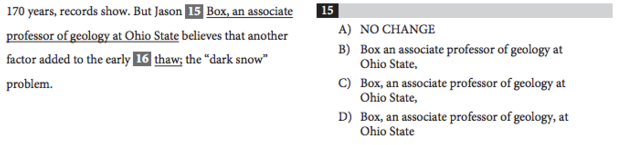
Image Courtesy of Khan Academy.
- Read the sentence and identify the question type. There's nonessential information about Jason Box in the middle of the sentence. This is an "extra info" punctuation question.
- Remember: nonessential info in the middle of a sentence needs two matching punctuation marks around it. If you remove the section inside the punctuation, the sentence should still read smoothly.
- Check the answer choices. C is the only answer that uses two matching punctuation marks and correctly separates all the nonessential information.
The correct answer is C.
Conventions of Punctuation Question 2

Image Courtesy of Khan Academy.
Read the sentence and work through it with process of elimination:
- "One of it's" doesn't work because "it's" means "it is," giving you "one of it is tiniest." You need the possessive "its." This eliminates A and D.
- Next, look at the punctuation after the underlined section. A semicolon connects two independent clauses, but "the Thorne Miniature Rooms" can't stand alone as a complete sentence. So a semicolon doesn't work here. This eliminates B.
The correct answer is C.
Process of elimination is especially useful for punctuation questions. Even if you're unsure which answer is right, you can often rule out two or three that are clearly wrong.
Conventions of Punctuation Question 3

Image Courtesy of Khan Academy.
Read the sentence and identify what's happening: you need to pick the right punctuation to separate items in a list.
- Commas are the standard separator for list items, as long as the items themselves don't contain commas. None of these list items have internal commas, so commas are correct. This eliminates A and B (which use semicolons).
- Between C and D: In D, "and" is set off with commas on both sides, but you only need one comma before the conjunction in a list.
The correct answer is C.
💥 Conclusion
That covers the three main categories of Standard English Conventions on the SAT Writing and Language section. A few final reminders:
- Always read the full sentence (and surrounding sentences) before jumping to the answer choices.
- Use process of elimination. Even partial knowledge of a grammar rule can help you cross off wrong answers.
- Review the grammar rules that trip you up most. A little targeted practice goes a long way.
- Trust your ear, but verify with the rules. If an answer "sounds right" and follows the grammar, you're in good shape.