
🤗 Overview: Expression of Ideas
Expression of Ideas is one of the core skill areas tested in the SAT Writing and Language section. These questions focus on the rhetorical side of writing: whether a passage's ideas are well-developed, logically organized, and expressed with the right words.
There are three key elements in this category:
- 👩🎨 Developing ideas: Adding, revising, or removing details to achieve the writer's purpose.
- 🗂 Organizing ideas: Arranging sentences and paragraphs so the passage flows logically.
- 📑 Using language effectively: Choosing words and sentence structures that fit the passage's meaning and tone.
This guide covers each element with strategies and worked examples so you know exactly what to expect on test day.
👩🎨 Development of Ideas
Development questions ask how ideas can be strengthened, clarified, or supported within a passage. You'll be asked to decide whether to add or delete information, choose the best supporting detail, or interpret data from a graph.
Four main question types fall under this category:
- 📋 Proposition — These ask you to evaluate or revise the central claims and ideas of a passage so they're expressed effectively.
- 🏋️♀️ Support — These ask you to choose the detail or example that best supports an idea already in the text.
- 🔬 Focus — These ask you to add, change, or delete information to keep the passage on topic and improve clarity.
- 📊 Quantitative Information — These ask you to read a graph or table and select the answer choice that accurately reflects the data.
Strategies for Development questions:
- Identify main ideas first. Before you even look at the question, note what the passage is about. This makes it much easier to judge which details belong and which don't.
- Eliminate answers that stray from the main ideas. If a choice introduces something unrelated to the passage's focus, cross it off.
- For keep/delete questions, try reading the relevant section both with and without the sentence in question. Does removing it leave a gap, or does it actually tighten the paragraph?
- For graph questions, read the title, axis labels, and units carefully before looking at the answer choices. Many wrong answers reference data that simply isn't on the graph.
📋 Development: Proposition
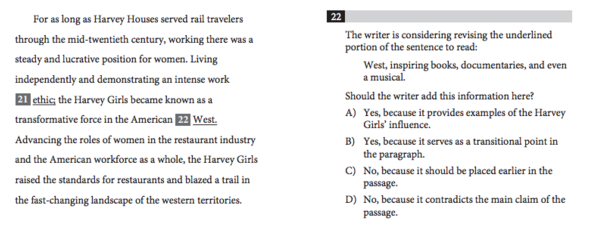
Image Courtesy of Khan Academy
Answer: A
Start by identifying the passage's main ideas:
- The Harvey Girls advanced the roles of American women in the workforce and restaurant industry.
- The Harvey Girls had a major impact on the American West.
The question asks whether to add a sentence about the Harvey Girls inspiring books, documentaries, and a musical. That detail supports the idea that they had a large cultural impact, so the sentence should be added. Eliminate choices C and D.
Between A and B, choice A is stronger because it specifically connects the added detail to the Harvey Girls' influence, which ties directly to the passage's main argument.
🏋️♀️ Development: Support

Image Courtesy of The College Panda
Answer: A
The passage's main ideas:
- Liberal arts education is increasingly seen as less practical.
- Employers are placing more value on majors tied directly to careers.
- Liberal arts programs are expanding to include career-oriented options.
Choices B and D discuss topics outside of education, so eliminate them. Between A and C, choice C highlights a positive aspect of liberal arts, which contradicts the passage's focus on perceived downsides. Choice A aligns with the passage's argument, making it the best answer.
🔬 Development: Focus
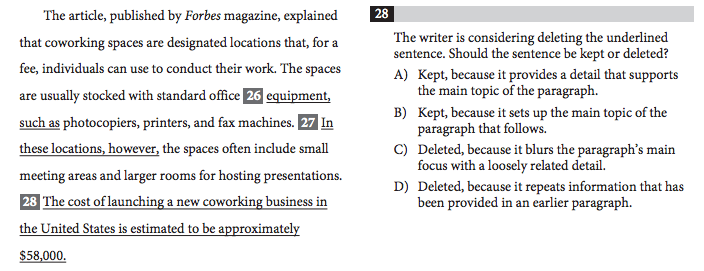
Image Courtesy of Khan Academy
Answer: C
The passage's main ideas:
- Coworking spaces are places people can pay to work in.
- They offer various resources for getting work done.
The sentence in question is about launching a coworking business. That's a different topic from using a coworking space, so it pulls the passage off focus and should be deleted. This eliminates A and B.
Between C and D, choice D claims the idea is repeated elsewhere in the passage. But the real problem isn't repetition; it's that the sentence introduces an unrelated idea. Choice C correctly identifies this, so it's the answer.
📊 Development: Quantitative Information

Image and Question Courtesy of College Board
- Which choice completes the sentence with accurate data based on the graph?
A) NO CHANGE
B) warning, however, that job growth in urban and regional planning will slow to 14 percent by 2020.
C) predicting that employment of urban and regional planners will increase 16 percent between 2010 and 2020.
D) indicating that 14 to 18 percent of urban and regional planning positions will remain unfilled.
Answer: C
Start with the graph. The title and labels tell you it shows the projected percent increase in employment for Urban and Regional Planners between 2010 and 2020.
Now check each answer against the graph:
- Choice A mentions "percent of all new jobs," which isn't what the graph measures. Eliminate.
- Choice D mentions "unfilled positions," also not on the graph. Eliminate.
- Choice B says growth will "slow to 14 percent." The graph actually shows 16 percent, not 14. Eliminate.
- Choice C says employment will "increase 16 percent between 2010 and 2020." That matches the graph exactly.
🗂 Organization of Ideas
Organization questions test whether you can arrange ideas in a logical order and choose the right transition words to connect them. The goal is always to pick the option that creates the smoothest, most logical flow.
Two main question types:
- ➡️ Logical Sequence — You're asked to place a sentence in the most logical position within a passage or paragraph.
- 💭 Intros, Conclusions, and Transitions — You're asked to choose the best introductory, concluding, or transitional word/phrase to maintain the passage's flow.
➡️ Organization: Logical Sequence
Where should sentence 4 be placed so that this story makes sense?
"[1] However, I did not have any flour. [2] I went to the store and bought some flour. [3] I used the flour to bake a chocolate cake, and she loved it. [4] Since it was my mom's birthday, I decided I would make a cake."
Sentence 4 should be placed before sentence 1. Here's how to work through it:
- Left as-is: The reader has no context for why the narrator needs flour or who "she" is in sentence 3. The premise is missing.
- Before sentence 3: "[1] However, I did not have any flour. [2] I went to the store and bought some flour. [4] Since it was my mom's birthday... [3] I used the flour..." This interrupts the natural connection between buying flour (sentence 2) and using it (sentence 3).
- Before sentence 2: "[1] However, I did not have any flour. [4] Since it was my mom's birthday... [2] I went to the store..." Better, but sentence 1 starts with "However," which signals a contrast with a previous idea. There's nothing before it to contrast with.
- Before sentence 1: "[4] Since it was my mom's birthday, I decided I would make a cake. [1] However, I did not have any flour. [2] I went to the store and bought some flour. [3] I used the flour to bake a chocolate cake, and she loved it."
Now the passage follows a natural sequence: decision → problem → solution → result. The word "However" in sentence 1 properly contrasts with the cake-making plan in sentence 4.
Takeaway: For logical sequence questions, test each possible placement by reading the paragraph aloud (or in your head). Pay special attention to transition words like "however," "therefore," and "for example," since they signal how a sentence connects to what comes before and after it.
💭 Organization: Introductions, Conclusions, and Transitions
Intros, Conclusions, and Transitions: Question 1
"My little brother's favorite color is green. ________, we decorated his bedroom with green curtains, pillows, and toys."
Which word best fills in the blank?
A) However
B) Therefore
C) Such as
D) Then
E) For instance
The answer is B) Therefore.
The first sentence states a cause (his favorite color is green), and the second sentence describes an effect (decorating in green). You need a cause-and-effect transition. "Therefore" is the only option that signals this relationship. "However" signals contrast, "such as" introduces examples within a sentence, "then" signals time sequence, and "for instance" introduces an example of a previous claim.
Strategies for transition and organization questions — use RAT 🐀:
- 📖 Read through the entire passage first. Get a feel for the overall topic and flow before answering.
- 🤹♀️ Consider your Alternatives. Try each answer choice (or each sentence placement) by reading the passage with it plugged in. Keep testing until you find the option that flows best.
- 🌊 Look for Transitions. Transition words are clues. If you see "however," the sentence should contrast with what came before. If you see "for example," the sentence should illustrate a previous point. Make sure the transition's function matches how it's being used.

Image Courtesy of English Grammar Here
- If you spot a transition word, verify that its placement matches its purpose. In the logical sequence example above, "however" was the key clue that sentence 1 couldn't be first, because there was nothing before it to contrast with.
- If you need a refresher on transition word categories, check out this resource.
Intros, Conclusions, and Transitions: Question 2
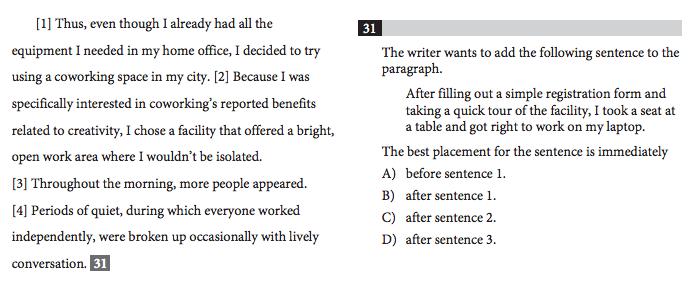
Image Courtesy of Khan Academy
Answer: C
Using RAT 🐀:
- 📖 Read through the entire passage without the new sentence to understand the topic and flow.
- 🤹♀️ Alternatives: Try placing the new sentence after each existing sentence. It makes sense for the narrator to fill out a registration form after deciding to try a coworking space (sentence 1) and choosing the type of facility (sentence 2). It also needs to come before noticing other people arriving (sentence 3) and describing the environment (sentence 4), since "taking a seat at a table" logically precedes those observations. This puts the new sentence after sentence 2.
- 🌊 Transitions: Check that the flow reads naturally with the sentence in that position. It does, confirming the answer is C.
Intros, Conclusions, and Transitions: Question 3

Image Courtesy of College Board SAT Practice Test
Answer: D
Reading through the passage, the text discusses literature that combines poetry and prose, and then presents Bernardine Evaristo's novel as a specific example of this kind of work. The blank needs a transition that introduces an illustration or example.
- "By contrast" signals an opposing idea. That doesn't fit.
- "Consequently" signals a result. The novel isn't a result of hybrid literature existing.
- "Secondly" signals a list. There's no "first" item being listed.
- "For instance" introduces an example, which is exactly the relationship between the general claim and Evaristo's novel.
📑 Effective Language Usage
These questions ask you to pick the word choice, phrasing, or sentence structure that best fits the passage. The focus is on making the writing precise, concise, and consistent in tone.
Four ways the writing can be improved:
- 🔪 Precision — Choosing a word that's more specific or accurate for the context.
- ❎ Concision — Removing unnecessary words or phrases to tighten the writing.
- 💅 Style and Tone — Matching word choice to the passage's established voice (formal, informal, scientific, conversational, etc.).
- ♾ Syntax — Combining sentences in the way that reads most smoothly and clearly.
Strategies for language usage questions:
- Read the passage to establish its overall tone and audience. Is it formal and academic? Informative but accessible? This context shapes which word choices are appropriate.
- Try each answer choice in the sentence. Read the full sentence with each option plugged in. Often one choice will clearly sound more natural or precise than the others.
- If two answer choices mean nearly the same thing, they probably both have to be wrong (since there can only be one correct answer).
🔪 Language Usage: Precision

Image Courtesy of Khan Academy
Answer: D
Try reading the sentence with the underlined word left blank and think about what word would naturally fit. Words like "outweigh," "exceed," or "surpass" come to mind.
Now check the answer choices. "Outdo" and "outperform" mean essentially the same thing. Since only one answer can be correct, they must both be wrong. That leaves B (defeat) and D (exceed). "Defeat" implies a battle or competition, which doesn't match the passage's informative tone. "Exceed" fits the context precisely.
❎ Language Usage: Concision

Image Courtesy of Khan Academy
Answer: D
The sentence discusses increased ebook circulation and how libraries have had to adapt. For concision questions, your goal is to find the option that conveys the same information with the fewest and clearest words.
Choices A, B, and C all contain unclear pronoun references. As a reader, you can't tell who or what "them" refers to. Choice D avoids this ambiguity and delivers the information more directly. When in doubt on concision questions, pick the shortest option that's still grammatically correct and clear in meaning.
💅 Language Usage: Style and Tone
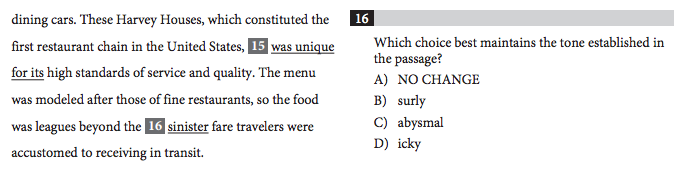
Image Courtesy of Khan Academy
Answer: C
The question asks you to maintain the passage's tone. First, identify that tone: informative and moderately formal, but still accessible.
Now evaluate each choice:
- A) Sinister means evil or threatening. You wouldn't describe food this way unless writing a horror story.
- B) Surly means unfriendly or hostile. It describes people's attitudes, not food quality.
- C) Abysmal means extremely bad or awful. It fits both the meaning (terrible food) and the passage's formal-but-readable tone.
- D) Icky means gross. It's too casual and informal for this passage's tone.
Choice C is the only word that matches both the intended meaning and the passage's style.
♾ Language Usage: Syntax
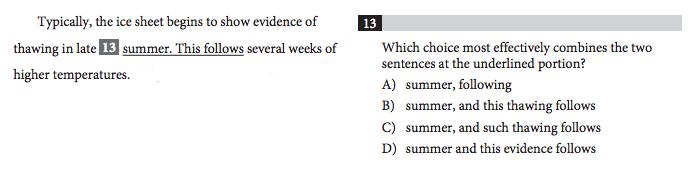
Image Courtesy of Khan Academy
Answer: A
This question asks you to combine two sentences. First, check for grammatical correctness. Choice D uses "and" alone to connect two independent clauses without a comma, creating a run-on. Eliminate it.
Among A, B, and C, all are grammatically acceptable. But the goal is to find the most concise and smooth combination. Choice A accomplishes this most directly, without adding unnecessary words or restructuring that makes the sentence harder to follow.
👏 Conclusion
You've now covered all three areas of Expression of Ideas: Development, Organization, and Effective Language Use. Across all question types, the core approach stays the same:
- Read the passage and identify its main ideas and tone before looking at the question.
- Eliminate answer choices that don't connect to the main ideas or don't match the passage's style.
- Plug remaining choices into the passage and pick the one that reads most clearly and logically.
Trust your reading instincts. If an answer choice sounds awkward or off-topic when you read it in context, it probably is. 🎊