
🎓SAT Review
Fiveable SAT: How to Improve Your SAT Reading, Writing, and Language Score
Fiveable SAT: How to Improve Your SAT Reading, Writing, and Language Score
The SAT Reading, Writing, and Language sections test your reading comprehension, grammar, and editing skills. These sections aren't about memorizing facts. They're about engaging with passages, spotting errors, and understanding context. This guide covers the most effective strategies for improving your score.
💭 SAT Humanities: What's On It?
The Reading section gives you passages and asks questions about what you've read: main ideas, details, inferences, and vocabulary in context. The Writing and Language section presents passages with underlined portions and asks you to fix or improve them, testing grammar, punctuation, sentence structure, and effective language use.
Neither section requires outside knowledge. Everything you need is in the passage itself. Your job is to read carefully and apply a consistent set of skills.
🍀 SAT Humanities: Tips & Tricks
♣️ Be Wary of Tricks
The SAT is a standardized test, so it can't rely on obscure vocabulary or highly specialized knowledge. Instead, the College Board tests straightforward concepts but uses clever answer choices designed to trip you up.
The biggest trap on SAT Reading is the "two right answers" situation. Two answer choices will often seem correct, but only one fully answers the question. The other is usually partially correct or slightly off-target. Telling them apart requires a careful read of both the question and the relevant part of the passage.
To get better at this:
- Learn the types of questions on the SAT Reading section so you know what each question is actually asking.
- Practice with real SAT questions and, for every "close call" between two answers, identify exactly why one is better than the other.
- Look for the answer that is fully supported by the text, not the one that sounds reasonable based on outside knowledge.
🚨 Know Your Weaknesses
Do you always run out of time? Do you consistently miss comma rule questions or inference questions? Do you fall for the "two possible answers" trap? Identifying your specific weaknesses is the fastest path to a higher score.
Once you know where you're losing points, you have a clear study plan:
- ⏰ If pacing is your biggest issue, spend extra time doing timed practice exams. Build the habit of moving through passages at a steady pace.
- 🤔 If you struggle with specific content like comma rules or inference questions, focus your study time there. Drilling timed full-length tests won't help much if the real problem is that you don't know when to use a semicolon.
💪🏼 Hype Yourself Up
Confidence matters more than you'd think on this exam. Students who second-guess themselves often change correct answers to incorrect ones after finishing a section, costing themselves real points.
Your first instinct on a question is right more often than not. Unless you can logically explain why your original answer is wrong and why the new one is right, stick with your gut. Trust the preparation you've put in.
🚫 Eliminate Wrong Answers
When you're stuck on a question, flip your approach: instead of searching for the right answer, eliminate the wrong ones. If you can confidently rule out three choices, the remaining one is correct by default.
Common flaws in wrong answer choices:
- Too specific: Focuses on a minor detail when the question asks about the passage as a whole.
- Too broad: Makes a sweeping claim that goes beyond what the passage actually says.
- Unrelated topic: Introduces an idea the passage never discusses.
- Incorrect or irrelevant connection: Links two ideas from the passage in a way the author didn't intend.
Which flaw you're looking for depends on the question. A question about the passage's overall purpose will usually have a "too specific" trap answer. A question about a particular detail will often have a "too broad" trap.
This elimination strategy works on any standardized test. Get familiar with other global strategies to strengthen your overall test-taking approach.
📖 Find a Reading Technique that Works for You
There's no single "best" way to tackle SAT passages. Different brains process information differently, so experiment with these strategies during practice to find what fits you.
🃏 SAT Reading Strategies
| Strategy | How-To | Critical Skills | Possible Pitfalls |
|---|---|---|---|
| Skimming | Skim the passage quickly, then start answering questions. Use line numbers in the questions to refer back to specific parts of the passage as needed. | You need to pick up the general idea and structure of a passage without reading every word. | If you skim too loosely, you'll waste time bouncing back and forth between the questions and the passage. |
| Read Questions First | Read the questions before the passage. Then skim the passage, marking the specific lines and details the questions reference. Slow down when you hit those key sections. | Works best for experienced test-takers who already know the question types well enough to hold them in memory while reading. | Can be time-consuming if you get caught up thinking about answer choices before you've fully understood the passage. You may also misinterpret information out of context. |
| Annotate the Passage + Answer | Read the full passage carefully, annotating anything that seems important, then answer the questions. | Best for strong readers who can move through a passage quickly while retaining key details. | You risk spending time on sections the questions never ask about. Your annotations may not line up with what the questions actually test. |
Try each approach on a few practice passages and track which one gives you the best combination of accuracy and speed.
🤓 Master Grammar Rules
The Writing and Language section tests a specific, learnable set of grammar rules. The most frequently tested concepts include:
- Subject-verb agreement (making sure the verb matches the subject, even when other words separate them)
- Verb tense consistency (keeping tenses logical within and across sentences)
- Punctuation rules (commas, semicolons, colons, apostrophes)
- Sentence structure (fragments, run-ons, misplaced modifiers, parallel structure)
These aren't random. The same rules show up test after test. Study them systematically, then practice applying them to real SAT questions. Even working through 5 questions a day builds real improvement over a few weeks.
👉🏽 We've broken the SAT Standard English Conventions section down with tips and practice questions.
🧐 Master Context Clues
When you hit an unfamiliar word on the SAT, the passage almost always gives you enough information to figure out its meaning. Look at the surrounding sentences for:
- Synonyms or restatements that echo the word's meaning
- Antonyms or contrasts that tell you what the word does not mean
- Examples or descriptions that illustrate the concept
- Tone of the passage that narrows down whether the word is positive, negative, or neutral
The Writing and Language section has a specific question type built around this skill called "Words in Context," where you choose the most appropriate word for a given sentence. Check out our SAT Writing and Language: Words in Context guide for more detail.
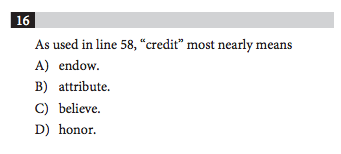
Here is an example of what a words-in-context question looks like! Image Courtesy of PrepScholar
🥽 Dive Deep into Your Mistakes
When reviewing practice questions you got wrong, don't brush them off with "I made a silly mistake" or "I just read it wrong." That tells you nothing useful. Instead, ask yourself:
- Why did I pick that answer? What made it seem right?
- What did I misread or overlook? Was it a word in the question, a detail in the passage, or a subtle difference between two answer choices?
- How do I prevent this next time? Is there a specific habit to change or a rule to review?
The College Board designs answer choices to exploit common misreadings and assumptions. By analyzing your mistakes at this level, you start recognizing those patterns before they cost you points.
After every practice test or real SAT/PSAT, review your results using these three questions:
- 🤩 What questions did I get right? Look for patterns. Were they mostly one question type, like Words in Context or Inference? This shows you where your strengths are.
- 💭 What questions did I get wrong, and why? Separate careless errors from genuine knowledge gaps. Each type needs a different fix.
- 💪 Which sections were strongest and weakest overall? This helps you allocate study time across Reading, Writing and Language, and Math.
Try organizing your strengths and weaknesses in a table so you can build a study plan around them.
🎞️ Improving Your SAT Score
Those are eight strategies to help you raise your SAT Reading, Writing, and Language score. Only you can figure out which methods work best for your brain, but the common thread is this: practice with real questions, study your mistakes honestly, and build your skills one rule and one question type at a time. Good luck on your next test.