
🎓SAT Review
Fiveable SAT Writing And Language: Tips and Tricks
Fiveable SAT Writing And Language: Tips and Tricks
✍️SAT Writing and Language: Tips & Tricks
The SAT Writing and Language section gives you 44 multiple-choice questions in 35 minutes. That works out to about 45 seconds per question, but many questions take only 15 seconds once you know the grammar rules. The key is working efficiently and knowing what the test likes to throw at you.
📖 Answer Questions As You Read
Answer each question as you encounter it in the passage. Reading the entire passage first and then going back wastes time because you'll end up re-reading most of it anyway.
Here's a practical approach:
- Skim the questions quickly before you start reading so you know what to look for.
- Read the passage from the beginning, and when you hit an underlined portion, answer that question right away.
- If a question asks about the passage as a whole (like "which sentence best concludes the passage?"), skip it and come back after you've finished reading.
This method keeps you moving forward and prevents unnecessary re-reading.
❓❗ Study Punctuation
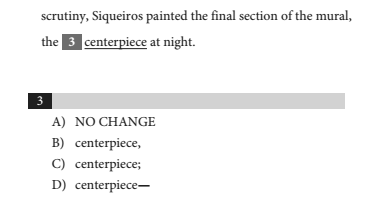
Punctuation questions are some of the most common on this section, and they're also some of the fastest to answer if you know the rules. Before test day, make sure you're solid on:
- Commas — used to separate items in a list, after introductory phrases, and around nonessential (appositive) clauses
- Semicolons — connect two independent clauses (each side must be a complete sentence on its own)
- Colons — introduce a list, explanation, or elaboration; the part before the colon must be an independent clause
- Apostrophes — show possession (the student's book) or mark contractions (it's = it is); remember that its without an apostrophe is the possessive form
- Dashes and hyphens — dashes set off extra information (similar to parentheses), while hyphens join compound modifiers (well-known author)
A big part of getting these right is understanding independent vs. dependent clauses. An independent clause can stand alone as a sentence. A dependent clause cannot. Knowing the difference tells you whether you need a comma, a semicolon, or a period.
📋 Use Process of Elimination
Process of elimination is your best friend on this section. Here's the most useful version of it:
If two answer choices express the same meaning using different words, you can eliminate both of them. Since every question has exactly one correct answer, two choices that say the same thing can't both be right, which means neither is.
This is especially helpful when you're stuck between two or three options. Cross out what you can, and your odds improve significantly.
🛑 Be Wary of the Word "Being"
On the SAT, answer choices containing the word "being" are almost always wrong. While "being" is technically grammatical in some constructions, the SAT tends to use it in answer choices where it creates awkward, wordy phrasing.
For example:
- Weak: "The project being completed by the team was impressive."
- Better: "The project completed by the team was impressive."
If you see "being" in an answer choice, treat it as a red flag. It's not a guaranteed wrong answer, but pick it only if every other option has a clear grammatical error.

📝 Be Concise
The SAT consistently rewards concise writing. When two answer choices are both grammatically correct, the shorter one is usually right. Watch out for these traps:
- Redundancy — "returned back" (returned already means going back), "past history," "combine together"
- Wordiness — "due to the fact that" instead of "because," or "at this point in time" instead of "now"
If you're unsure between two grammatically sound options, pick the one that says the same thing in fewer words.
📣 "NO CHANGE" Might Be the Answer
Don't overthink the "NO CHANGE" option. The original sentence is sometimes already correct, and "NO CHANGE" appears as the right answer multiple times per test. If you read the underlined portion and nothing sounds wrong, trust your instincts. Changing a correct sentence just because you feel like you should pick something different is a common way to lose easy points.

🔁 Practice
The fastest way to improve your Writing and Language score is taking full practice sections under timed conditions. As you practice, you'll start recognizing question patterns and answering more quickly. After each practice test, review every question you got wrong and identify why the correct answer is right. If you finish a section with time to spare, go back and double-check any questions you flagged.