
🎓SAT Review
What are the SAT Reading Test Questions Like?
What are the SAT Reading Test Questions Like?
The Reading test is one of two tests in the SAT's Evidence-Based Reading and Writing section. It measures your ability to comprehend written passages and draw conclusions from them. The section has 52 multiple-choice questions spread across 5 passages, and you get 65 minutes to complete it.
Types of Passages
Each passage runs between 500 and 750 words, and the difficulty level varies across passages.
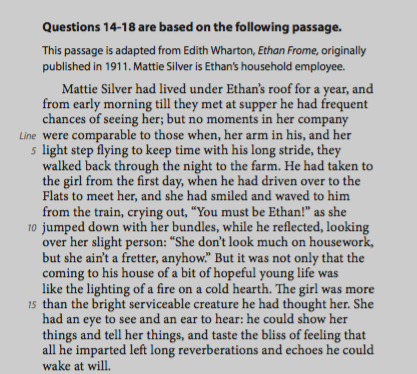
The Literature Passage
One passage always comes from a classic or contemporary work of U.S. or World Literature. It's typically an excerpt from a novel, short story, memoir, or personal essay. Because you're dropped into the middle of a longer work, context can be limited. That's why you should always read the short introductory blurb above the passage before diving in. This blurb appears before every SAT passage and often provides key details about the author, time period, or situation that help you orient yourself.
The History Passage
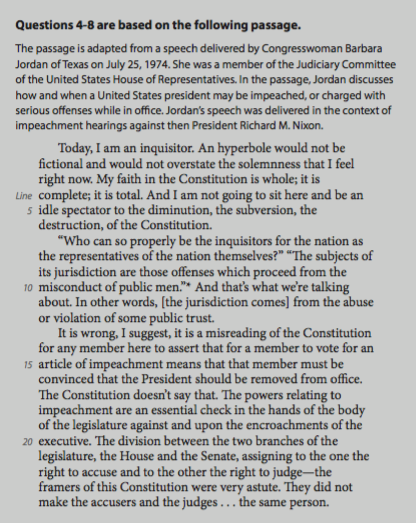
One or two passages come from U.S. founding documents or texts in the "Great Global Conversation" about topics like freedom, justice, and human rights. Common subjects include the French Revolution, slavery, and women's suffrage. These passages tend to be the trickiest because the writing style is often old-fashioned, with long sentences and vocabulary that isn't used much anymore. Slow down when you hit these. Budget a few extra minutes here, and don't panic if you need to reread a sentence to parse its meaning.
The Social Science Passage
The social science passage covers topics like economics, psychology, or sociology. These passages tend to present research findings or arguments supported by data. You can approach them similarly to history passages: focus on the author's main claim and how the evidence supports it.
The Science Passages
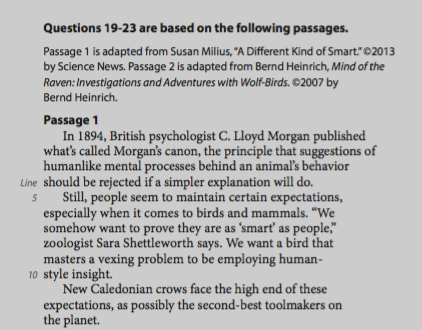
Two of the five passages are science-based, covering Earth science, biology, chemistry, or physics. These frequently describe experiments and include data in tables or graphs. You might need to identify a hypothesis, interpret results, or evaluate conclusions. No outside scientific knowledge is required. Every answer is based solely on what's in the passage and any accompanying figures.
Types of Questions
Knowing the question types ahead of time helps you recognize what each question is really asking. The example questions below all refer to this passage excerpt. Read through it, then work through the samples. Answers and explanations follow each one.


Big-Picture Questions
These ask about the author's point of view, the overall purpose of the passage, or the central conflict. You need to have read the entire passage before answering, since the answer comes from the big picture rather than a single detail.

Answer: B
Solution: In the passage, Akira surprises Chie by asking for Naomi's hand in marriage. Multiple details point to Chie's shock. For example, in lines 72–73, Akira says "I see I've startled you." Choice A is incorrect because Chie and Akira speak politely throughout; in line 35, Chie even admires Akira's sincerity. Choices C and D lack any supporting evidence in the text.
Detail Questions
These are specific and direct. They ask you to locate particular information stated in the passage. Because the answer is right there in the text, these should be among the fastest questions to answer.

Answer: C
Solution: In line 41, Akira tells Chie he has received an opportunity to work as a dentist in Seattle. His future plans depend on whether he gets permission to marry Naomi: if he marries her, he'll stay in Japan; otherwise, he'll leave for America. While Choice D contains a true statement, Akira's meeting with Chie is "a matter of urgency" specifically because of the job offer's time pressure. There's no evidence that Akira fears his parents disapproving of Naomi or that Naomi might reject him.
Inference Questions
These ask you to draw a logical conclusion that isn't stated outright in the passage. The answer won't be a direct quote, but small details in the text will point you toward it.

Answer: A
Solution: Akira is concerned about how untraditional and hasty his proposal appears. In line 63, he tells Chie to "not judge his candidacy by the unseemliness of [his] proposal." He explains that he's asking directly to save time and that parental approval is what matters most. Choice B is incorrect because nothing suggests Akira worries about seeming immature. Choice D is wrong because Akira isn't concerned about his sincerity being questioned. Choice C doesn't work either: Akira already knows his visit is an imposition, so that's not the reaction he fears most.
Vocabulary-in-Context Questions
These give you a word from the passage and ask what it means in that specific context. Always go back to the passage and reread the sentence. A helpful strategy: before looking at the answer choices, mentally substitute your own word for the one being tested.

Answer: C
Solution: Line 1 reads "[Akira] came directly, breaking all tradition." Line 65 says Akira "ask[ed] directly," without using "a go-between." Both uses refer to Akira bypassing the traditional process of having intermediaries arrange the proposal. So "directly" most nearly means "without mediation." While "frankly," "confidently," and "with precision" are all valid definitions of "directly" in other contexts, none of them fit the meaning here.
Development and Function Questions
These test whether you understand why the author included a specific phrase, sentence, or paragraph. You need to think about the author's purpose and how that piece fits into the larger passage.

Answer: D
Solution: The first paragraph explores Chie's reaction to Akira's sudden request. Its final line asks: "Had he followed form—had he asked his mother to speak to his father to approach a go-between—would Chie have been more receptive?" This questions whether Chie's reaction would have been different if Akira had followed tradition. Choice A is wrong because the paragraph only touches on one aspect of Japanese culture. Choice B is wrong because the focus is on Akira's actions, not a criticism of the tradition itself. Choice C is wrong because the narrator isn't questioning a suggestion.
Evidence Support Questions
These ask you to identify the specific lines that support your answer to a previous question. They always appear paired with another question, and they're one of the most common question types on the Reading test.

Answer: B
Solution: The answer to Question 9 is C (Akira's job offer creates urgency). So you need to find the lines where Akira tells Chie about the Seattle opportunity. Choice B contains exactly those lines. The other choices point to evidence for different claims.
Taking full-length practice tests is the single best way to improve on the Reading section. Familiarity with these question types helps you identify what's being asked faster, so you can spend your time finding the right answer instead of figuring out the question.