
ABC analysis is a powerful inventory management tool that categorizes items into A, B, and C groups based on their importance. This method applies the Pareto principle to optimize resource allocation and prioritize inventory control efforts in production and operations management.
By focusing on high-value A items, moderately important B items, and less critical C items, companies can improve decision-making and efficiency. ABC analysis enables targeted strategies for each category, enhancing overall inventory management and supporting supply chain objectives.
Definition of ABC analysis
- Inventory categorization method divides items into three classes (A, B, and C) based on their importance
- Applies the Pareto principle (80/20 rule) to inventory management
- Enables focused resource allocation and prioritization in production and operations management
Purpose and benefits
- Optimizes inventory control by identifying items that require different levels of attention
- Improves resource allocation efficiency in production and operations management
- Enhances decision-making processes for inventory-related strategies
Value-based criteria
- Utilizes annual dollar usage as the primary metric for classification
- Calculates by multiplying the unit cost by annual consumption quantity
- Typically categorizes items as:
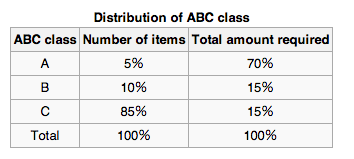
- A items: Top 70-80% of annual dollar usage
- B items: Next 15-25% of annual dollar usage
- C items: Remaining 5-10% of annual dollar usage
Volume-based criteria
- Focuses on the quantity of items consumed or sold annually
- Considers physical units rather than monetary value
- Classifies items based on their contribution to total volume:
- A items: Top 10-20% of items by volume
- B items: Next 30-40% of items by volume
- C items: Remaining 40-60% of items by volume
Steps in ABC analysis
- Involves a systematic approach to categorize and analyze inventory items
- Provides insights for inventory management strategies in production and operations
- Helps in identifying areas for cost reduction and efficiency improvement
Data collection
- Gather relevant information for each inventory item (unit cost, annual usage, lead time)
- Ensure data accuracy and completeness for reliable analysis
- Utilize inventory management systems or ERP software to extract data
Item categorization
- Calculate the total annual dollar usage for each item
- Rank items in descending order based on annual dollar usage
- Determine cut-off points for A, B, and C categories based on cumulative percentage of total annual dollar usage
Analysis of results
- Evaluate the distribution of items across categories
- Identify patterns or trends in item characteristics within each category
- Generate reports and visualizations (Pareto charts, pie charts) to present findings
A category characteristics
- Represents the most critical items in inventory management
- Requires stringent control measures and frequent monitoring
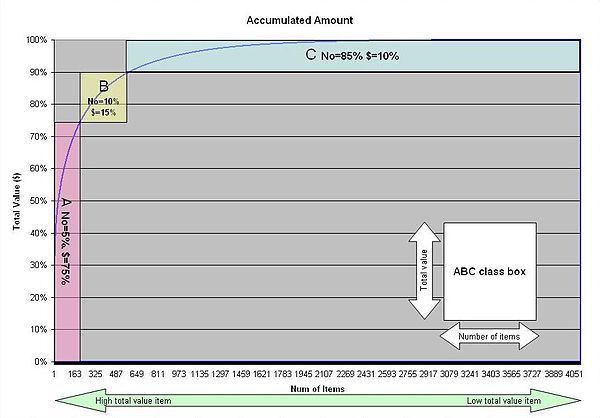
- Typically constitutes a small percentage of total items but accounts for a large portion of value
High-value items
- Comprise approximately 10-20% of total inventory items
- Account for 70-80% of total annual dollar usage
- Often include expensive raw materials, critical components, or high-demand finished products
Management strategies for A items
- Implement tight inventory control with frequent cycle counts
- Utilize safety stock to prevent stockouts
- Negotiate favorable terms with suppliers for bulk purchases or just-in-time delivery
- Conduct regular demand forecasting and analysis
B category characteristics
- Represents items of moderate importance in inventory management
- Requires regular monitoring but less frequent than A items
- Typically constitutes a larger percentage of items compared to A category
Medium-value items
- Comprise approximately 30-40% of total inventory items
- Account for 15-25% of total annual dollar usage
- Often include moderately priced components or products with steady demand
Management strategies for B items
- Implement periodic review systems with moderate cycle counting frequency
- Maintain adequate safety stock levels
- Consider economic order quantities (EOQ) for ordering decisions
- Analyze for potential reclassification to A or C categories
C category characteristics
- Represents the least critical items in inventory management
- Requires minimal monitoring and control measures
- Typically constitutes the largest percentage of items but accounts for a small portion of value
Low-value items
- Comprise approximately 40-60% of total inventory items
- Account for 5-10% of total annual dollar usage
- Often include low-cost consumables, maintenance supplies, or slow-moving products
Management strategies for C items
- Implement simple inventory control methods (two-bin system, visual inspection)
- Use longer review periods and larger order quantities
- Consider outsourcing management to suppliers through vendor-managed inventory (VMI)
- Evaluate for potential obsolescence or discontinuation
ABC analysis in inventory management
- Serves as a foundation for developing targeted inventory control policies
- Enables efficient allocation of resources and attention across different item categories
- Supports overall production and operations management strategies
Inventory control policies
- Implement cycle counting frequencies based on item categories:
- A items: Weekly or bi-weekly counts
- B items: Monthly or quarterly counts
- C items: Semi-annual or annual counts
- Adjust safety stock levels according to item importance:
- A items: Higher safety stock to prevent stockouts
- B items: Moderate safety stock levels
- C items: Minimal or no safety stock
Reorder points vs categories
- Set reorder points based on item classification:
- A items: Lower reorder points with frequent small orders
- B items: Moderate reorder points with regular order intervals
- C items: Higher reorder points with less frequent, larger orders
- Consider lead times and demand variability when determining reorder points
ABC analysis in supply chain
- Enhances supply chain management by prioritizing relationships and resources
- Supports decision-making in procurement and supplier management strategies
- Aligns inventory management with overall supply chain objectives
Supplier relationships
- Develop strategic partnerships with suppliers of A items:
- Negotiate long-term contracts and volume discounts
- Collaborate on demand forecasting and quality improvement initiatives
- Maintain good relationships with suppliers of B items:
- Seek competitive pricing and reliable delivery performance
- Explore opportunities for process improvements and cost reductions
- Simplify relationships with suppliers of C items:
- Consider consolidating orders or using distributors
- Implement automated ordering systems to minimize administrative costs
Order frequency vs categories
- Adjust order frequency based on item classification:
- A items: More frequent orders with smaller quantities
- B items: Regular orders with moderate quantities
- C items: Less frequent orders with larger quantities
- Balance order costs with inventory holding costs for each category
Limitations of ABC analysis
- Focuses primarily on value or volume, potentially overlooking other critical factors
- May not account for sudden changes in demand or market conditions
- Requires regular updates to maintain accuracy and relevance
- Can oversimplify complex inventory situations or unique item characteristics
- May not consider lead times or supplier reliability in classification
ABC analysis vs other methods
- Compares ABC analysis with alternative inventory classification techniques
- Highlights strengths and weaknesses of different approaches
- Helps in selecting the most appropriate method for specific business contexts
ABC vs XYZ analysis
- ABC analysis focuses on value or volume, while XYZ analysis considers demand variability
- XYZ categories:
- X: Stable demand with high forecast accuracy
- Y: Fluctuating demand with medium forecast accuracy
- Z: Irregular demand with low forecast accuracy
- Combining ABC-XYZ creates a matrix for more nuanced inventory management strategies
ABC vs VED analysis
- ABC analysis prioritizes based on value, while VED analysis considers item criticality
- VED categories:
- Vital: Essential items that cannot be out of stock
- Essential: Important items with some flexibility in stock levels
- Desirable: Non-critical items with higher tolerance for stockouts
- VED analysis is particularly useful in healthcare and maintenance inventory management
Technology in ABC analysis
- Leverages advanced software and data analytics to enhance ABC analysis effectiveness
- Enables real-time inventory tracking and dynamic category adjustments
- Supports integration with other business systems for comprehensive inventory management
Software tools
- Utilize Enterprise Resource Planning (ERP) systems with built-in ABC analysis modules
- Implement specialized inventory management software with ABC classification features
- Leverage business intelligence tools for advanced data visualization and reporting
Automation possibilities
- Automate data collection and updates for continuous ABC analysis
- Implement machine learning algorithms for predictive inventory categorization
- Develop automated reordering systems based on ABC classifications and real-time data
Implementing ABC analysis
- Requires careful planning and execution to maximize benefits
- Involves cross-functional collaboration within the organization
- Necessitates ongoing monitoring and adjustment of the analysis process
Organizational considerations
- Secure management buy-in and support for ABC analysis implementation
- Provide training to staff on ABC analysis principles and procedures
- Establish clear roles and responsibilities for inventory management based on ABC categories
- Align ABC analysis with overall business objectives and performance metrics
Challenges and solutions
- Data accuracy: Implement rigorous data validation processes and regular audits
- Resistance to change: Communicate benefits and provide change management support
- Complexity in multi-location operations: Develop standardized procedures and centralized data management
- Dynamic market conditions: Conduct regular reviews and updates of ABC classifications
ABC analysis case studies
- Retail chain optimizes inventory turnover by implementing ABC analysis across stores
- Manufacturing company reduces carrying costs by 25% through ABC-based inventory policies
- Pharmaceutical distributor improves service levels for critical medications using ABC-VED analysis
- E-commerce platform enhances warehouse efficiency by reorganizing storage based on ABC categories