9.4 Ovid's Metamorphoses

📚Myth and Literature Unit 9 Review
9.4 Ovid's Metamorphoses
📚 Myth and Literature
9.1
Greek tragedies and mythological themes
9.2
Roman adaptations of Greek myths
9.3
Mythological allusions in epic poetry
9.4
Ovid's Metamorphoses
9.5
Mythological themes in Shakespeare's works
9.6
Milton's Paradise Lost and biblical mythology
9.7
Mythological influences in Renaissance art and literature
9.8
Romantic poets and mythological imagery
9.9
Classical myths in 19th-century novels
Ovid's Metamorphoses is a sweeping epic that weaves together Greek and Roman myths into a single continuous narrative. It spans from the creation of the world to the deification of Julius Caesar, and its central thread is transformation: bodies changing shape, identities shifting, the world itself in constant flux. For centuries, it served as the go-to source of classical mythology for Western writers and artists.
Overview of Metamorphoses
The poem collects roughly 250 myths and links them into one unbroken story. Some of these myths are famous (Apollo and Daphne, Narcissus and Echo), while others are obscure local legends Ovid rescued from relative obscurity. The result is less a traditional epic with a single hero and more a mythological encyclopedia held together by the theme of change.
Its influence is hard to overstate. Shakespeare, Dante, and Chaucer all drew heavily from it. Renaissance painters treated it as a sourcebook. Even today, retellings and adaptations keep appearing across every medium.

Top images from around the web for Ovid's life and times
Rome’s Augustus and the allure of the strongman | Pursuit by The University of Melbourne View original
Is this image relevant?
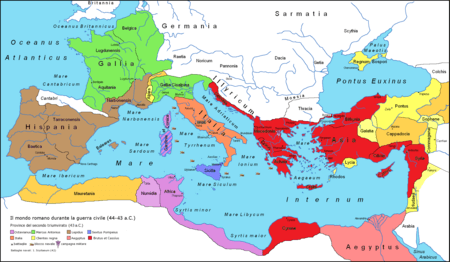
Triumviratus Kedua - Wikipedia bahasa Indonesia, ensiklopedia bebas View original
Is this image relevant?
An Ancient Network: The Roads of Rome View original
Is this image relevant?
Rome’s Augustus and the allure of the strongman | Pursuit by The University of Melbourne View original
Is this image relevant?
Triumviratus Kedua - Wikipedia bahasa Indonesia, ensiklopedia bebas View original
Is this image relevant?
Ovid's life and times
Ovid was born in 43 BCE in Sulmo, Italy, right as the Roman Republic was collapsing into the Empire. He grew up during the reign of Emperor Augustus and trained as a rhetorician, holding minor public offices before committing fully to poetry.
In 8 CE, Augustus exiled Ovid to Tomis (modern-day Constanța, Romania) on the Black Sea coast. The exact reasons remain a mystery. Ovid himself cryptically referred to "a poem and a mistake," which scholars have debated ever since. Some suspect his playful, irreverent poetry clashed with Augustus's moral reform campaigns; others point to possible involvement in a political scandal. He never returned to Rome and died in exile around 17 CE.
Structure and composition
- 15 books containing approximately 12,000 lines of dactylic hexameter, the traditional meter of Greek and Roman epic
- The chronological arc moves from the creation of the cosmos out of primordial Chaos to the deification of Julius Caesar, giving the poem a grand historical sweep
- Rather than telling each myth as a standalone episode, Ovid uses a continuous narrative technique. Stories flow into one another through thematic echoes, shared characters, or geographical links. One tale's ending becomes the next tale's beginning.
- This structure means the poem feels less like a collection and more like a river of stories, always moving forward while constantly branching.
Themes and motifs
Transformation is the unifying thread. Bodies change into trees, animals, stones, stars, rivers. But Ovid treats metamorphosis on multiple levels: physical, psychological, and metaphorical.
- Love and desire drive many of the transformations. Passion in Ovid rarely ends well; it leads to pursuit, violence, grief, and radical bodily change.
- Power dynamics between gods and mortals recur constantly. The gods act on whims, and mortals bear the consequences. Divine "love" often looks more like predation.
- Art and nature intertwine throughout. Ovid fills the poem with artists, musicians, and weavers, and he repeatedly asks: what's the relationship between creating something and transforming it?
Major stories and myths
Creation and early world
The poem opens with the universe taking shape out of Chaos, a formless mass where all the elements are jumbled together. A creator figure (Ovid leaves this vague) separates earth from sky, land from sea, establishing order.
From there, Ovid recounts the Four Ages of Man: Gold, Silver, Bronze, and Iron. Each age represents a step downward in human morality. The Golden Age had no laws because none were needed; by the Iron Age, greed and violence dominate.
Two other early stories set the tone:
- Deucalion and Pyrrha: After Jupiter floods the earth to punish human wickedness, this pious couple survives and repopulates the world by throwing stones over their shoulders, which transform into people. It's Ovid's version of the flood myth found across many cultures.
- Phaethon: The son of the sun god Helios begs to drive the sun chariot for a day, loses control, and scorches the earth. Jupiter strikes him down with a thunderbolt. The story is a vivid cautionary tale about ambition exceeding ability.
Gods and mortals
These stories showcase how interactions between divine and human characters almost always end in someone getting transformed.
- Apollo and Daphne: Apollo, struck by Cupid's arrow, chases the nymph Daphne. She prays for escape, and her father (a river god) transforms her into a laurel tree. Apollo claims the laurel as his sacred symbol. The story captures a disturbing pattern: the god gets a trophy, the woman loses her body.
- Jupiter and Io: Jupiter pursues the nymph Io, then transforms her into a cow to hide the affair from his wife Juno. Juno, not fooled, sets the hundred-eyed Argus to guard Io. Here metamorphosis serves as both concealment and punishment.
- Baucis and Philemon: A rare feel-good story. This elderly couple welcomes disguised gods (Jupiter and Mercury) into their humble home when wealthier neighbors refuse. As a reward, their cottage becomes a temple, and at death they're transformed into intertwining trees, an oak and a linden, so they're never separated.
Transformation narratives
- Narcissus and Echo: Echo, cursed to only repeat others' words, falls in love with Narcissus, who rejects her. Narcissus then falls in love with his own reflection in a pool and wastes away, becoming the narcissus flower. Echo fades until only her voice remains. The myth explores self-absorption and the impossibility of loving what you can never truly reach.
- Arachne: A mortal weaver who boasts she's more skilled than Minerva (Athena). They hold a contest. Arachne's tapestry depicts the gods' abuses of mortals and is technically flawless. Minerva, enraged, destroys it and strikes Arachne, who hangs herself. Minerva then transforms her into a spider. The story raises uncomfortable questions about what happens when a mortal's art tells truths the gods don't want told.
- Actaeon: While hunting, Actaeon stumbles upon Diana bathing. She transforms him into a stag, and his own hunting dogs tear him apart. His crime was accidental, which makes the punishment feel disproportionate. That disproportion is part of Ovid's point about divine power.
Heroes and quests
Ovid includes traditional heroic narratives but consistently emphasizes the transformation elements over the heroics themselves.
- Perseus rescues Andromeda from a sea monster and uses Medusa's severed head to petrify his enemies, including the Titan Atlas, who becomes a mountain range.
- Jason and Medea: Ovid focuses less on the Golden Fleece quest and more on Medea's sorcery. She rejuvenates Jason's father Aeson through a magical ritual, then tricks Pelias's daughters into killing their own father. Medea is one of the poem's most complex figures.
- Theseus defeats the Minotaur in the labyrinth and later abandons Ariadne on the island of Naxos, where Bacchus finds and marries her.
Literary techniques
Narrative framing devices
Ovid's storytelling architecture is one of the poem's most distinctive features.
- Continuous narrative: Stories link to each other through shared characters, locations, or themes, creating the illusion of a single unbroken tale.
- Embedded narratives: Characters within the poem tell stories to each other. Orpheus, for instance, narrates several myths while singing. This creates layers of storytelling, with tales nested inside other tales.
- Apostrophe: Ovid sometimes addresses characters directly ("You, Narcissus..."), pulling the reader into the scene.
- Prolepsis and analepsis: He jumps forward (prolepsis) or backward (analepsis) in time to build suspense or create dramatic irony.
Poetic style and meter
The poem is composed in dactylic hexameter, the same meter used by Homer and Virgil. This places Metamorphoses in the tradition of serious epic, even though Ovid's tone is often playful and irreverent.
Ovid is known for his rhetorical polish: alliteration, assonance, and chiasmus (reversed parallel structures) appear throughout. His imagery is vivid and sensory. He also loves wordplay and puns, especially ones that connect a character's name to their eventual transformation. This wit distinguishes him from more solemn epic poets.
Symbolism and allegory
- Metamorphosis itself functions as a symbol for the instability of identity. If your body can change completely, what makes you you?
- Natural elements carry symbolic weight. Characters become trees, flowers, rivers, and stones, and these new forms often reflect something about who they were as humans.
- Ekphrasis (detailed descriptions of artworks within the text) appears in key moments, like the weaving contest between Arachne and Minerva. These passages explore the relationship between art, truth, and power.

Influence and legacy
Impact on Western literature
Metamorphoses was the single most important source of classical mythology for medieval and Renaissance Europe. Writers who couldn't read Homer in Greek could read Ovid in Latin.
- Dante places Ovid among the great poets in Inferno and draws on his myths throughout the Divine Comedy.
- Chaucer adapts several Ovidian tales in The Canterbury Tales and The Legend of Good Women.
- Shakespeare borrows from Ovid constantly. A Midsummer Night's Dream reworks the Pyramus and Thisbe story directly. The Tempest, Titus Andronicus, and the Sonnets all show Ovidian influence.
The poem also helped establish metamorphosis as a literary genre in its own right, influencing works from Kafka's The Metamorphosis to modern fantasy.
Artistic interpretations
Visual artists have treated Metamorphoses as an inexhaustible source of subjects.
- Roman frescoes and mosaics depicted Ovidian scenes in homes and public spaces.
- Renaissance painters (Titian, Rubens, Botticelli) produced iconic works based on the poem.
- Bernini's sculpture Apollo and Daphne (1622-1625) captures the exact moment of transformation, with Daphne's fingers sprouting leaves and her feet becoming roots.
- Illuminated manuscripts and tapestries kept the stories circulating through the medieval period.
Modern adaptations
- Ted Hughes's Tales from Ovid (1997) translates selected myths into powerful modern English verse.
- Christoph Ransmayr's novel The Last World (1988) reimagines the Metamorphoses in a dystopian setting.
- Theatrical productions, ballets, and operas continue to draw on Ovidian material.
- Graphic novels and films regularly adapt or reference these myths for contemporary audiences.
Critical interpretations
Augustan context
Ovid wrote during a period of intense cultural engineering. Augustus promoted traditional Roman values, moral legislation, and a particular vision of Roman identity. Metamorphoses can be read in tension with this program.
The poem's final books narrate the deification of Julius Caesar and praise Augustus, but scholars debate whether this is sincere or subtly ironic. Ovid's emphasis on the gods' cruelty, lust, and pettiness doesn't exactly align with Augustan piety. His exile suggests the regime saw something threatening in his work, even if we can't pinpoint exactly what.
Gender and power dynamics
Many of the poem's transformation stories involve male gods pursuing female mortals, with the women's bodies changing as a direct result of male aggression. Daphne becomes a tree to escape Apollo. Io becomes a cow because Jupiter wants to hide his assault. Philomela is transformed after being raped by Tereus.
These patterns have made Metamorphoses a rich text for feminist criticism. Some scholars argue Ovid is sympathetically depicting female suffering; others see him as aestheticizing violence. The poem also contains stories that complicate gender norms, like Iphis (a girl raised as a boy who is transformed into a man before marriage), which has drawn attention from queer theory scholars.
Nature vs. culture
The poem constantly blurs the boundary between the human and natural worlds. Characters become parts of nature. Cities rise and fall. Landscapes carry the traces of mythological events.
- Wilderness in Ovid is both dangerous (Actaeon is killed in the forest) and a site of transformation and renewal.
- The poem can be read as a meditation on humanity's desire to control nature and the consequences when that control fails (Phaethon, Erysichthon).
- Some contemporary scholars have explored ecological readings, noting how Ovid depicts an interconnected world where human actions ripple outward into the environment.
Key characters
Gods and goddesses
- Jupiter (Zeus): King of the gods and the poem's most frequent instigator of transformation, usually through his sexual pursuits. His affairs and Juno's jealous responses drive many stories.
- Apollo: God of prophecy, music, and the sun. Features in multiple myths, most memorably the Daphne story. Often portrayed as arrogant despite his beauty and talent.
- Venus (Aphrodite): Goddess of love, central to stories involving desire and romantic transformation. Her son Cupid's arrows set many plots in motion.
- Minerva (Athena): Goddess of wisdom and crafts. Her contest with Arachne is one of the poem's most thematically rich episodes.
Mortal protagonists
- Orpheus: The legendary musician who descends to the underworld to retrieve his dead wife Eurydice. He fails (by looking back too soon) and spends his remaining life singing the myths that fill several of the poem's later books.
- Pygmalion: A sculptor disgusted by real women who carves an ivory statue so beautiful he falls in love with it. Venus brings the statue to life. The story raises questions about idealization, art, and desire.
- Medea: A powerful sorceress and one of the poem's most psychologically complex characters. Her magical abilities, passionate love for Jason, and eventual acts of vengeance make her both sympathetic and terrifying.
- Aeneas: The Trojan hero whose journey from Troy to Italy links Greek mythology to Roman national identity. Ovid's treatment of Aeneas connects Metamorphoses to Virgil's Aeneid.
Mythical creatures
- Centaurs: Half-human, half-horse beings. Their battle with the Lapiths at a wedding feast is one of the poem's most violent set pieces.
- Minotaur: The bull-headed creature confined in the labyrinth built by Daedalus, killed by Theseus.
- Phoenix: The self-regenerating bird that dies in flame and is reborn from its own ashes, serving as a powerful symbol of cyclical transformation.
- Sirens: Sea creatures with enchanting voices who lure sailors to destruction. In Ovid's version, they were originally companions of Proserpina.

Themes of transformation
Physical metamorphoses
The most obvious type of change in the poem: bodies turning into other things. Humans become animals (Actaeon into a stag), plants (Daphne into a laurel), stones (Niobe), stars (Callisto into Ursa Major), and even geographical features (Atlas into a mountain).
What makes these transformations compelling is that Ovid often preserves the character's consciousness inside the new form. Io is a cow but still thinks and feels as a human. This raises a disturbing question the poem returns to again and again: if your body changes completely, does your identity survive?
Transformation can serve as punishment (Arachne), escape (Daphne), reward (Baucis and Philemon), or simply the result of overwhelming emotion (Niobe weeping until she becomes stone).
Psychological changes
Not all metamorphoses are physical. Ovid tracks internal transformations too.
- Characters experience madness, obsession, and grief that fundamentally alter who they are. Hecuba, driven mad by the murder of her children, transforms psychologically before she transforms physically.
- Divine possession changes characters from the inside out. Bacchic frenzy, prophetic ecstasy, and lovesickness all function as forms of psychological metamorphosis.
- The poem repeatedly asks what happens to a person's sense of self when their circumstances change radically, whether through trauma, exile, or sudden shifts in power.
Social transformations
Metamorphosis in Ovid doesn't just change bodies; it changes social realities.
- Characters move between human and non-human status, losing their place in society entirely.
- Family relationships are disrupted or destroyed. Tereus, Procne, and Philomela's story shows how violence transforms an entire family structure.
- Exile functions as a kind of social metamorphosis. Given Ovid's own banishment, these themes carry autobiographical resonance.
- Some transformations create new features of the natural world: rivers, mountains, flowers, and constellations all originate in someone's story.
Philosophical underpinnings
Roman philosophy in Metamorphoses
Ovid engages with several philosophical traditions, though always as a poet rather than a systematic thinker.
- Pythagoreanism gets the most explicit treatment. In Book 15, the philosopher Pythagoras delivers a long speech about metempsychosis (the transmigration of souls), arguing that souls pass from body to body and that nothing truly perishes, only changes form. This speech serves as a philosophical capstone for the entire poem.
- Stoic ideas about fate and cosmic order surface in stories where characters struggle against or submit to forces beyond their control.
- Epicurean themes of pleasure and pain run through the love stories.
- Platonic questions about form and essence arise naturally: if a person's physical form changes, what remains of their essential nature?
Concepts of change and permanence
The poem's deepest philosophical tension is between flux and stability. Everything changes, yet something persists.
- Ovid explores whether identity can survive transformation, and his answers vary from story to story.
- Memory and consciousness often serve as the thread of continuity. A transformed character who remembers being human hasn't fully ceased to exist.
- Fame emerges as one form of permanence. The poem's famous closing lines claim that Ovid's work will outlast even the power of Jupiter, granting the poet a kind of immortality through art.
Moral lessons and warnings
Many myths function as cautionary tales, though Ovid's moral framework is more complex than simple "don't do this" messaging.
- Hubris is consistently punished. Arachne challenges a goddess; Niobe boasts about her children; Phaethon overreaches. All suffer for it.
- Divine justice in the poem is real but often disproportionate or arbitrary, which complicates any straightforward moral reading.
- Excessive passion, unchecked curiosity, and reckless ambition all lead to transformation, but so does simple bad luck (Actaeon). The moral universe of Metamorphoses is not always fair, and Ovid seems aware of that.
Comparative mythology
Greek vs. Roman myths
Ovid works primarily with Greek mythological material but writes for a Roman audience and adapts accordingly.
- Gods are referred to by their Roman names (Jupiter, not Zeus; Minerva, not Athena; Venus, not Aphrodite), though the underlying myths are largely Greek in origin.
- Ovid incorporates distinctly Roman legends, especially in the later books. The stories of Romulus, Numa, and Julius Caesar's apotheosis connect the mythological past to Roman national history.
- This blending served a cultural purpose: it positioned Rome as the inheritor and culmination of Greek civilization, a claim that mattered politically under Augustus.
Ovid's innovations in storytelling
Ovid wasn't just retelling old stories. He transformed them.
- His tone is distinctive. Where Homer is grand and Virgil is solemn, Ovid is witty, ironic, and psychologically sharp. He finds humor in divine behavior and pathos in minor characters.
- He gives attention to lesser-known myths and marginal figures, expanding what counted as "important" mythology.
- His use of metamorphosis as a unifying device was itself an innovation. No previous poet had organized such a vast body of myth around a single thematic principle.
- He frequently includes social commentary, using mythological settings to comment on Roman attitudes toward love, power, gender, and art.
Cross-cultural parallels
Many of Ovid's stories have parallels in other mythological traditions, suggesting shared human concerns.
- The flood myth (Deucalion and Pyrrha) resembles the Epic of Gilgamesh's flood narrative and the biblical story of Noah.
- Creation from chaos appears in Norse, Hindu, and Mesopotamian traditions as well.
- Transformation stories exist across cultures: shape-shifting gods in Norse mythology, animal transformations in Native American traditions, and metamorphosis tales in Hindu epics.
- These parallels don't necessarily indicate direct influence. They more likely reflect universal human fascination with the boundaries between human, animal, and divine.
See Fiveable more often in Google
Mark Fiveable as a preferred source and Google is more likely to show you our guides in Top Stories, with a "preferred" badge in AI Mode and AI Overviews.