1.1 Defining Communication

📱Intro to Communication Studies Unit 1 Review
1.1 Defining Communication
📱 Intro to Communication Studies
Communication is how we share ideas, express feelings, and connect with others. Whether it's a casual conversation or a formal presentation, understanding how communication actually works gives you a foundation for nearly every other topic in this course.
Communication and its components
Defining communication
Communication is the process of creating and exchanging messages between people to share information, ideas, and feelings. That sounds simple, but there are several moving parts.
Every act of communication involves these key components:
- Sender: the person who creates and transmits the message
- Receiver: the person who takes in and interprets the message
- Message: the information, idea, or feeling being communicated
- Channel: the medium used to transmit the message (face-to-face, email, phone, text)
- Feedback: the receiver's response, which lets the sender know how the message landed
Here's how they work together: the sender encodes a message (puts thoughts into words, gestures, or symbols), then transmits it through a channel. The receiver decodes it (interprets what was sent) and may provide feedback, which starts the cycle again.
Three characteristics of communication are worth remembering:
- Dynamic: Communication constantly changes based on who's involved, the context, and the feedback being exchanged. No two conversations are exactly the same.
- Irreversible: Once you send a message, you can't fully take it back. You can clarify or apologize, but the original message has already made an impact.
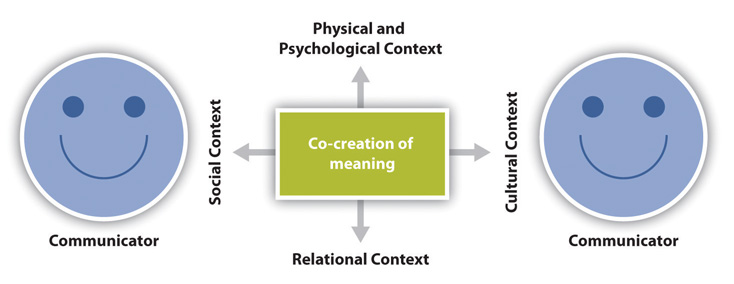
- Contextual: The physical, social, and psychological environment shapes how messages are sent and received. Saying "we need to talk" hits differently in a quiet office than in a crowded hallway.
Characteristics of communication
Communication is a process, not a single event. It involves encoding, transmitting, receiving, and decoding messages in a continuous loop.
Active listening is a major part of effective communication. It means fully concentrating on what the speaker is saying and working to comprehend their message, rather than just waiting for your turn to talk.
Feedback is what closes the loop. It lets the sender gauge whether the receiver understood the message and how they responded to it.
- Verbal feedback: asking questions, paraphrasing what was said
- Nonverbal feedback: nodding, making eye contact, leaning in
Noise is anything that interferes with the communication process by distorting or blocking the message. There are two main types:
- External noise: background sounds, visual distractions, a bad phone connection
- Internal noise: the receiver's own thoughts, biases, emotions, or preoccupations
Contexts of communication
Intrapersonal and interpersonal communication
Intrapersonal communication is the internal dialogue that happens inside your own mind. Think self-reflection, problem-solving, weighing a decision, or setting goals. You do it constantly, even if you don't realize it.
Interpersonal communication is the exchange of messages between two or more people, most often face-to-face. It can be formal (a job interview) or informal (catching up with a friend). Effective interpersonal communication draws on active listening, empathy, self-disclosure, and conflict management skills.

Group and public communication
Small group communication happens when roughly 3 to 15 people interact around a shared purpose, like a work team tackling a project or a study group preparing for an exam. For small groups to function well, members typically need to establish roles, norms, and decision-making processes.
Public communication involves one speaker addressing an audience, such as giving a speech or a presentation. The flow is mostly one-to-many. Effective public communication requires understanding your audience, organizing your message clearly, and delivering it with confidence.
Mass communication is the transmission of messages to a large, often anonymous audience through media channels like television, radio, or the internet. Traditional mass communication tends to be one-way (a news broadcast), while newer forms like social media allow two-way interaction.
Intercultural communication
Intercultural communication occurs when people from different cultural backgrounds exchange messages and work to negotiate shared meaning. Culture shapes communication through values, norms, and expectations.
Some key cultural differences that affect communication:
- Direct vs. indirect styles: Some cultures value saying exactly what you mean; others rely more on implication and context.
- High-context vs. low-context: In high-context cultures, much of the meaning comes from the situation, relationship, and nonverbal cues. In low-context cultures, the words themselves carry most of the meaning.
- Individualism vs. collectivism: Individualist cultures tend to prioritize personal goals in communication, while collectivist cultures emphasize group harmony.
Effective intercultural communication involves cultural self-awareness, knowledge of other cultures, and the ability to adapt your approach.
Communication in settings
Personal communication
In personal settings, communication helps you build and maintain relationships, express emotions and needs, and navigate everyday social interactions. Four skills are especially important here:
- Active listening: Fully concentrating on the speaker's message without interrupting or mentally planning your response
- Empathy: Understanding and sharing the feelings of another person
- Self-disclosure: Sharing personal information, thoughts, and feelings with others, which builds trust and closeness over time
- Conflict management: Addressing and resolving disagreements constructively rather than avoiding them or escalating
Professional communication
In the workplace, communication is how you collaborate with colleagues, interact with clients, and work toward organizational goals. Professional communication uses both formal channels (emails, reports, presentations) and informal channels (hallway conversations, team chats).
- Formal communication follows established protocols and hierarchies.
- Informal communication is more casual and spontaneous but still matters for building relationships and sharing information quickly.
Three communication skills are especially valued in professional settings:
- Clarity: Expressing ideas so they're easy to understand
- Conciseness: Getting to the point without unnecessary filler
- Adaptability: Adjusting your style based on who you're talking to and the situation
Verbal vs nonverbal communication
Verbal communication
Verbal communication is the use of language, both spoken and written, to convey messages. It's not just what you say but how you say it. Three elements shape how verbal messages are received:
- Word choice: Selecting words that accurately convey your intended meaning. Saying "I'm frustrated" lands differently than "I'm furious."
- Tone of voice: The way words are spoken, including pitch, volume, and pacing
- Vocal inflections: Changes in pitch or tone that convey emphasis or emotion (think about how a rising pitch at the end of a sentence turns a statement into a question)
Effective verbal communication means using language that's clear, concise, and appropriate for your audience and purpose.
Nonverbal communication
Nonverbal communication is everything you convey without words: body language, facial expressions, gestures, eye contact, posture, touch, and use of personal space. Research consistently shows that nonverbal cues carry significant weight in how messages are interpreted.
Nonverbal cues interact with verbal messages in three ways:
- Reinforcing: The nonverbal cue supports the verbal message (nodding while saying "I agree")
- Contradicting: The nonverbal cue conflicts with the verbal message (crossing your arms while saying "I'm totally open to feedback")
- Substituting: The nonverbal cue replaces a verbal message entirely (holding up your hand to signal "stop")
Common types of nonverbal communication and what they can convey:
- Eye contact: interest, attention, or dominance
- Posture: confidence, openness, or defensiveness
- Facial expressions: emotions like happiness, sadness, surprise, or anger
- Touch: affection, support, or aggression
- Personal space: comfort level and relationship closeness
The interpretation of nonverbal cues varies across cultures. A gesture that's friendly in one culture might be offensive in another, so awareness of cultural norms is important whenever you're communicating across cultural boundaries.
See Fiveable more often in Google
Mark Fiveable as a preferred source and Google is more likely to show you our guides in Top Stories, with a "preferred" badge in AI Mode and AI Overviews.