3.2 Types of Authoritarian Regimes

🪩Intro to Comparative Politics Unit 3 Review
3.2 Types of Authoritarian Regimes
🪩 Intro to Comparative Politics
Authoritarian regimes come in various forms, from military dictatorships to one-party states and personalist rule. These systems concentrate power in the hands of a few, limiting political freedom and civil liberties through coercion, co-optation, and legitimation strategies.
Understanding the types and control mechanisms of authoritarian regimes is crucial for grasping how they differ from democracies. This knowledge helps explain why some authoritarian systems persist while others crumble, and it sheds light on the complex nature of political power and governance.
Authoritarian Regimes: Types and Control

Top images from around the web for Forms of Authoritarian Regimes
List of regimes - Wikipedia View original
Is this image relevant?
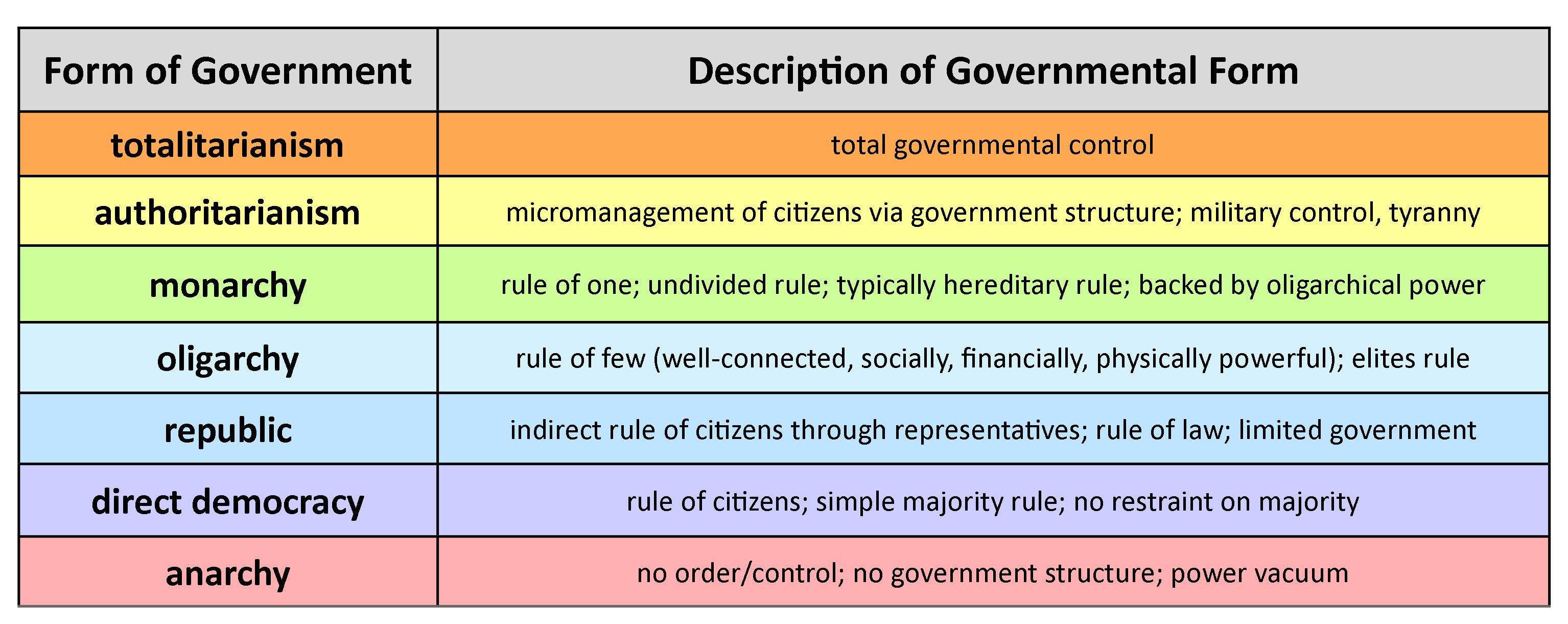
United States Government: Why form a government? | United States Government View original
Is this image relevant?
Political Parties | Texas Government View original
Is this image relevant?
List of regimes - Wikipedia View original
Is this image relevant?
United States Government: Why form a government? | United States Government View original
Is this image relevant?
Forms of Authoritarian Regimes
Authoritarian regimes share a core feature: they concentrate power in the hands of a single leader or a small group, limit political pluralism, and restrict civil liberties. But they differ significantly in who holds power and how they hold it.
- Military dictatorships are led by high-ranking military officers who typically seize power through a coup d'état. They often justify their rule as necessary for maintaining order and national stability. Egypt under Abdel Fattah el-Sisi is a current example: el-Sisi, a former military general, took power after the 2013 coup and has governed with heavy military involvement in politics and the economy.
- One-party states are dominated by a single political party that monopolizes power and suppresses opposition. These regimes combine ideology, propaganda, and repression to maintain control. China under the Chinese Communist Party (CCP) is the most prominent example. The CCP controls all levels of government, and no genuine opposition parties are permitted to compete for power.
- Personalist rule (sometimes called "strongman" rule) is characterized by the dominance of a single individual who exercises power through a cult of personality, patronage networks, and the elimination of potential rivals. North Korea under Kim Jong-un fits this category: the Kim family has maintained dynastic control for three generations, with power flowing directly from the leader rather than from a party or military institution.
- Hybrid regimes combine elements of different authoritarian forms. Russia under Vladimir Putin blends personalist rule with a dominant party (United Russia) and significant military and security-service influence. These regimes can be harder to classify neatly because they draw on multiple sources of authority at once.
Mechanisms of Control in Authoritarian Regimes
Authoritarian regimes rely on a combination of coercion, co-optation, and legitimation to maintain their grip on power. Most regimes use all three, but the balance varies.
- Coercion involves the use of state violence, surveillance, and intimidation to suppress dissent. Regimes employ the military, police, and intelligence agencies to enforce compliance. Syria under Bashar al-Assad is an extreme case, where the regime used widespread military force against its own population during the civil war that began in 2011.
- Co-optation is the selective distribution of benefits to key supporters and potential rivals to secure their loyalty. These benefits can include patronage, government positions, and access to resources. Saudi Arabia, for instance, distributes oil wealth to the royal family and key allies, buying loyalty from groups that might otherwise challenge the regime.
- Legitimation strategies aim to justify the regime's rule through ideology, nationalism, religion, or promises of stability and development. Regimes propagate these narratives through state-controlled media and education systems. Iran's theocratic government, for example, uses Islamic ideology and the authority of the Supreme Leader to frame its rule as religiously legitimate.
- Electoral manipulation is another common tool. Some authoritarian regimes hold elections to create a veneer of democratic legitimacy, but they engage in fraud, voter intimidation, or the outright banning of opposition parties. Belarus under Alexander Lukashenko has held elections widely regarded as neither free nor fair, with the regime using them to claim a popular mandate it doesn't genuinely possess.

Stability and Instability of Authoritarian Regimes
Factors Affecting Authoritarian Regime Stability
The stability of authoritarian regimes depends on a complex interplay of political, economic, social, and international factors. No single factor determines whether a regime survives or falls.
Political factors include the degree of elite cohesion, the effectiveness of the repressive apparatus, the strength of opposition movements, and the regime's adaptability.
- Elite cohesion and effective repression can bolster stability. Singapore under the People's Action Party (PAP) has maintained power since 1959 through tight party discipline and a highly capable bureaucracy.
- Strong opposition movements and regime inflexibility can undermine stability. Tunisia during the 2010-2011 Arab Spring saw a rigid regime unable to adapt to mass protests, leading to the fall of President Ben Ali.
Economic factors such as the level of development, inequality, and the regime's ability to distribute benefits and manage crises directly impact legitimacy and public support.
- Economic growth and effective distribution of benefits can enhance stability. China's rapid economic development over the past four decades has been a major source of legitimacy for the CCP.
- Economic crises and high inequality can erode support and trigger instability. Venezuela under Nicolás Maduro has experienced severe economic collapse, hyperinflation, and mass emigration, all of which have weakened the regime's standing.
Social factors including ethnic, religious, or regional cleavages, civil society mobilization, and information control also shape regime durability.
- Deep social cleavages can challenge regime authority. Yugoslavia under Josip Broz Tito held together diverse ethnic groups through Tito's personal authority, but those divisions resurfaced violently after his death.
- Effective information control and suppression of civil society can reinforce stability. Turkmenistan under Saparmurat Niyazov maintained tight control over media and public life, leaving little space for organized opposition.
International factors such as foreign support or pressure, regional dynamics, and global trends can tip the balance.
- Foreign support can prop up authoritarian regimes. During the Cold War, the Soviet Union provided military and economic aid to allied communist regimes, helping them survive domestic challenges.
- International pressure and regional instability can destabilize authoritarian regimes. Libya under Muammar Gaddafi fell in 2011 after a combination of domestic uprising and NATO military intervention.

Impact of Authoritarian Rule on Society
Political Impact of Authoritarian Rule
Authoritarian regimes stifle political competition, limit civil liberties, and concentrate power in a narrow elite. This often leads to corruption, nepotism, and the erosion of political institutions. Zimbabwe under Robert Mugabe saw decades of institutional decay as Mugabe used state resources to reward loyalists and punish opponents.
The suppression of political opposition and civil society also hinders the development of democratic culture. In Myanmar under decades of military rule, political apathy and deep mistrust of government became widespread, making democratic transition far more difficult.
Economic Impact of Authoritarian Rule
Authoritarian regimes may prioritize short-term stability and the interests of key supporters over long-term economic development. This can result in inefficiency, inequality, and vulnerability to economic crises. Cuba under Fidel Castro, for example, maintained a centrally planned economy that provided basic services but struggled with chronic shortages and low productivity.
A lack of transparency, accountability, and rule of law can also deter investment and distort markets. Indonesia under Suharto became a textbook case of crony capitalism, where business success depended more on political connections than on competition or innovation.
Social Impact of Authoritarian Rule
Authoritarian regimes frequently restrict freedom of expression, association, and religion. This leads to the suppression of civil society, the marginalization of minority groups, and the erosion of social trust. Saudi Arabia's long-standing restrictions on women's rights (many of which have only recently been partially relaxed) illustrate how authoritarian control extends into everyday social life.
Authoritarian policies can also deepen existing social cleavages and fuel resentment among disadvantaged groups. Ethnic, religious, or regional discrimination can sow the seeds of future conflicts. Rwanda under Hutu-dominated rule systematically marginalized the Tutsi minority, contributing to the conditions that led to the 1994 genocide.
The legacy of authoritarian rule often persists even after a transition to democracy. It shapes the political culture, institutional arrangements, and social divisions of the post-authoritarian period. Chile after Augusto Pinochet's dictatorship (1973-1990) continued to grapple with a constitution written under military rule, deep economic inequality, and unresolved human rights abuses for decades after the return to democracy.
See Fiveable more often in Google
Mark Fiveable as a preferred source and Google is more likely to show you our guides in Top Stories, with a "preferred" badge in AI Mode and AI Overviews.