6.1 Structure and functions of forex markets

🥇International Economics Unit 6 Review
6.1 Structure and functions of forex markets
🥇 International Economics
Key Participants and Transactions in Forex Markets
The foreign exchange (forex) market is where currencies are bought and sold. It's the largest financial market in the world, with daily turnover exceeding $7.5 trillion as of 2022. Understanding who trades, what types of transactions exist, and how the market is structured gives you the foundation for everything else in this unit.

Top images from around the web for Key participants in forex markets
Rethinking the small and medium-sized enterprise financing model and the role of commercial ... View original
Is this image relevant?
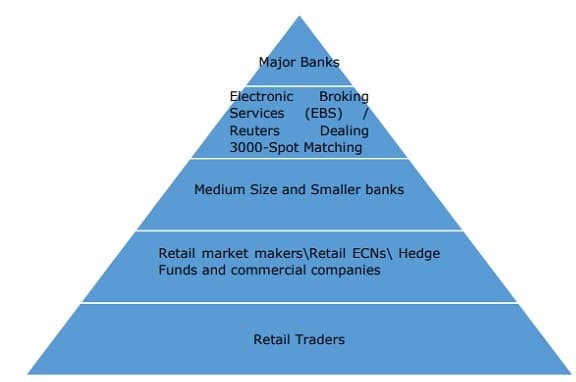
La struttura del mercato forex View original
Is this image relevant?
Foreign Exchange Market: Institutional Structure, Regulation, and Policy Implications View original
Is this image relevant?
Rethinking the small and medium-sized enterprise financing model and the role of commercial ... View original
Is this image relevant?
La struttura del mercato forex View original
Is this image relevant?
Key participants in forex markets
Commercial banks are the backbone of the forex market. They act as dealers, executing trades both for clients and on their own accounts. By constantly quoting prices to buy and sell currencies, they supply the liquidity that keeps the market functioning. Banks also trade with each other in the interbank market, which is where the bulk of forex volume actually occurs. This interbank trading helps them manage their own currency exposure and fill large client orders.
Central banks participate in forex markets to carry out monetary policy and maintain economic stability. They manage their country's foreign exchange reserves and sometimes intervene directly in the market to influence their currency's value. The Bank of Japan, for example, has historically intervened to prevent excessive yen appreciation. Central bank decisions on interest rates and tools like quantitative easing also move exchange rates indirectly, since higher interest rates tend to attract foreign capital and strengthen a currency.
Corporations use forex markets to support international trade and investment. A company like Toyota, which earns revenue in dozens of currencies, needs to convert those earnings back to yen. To protect against unfavorable exchange rate moves, corporations use hedging strategies such as forward contracts or options that lock in a known rate for future transactions.
Institutional investors include mutual funds, pension funds, and insurance companies (think BlackRock or Vanguard). When these firms buy foreign stocks or bonds, they need to convert currency, which generates significant forex volume. Their large transaction sizes can noticeably affect exchange rates for less liquid currency pairs.
Retail traders and investors are individuals who speculate on currency price movements through online platforms like MetaTrader. While each retail trader is small, collectively they account for a growing share of market activity. They typically trade through brokers who aggregate orders and route them to the broader market.

Types of forex transactions and orders
Spot transactions are the most straightforward: two parties exchange currencies at the current market rate. Despite the name "spot," settlement actually occurs within two business days (called T+2) after the trade date. These make up the largest share of daily forex volume.
Forward transactions lock in an exchange rate today for a currency exchange that will happen on a specific future date. They're widely used for hedging. If a U.S. importer knows it will need to pay €1 million in 90 days, it can enter a forward contract now to eliminate uncertainty about what that payment will cost in dollars.
Swap transactions combine a spot and a forward transaction executed simultaneously. For example, a bank might buy euros for dollars in the spot market and simultaneously agree to sell those euros back for dollars at a future date. Swaps are commonly used to manage short-term liquidity needs or hedge interest rate exposure across currencies.
Beyond transaction types, traders use several order types to control execution:
- Market orders execute immediately at the best available price. You get speed but not price certainty.
- Limit orders specify a target price (or better) at which to buy or sell. The trade only executes if the market reaches that price.
- Stop orders trigger a trade when the price hits a predetermined level. Traders use these primarily for risk management, such as automatically selling a position if the exchange rate moves against them beyond a set threshold.

Spreads, Trading Centers, and the Global Forex Market
Bid-ask spreads in forex trading
Every currency quote has two prices. The bid price is what the dealer will pay to buy the currency pair from you. The ask price (also called the offer) is what the dealer will charge to sell it to you. The ask is always higher than the bid.
The bid-ask spread is the difference between these two prices, and it represents the cost of executing a trade. For major pairs like EUR/USD or USD/JPY, spreads are typically very tight (around 1-2 pips). For exotic or less liquid pairs, spreads can be much wider.
Why does the spread matter? Every time you enter and exit a trade, you pay the spread. Wider spreads eat into profits, so traders generally prefer tighter spreads.
Three main factors influence spread width:
- Market liquidity: Heavily traded pairs have tighter spreads because there are more buyers and sellers competing. EUR/USD, the most traded pair in the world, consistently has the tightest spreads.
- Volatility: During periods of high uncertainty (major economic announcements, geopolitical events), dealers widen spreads to compensate for the increased risk of holding inventory.
- Time of day: Spreads tend to be tightest when major trading sessions overlap and widest during low-volume hours.
Major global forex trading centers
Forex trading doesn't happen on a single exchange. It's an over-the-counter (OTC) market spread across several major financial centers, and trading rotates around the globe as each center opens and closes.
- London is the world's largest forex hub, handling roughly 38% of global turnover. Its time zone bridges the Asian and North American sessions, which is a key reason for its dominance in liquidity.
- New York is the second-largest center. Trading is especially active during the London-New York overlap (roughly 8:00 AM to 12:00 PM EST), which is the most liquid window in the entire trading day.
- Tokyo is Asia's primary forex center and heavily influences yen-related pairs like USD/JPY and AUD/JPY. It sets the tone for the Asian session each day.
- Singapore and Hong Kong are fast-growing Asian centers that benefit from strategic locations and business-friendly financial regulations.
Because these centers are spread across different time zones, trading flows seamlessly from one to the next. When Tokyo winds down, London is opening. When London's session matures, New York comes online. This creates a continuous 24-hour market (Sunday evening to Friday evening, U.S. time) with consistent liquidity and near-constant price discovery. There's no opening bell and no closing bell, just a rolling global trading day.
See Fiveable more often in Google
Mark Fiveable as a preferred source and Google is more likely to show you our guides in Top Stories, with a "preferred" badge in AI Mode and AI Overviews.