15.4 Climate change and international economic policy

🥇International Economics Unit 15 Review
15.4 Climate change and international economic policy
🥇 International Economics
Climate change is reshaping the global economy, hitting agriculture, infrastructure, and public health in ways that vary dramatically by region. Developing countries and coastal areas face the steepest risks, even though they've often contributed least to the problem. These shifts are altering productivity, commodity prices, and government budgets worldwide.
International trade policies sit at the center of this issue. Trade can worsen environmental damage through higher emissions and resource exploitation, but it also spreads clean technologies across borders. As a result, trade agreements increasingly include environmental provisions, creating new tensions between economic growth and sustainability.
Climate Change and Global Economic Implications

Top images from around the web for Global economic impact of climate change
Wikipedia:Reference desk/Archives/Science/2017 September 5 - Wikipedia View original
Is this image relevant?
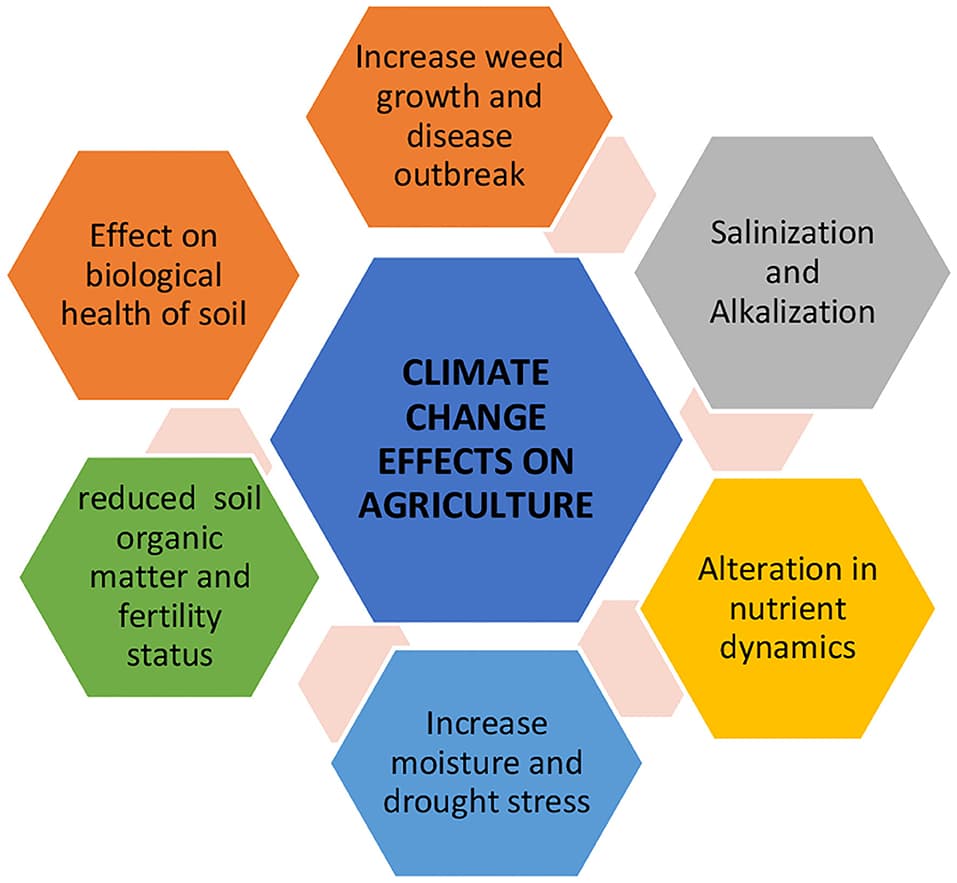
Frontiers | Climate Change and Salinity Effects on Crops and Chemical Communication Between ... View original
Is this image relevant?
Source: Arvis et al. (2020). View original
Is this image relevant?
Wikipedia:Reference desk/Archives/Science/2017 September 5 - Wikipedia View original
Is this image relevant?
Frontiers | Climate Change and Salinity Effects on Crops and Chemical Communication Between ... View original
Is this image relevant?
Global economic impact of climate change
Climate change affects economies through several interconnected channels. The costs are large and growing, but they fall unevenly across countries and sectors.
Agricultural productivity losses are among the most direct impacts. Shifting temperature and precipitation patterns alter growing seasons and reduce yields for staple crops like wheat, rice, and maize. More frequent droughts, floods, and extreme weather events compound these losses. The World Bank estimates that climate change could push an additional 132 million people into extreme poverty by 2030, largely through agricultural disruption.
Infrastructure damage from natural disasters is accelerating. Hurricanes, typhoons, and cyclones destroy buildings, roads, and power grids. Hurricane Katrina (2005) caused over $125 billion in damage; Typhoon Hainan (2013) killed over 6,000 people in the Philippines. Wildfires in Australia (2019–2020) and California have caused billions in property damage and disrupted regional economies for months.
Rising sea levels threaten coastal cities where hundreds of millions of people live. Low-lying areas in Miami, Mumbai, and Shanghai face increasing flood risk, forcing governments to spend heavily on coastal protection or relocate populations entirely. Small island nations like the Maldives and Kiribati face existential threats, with some projections showing them largely uninhabitable by 2100.
Health impacts reduce labor productivity and raise healthcare costs. Warmer temperatures expand the range of vector-borne diseases like malaria and dengue fever. Heatwaves in Europe and South Asia have caused tens of thousands of deaths and significant drops in worker output during peak months.
The distribution of these impacts is deeply unequal. Developing countries in sub-Saharan Africa and South Asia are more vulnerable because they have fewer resources to adapt. Meanwhile, wealthier nations that historically produced the most emissions have more capacity to invest in resilience.
At the macroeconomic level, these effects add up:
- Potential reduction in global GDP growth, with some estimates suggesting losses of 10–23% of global GDP by 2100 under high-emission scenarios
- Increased volatility in commodity prices, especially for agricultural goods
- Strain on public finances as governments spend more on disaster response, adaptation, and mitigation

Trade policies and environmental sustainability
Trade and the environment interact in complex ways. Expanding trade can increase environmental harm, but it can also be a vehicle for spreading solutions.
Environmental externalities of trade include:
- Transport emissions: Shipping goods across long distances generates significant greenhouse gases. International shipping alone accounts for roughly 3% of global emissions.
- Resource exploitation: Global demand drives deforestation and ecosystem degradation. Palm oil production, for example, has destroyed vast areas of tropical rainforest in Indonesia and Malaysia to supply international markets.
- Carbon leakage: When one country tightens environmental regulations, carbon-intensive industries may relocate to countries with weaker rules. This doesn't reduce global emissions; it just moves them. The EU's proposed Carbon Border Adjustment Mechanism (CBAM) is designed to address exactly this problem by taxing imports based on their carbon content.
Trade agreements increasingly include environmental provisions. Many modern agreements contain environmental chapters that aim to harmonize standards and promote sustainable practices. However, tensions arise when trade rules conflict with environmental policies. For instance, WTO rules have sometimes been used to challenge subsidies for renewable energy, creating friction between trade liberalization and climate goals.
Trade also helps spread clean technology. International commerce facilitates the transfer of eco-friendly innovations like solar panels, wind turbines, and electric vehicles. Reducing tariffs and non-tariff barriers on environmental goods and services makes these technologies cheaper and more accessible, particularly for developing countries that need them most.

International cooperation for climate challenges
Climate change is a global problem that no single country can solve alone. International institutions provide the framework for collective action.
The United Nations Framework Convention on Climate Change (UNFCCC), established in 1992, is the primary international treaty for coordinating the global response. It provides a platform for negotiations on emission reduction targets and adaptation measures, with nearly universal membership (198 parties).
The Paris Agreement (2015) is the most significant accord to emerge from this process. Its key features include:
- A goal to limit global temperature rise to well below 2°C above pre-industrial levels, with efforts to stay below 1.5°C
- Nationally Determined Contributions (NDCs): Each country submits voluntary pledges for emission reductions, updated every five years with the expectation of increasing ambition
- Mechanisms for climate finance, technology transfer, and capacity building to help developing countries participate. Wealthy nations pledged $100 billion per year in climate finance, though delivery has consistently fallen short
Challenges in international cooperation remain significant:
- National interests vs. global responsibility: Countries that depend heavily on fossil fuel exports (e.g., Saudi Arabia, Russia) face different incentives than those most vulnerable to climate impacts
- Equitable burden-sharing: Developing nations argue that wealthy countries, which produced most historical emissions, should bear greater costs. This tension shaped the creation of a "loss and damage" fund at COP27 in 2022
- The free-rider problem: Since the atmosphere is a global commons, individual countries have an incentive to let others bear the cost of emission reductions while still benefiting from the results. Voluntary NDCs make enforcement difficult
Market instruments for low-carbon transitions
Governments use market-based tools to put a price on pollution and steer economies toward cleaner energy. The two main carbon pricing mechanisms work differently:
-
Carbon taxes set a fixed price per ton of emitted. This gives businesses a clear, predictable cost signal and incentivizes them to reduce emissions or switch to cleaner technologies. Sweden's carbon tax, introduced in 1991 at around $26 per ton, now exceeds $100 per ton and has helped cut emissions while the economy grew.
-
Emissions trading systems (ETS) take a different approach. The government sets a cap on total emissions and issues a limited number of tradable allowances. Companies that reduce emissions cheaply can sell their unused allowances to companies that find reductions more expensive. The EU ETS is the world's largest, covering about 40% of EU emissions. California's Cap-and-Trade Program is another major example.
The effectiveness of either approach depends on design choices: how high the price is set, which sectors are covered, and how strictly the system is enforced.
Subsidies and incentives for clean energy complement carbon pricing:
- Government funding for research, development, and deployment of renewables (solar, wind, hydro)
- Feed-in tariffs and tax credits that make clean energy investment more attractive
- Phasing out fossil fuel subsidies, which the IMF estimated at $7 trillion globally in 2022 (including implicit subsidies from unpriced environmental damage), to level the playing field
Limitations and challenges remain real obstacles:
- Political feasibility: Carbon taxes and higher energy prices are often unpopular with voters. France's "yellow vest" protests in 2018 were triggered partly by a fuel tax increase linked to climate policy.
- Just transition: Workers in fossil fuel industries (coal miners, oil and gas workers) and their communities need retraining and economic support during the shift. Without this, political opposition can stall progress.
- Competitiveness concerns: Without a global carbon price, companies in countries with strict carbon pricing may lose market share to competitors in countries without one. This circles back to the carbon leakage problem and the need for border adjustment mechanisms.
See Fiveable more often in Google
Mark Fiveable as a preferred source and Google is more likely to show you our guides in Top Stories, with a "preferred" badge in AI Mode and AI Overviews.