2.2 Heckscher-Ohlin model and factor endowments

🥇International Economics Unit 2 Review
2.2 Heckscher-Ohlin model and factor endowments
🥇 International Economics
Heckscher-Ohlin Model and Factor Endowments
The Heckscher-Ohlin (H-O) model explains why countries trade by looking at what resources they have. Rather than focusing on productivity differences (like the Ricardian model), it argues that trade patterns are driven by differences in factor endowments, the relative supplies of labor, capital, land, and natural resources across countries. A country will export goods that intensively use whichever factor it has in relative abundance.
This model also has real consequences for who wins and who loses from trade within a country, making it central to debates about trade policy and income inequality.

Top images from around the web for Key assumptions of Heckscher-Ohlin model
Reading: Components of Economic Growth | Macroeconomics View original
Is this image relevant?
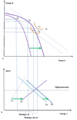
Category:Heckscher–Ohlin model - Wikimedia Commons View original
Is this image relevant?
Le modèle Heckscher-Ohlin-Samuelson appliqué à la zone euro | Captain Economics View original
Is this image relevant?
Reading: Components of Economic Growth | Macroeconomics View original
Is this image relevant?
Category:Heckscher–Ohlin model - Wikimedia Commons View original
Is this image relevant?
Key Assumptions of the Heckscher-Ohlin Model
The H-O model is built on a simplified 2×2×2 framework: two countries, two goods, and two factors of production. A standard example uses the United States and China, producing automobiles and textiles with capital and labor.
The critical assumptions:
- Identical technologies and preferences. Both countries have access to the same production methods, and consumers in both countries have similar tastes. This is what separates H-O from the Ricardian model: the difference between countries isn't how they produce, but what they have to produce with.
- Goods differ in factor intensity. Automobiles are capital-intensive (they require more capital per unit of labor), while textiles are labor-intensive (they require more labor per unit of capital).
- Countries differ in factor endowments. The U.S. is capital-abundant (higher ratio of capital to labor), while China is labor-abundant (higher ratio of labor to capital).
From these assumptions, the model's core prediction follows:
Countries export goods that intensively use their relatively abundant factor. The capital-abundant U.S. exports capital-intensive automobiles; labor-abundant China exports labor-intensive textiles.
A further prediction is factor price equalization: as countries trade, the prices of capital (interest rates) and labor (wages) tend to converge between trading partners. In theory, trade acts as a substitute for factor mobility, pushing factor prices toward equality even when workers and capital can't cross borders.

Factor Endowments and Comparative Advantage
Factor endowments are a country's relative supplies of the factors of production: land (arable land for agriculture), labor (both skilled and unskilled workers), capital (machinery, infrastructure, financial capital), and natural resources (oil, minerals, timber).
What matters is relative abundance, not absolute amounts. Germany has a high capital-to-labor ratio, giving it a comparative advantage in capital-intensive goods like precision machinery. Bangladesh has a high labor-to-capital ratio, giving it a comparative advantage in labor-intensive goods like garments.
These differences in endowments drive trade patterns through specialization:
- Saudi Arabia, rich in oil reserves, exports petroleum
- Japan, with high levels of physical and human capital but few natural resources, exports high-tech electronics
- Canada, with vast arable land, exports agricultural products and timber
The key insight is that trade allows countries to indirectly "export" their abundant factors. When Bangladesh exports garments, it's effectively exporting the labor embedded in those goods.

Trade Effects on Factor Prices
The H-O model doesn't just predict what gets traded. It also predicts who benefits and who gets hurt within each country.
Trade increases demand for a country's abundant factor (since exports expand in the sector that uses it intensively) and decreases demand for its scarce factor (since imports replace domestic production in the sector that uses it). This shifts relative factor prices:
- In a capital-abundant country like South Korea, trade raises returns to capital (higher profits for business owners) but puts downward pressure on wages
- In a labor-abundant country like Vietnam, trade raises wages for workers but lowers returns to capital
The Stolper-Samuelson theorem formalizes this: free trade benefits owners of the abundant factor and harms owners of the scarce factor. This has direct implications for income distribution. In developed, capital-abundant countries, trade tends to benefit capital owners and skilled workers while squeezing unskilled workers' wages. The reverse holds in labor-abundant developing countries.
This is why trade policy is politically contentious. Even when trade increases a country's total output, the gains aren't evenly distributed.
Empirical Evidence and Limitations
The H-O model is elegant, but real-world evidence for it is mixed.
The Leontief Paradox is the most famous challenge. In the 1950s, economist Wassily Leontief tested the model using U.S. trade data and found that U.S. exports were actually more labor-intensive than U.S. imports. This directly contradicted the H-O prediction, since the U.S. was clearly capital-abundant. Possible explanations include:
- Human capital differences. U.S. workers were far more educated and skilled than workers elsewhere, so U.S. "labor" embodied significant capital in the form of training and education.
- Technological advantages. The U.S. had superior technology that made its labor more productive, complicating the simple capital-vs-labor distinction.
Where the model holds up: Trade patterns for primary commodities and resource-intensive goods do tend to follow factor endowment predictions. Resource-rich countries export raw materials; capital-rich countries export manufactured goods.
Where it falls short:
- It assumes identical technologies across countries, which is rarely true
- It ignores transportation costs, tariffs, quotas, and other trade barriers
- It cannot explain intra-industry trade, where countries simultaneously export and import similar products (e.g., the U.S. both exports and imports automobiles). Explaining this requires models based on economies of scale and product differentiation.
- It doesn't account well for trade in services like consulting, finance, or tourism
Despite these limitations, the H-O model remains a foundational tool in trade theory. It provides the clearest framework for understanding how resource differences shape what countries produce and trade, and it offers real predictions about the distributional consequences of opening up to trade.
See Fiveable more often in Google
Mark Fiveable as a preferred source and Google is more likely to show you our guides in Top Stories, with a "preferred" badge in AI Mode and AI Overviews.