11.3 Repeated games and the Folk Theorem

🧃Intermediate Microeconomic Theory Unit 11 Review
11.3 Repeated games and the Folk Theorem
🧃 Intermediate Microeconomic Theory
Impact of Repeated Interactions

Top images from around the web for Repeated Games and Strategic Complexity
Crosstalk in concurrent repeated games impedes direct reciprocity and requires stronger levels ... View original
Is this image relevant?
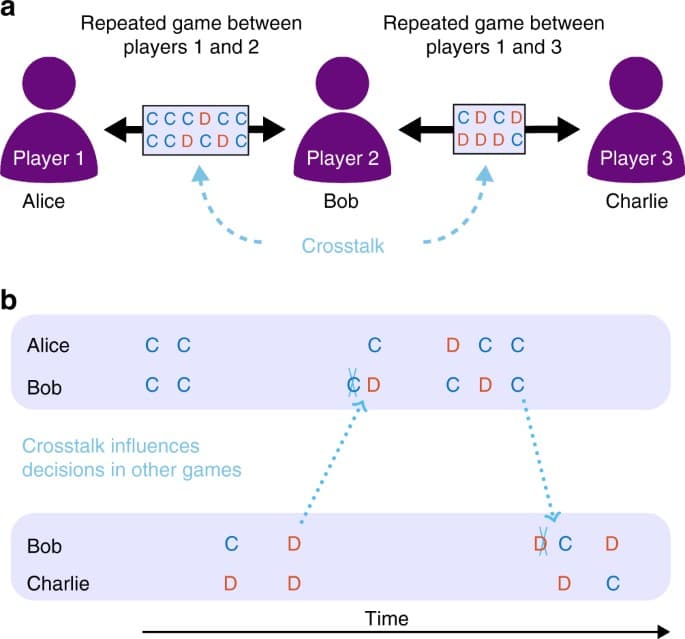
Crosstalk in concurrent repeated games impedes direct reciprocity and requires stronger levels ... View original
Is this image relevant?
Repeated Games and Strategic Complexity
A repeated game takes a single strategic interaction (the "stage game") and plays it multiple times between the same players. Because players observe what happened in earlier rounds, they can condition their current strategy on past behavior. This is what separates repeated games from simply playing a one-shot game over and over with strangers.
The shadow of the future is the core mechanism. When you know you'll face the same opponent again, today's choices carry consequences beyond today's payoff. The threat of future retaliation, or the promise of future reward, reshapes incentives in ways that don't exist in one-shot play.
Strategies in repeated games incorporate three elements absent from one-shot interactions:
- Punishment: retaliating against a player who deviated from cooperation
- Forgiveness: returning to cooperation after a punishment phase
- Reciprocity: matching your opponent's behavior from previous rounds
Discounting determines how much players care about future payoffs relative to present ones. The discount factor lies between 0 and 1:
- A high (close to 1) means future payoffs matter almost as much as current ones, making cooperation easier to sustain
- A low (close to 0) means players heavily prioritize immediate gains, making defection more tempting
You can also interpret as the probability the game continues to the next round. If there's a 5% chance the game ends after each round, then . Either interpretation (patience or continuation probability) produces the same mathematical structure.
The key result: repeated interactions can sustain cooperative behavior even in games where defection is the dominant strategy in the one-shot version. The infinitely repeated prisoner's dilemma is the canonical example.
Complexity and Examples in Repeated Games
Players can deploy far richer strategies in repeated games than in one-shot games. Two classic strategies illustrate the range:
- Tit-for-tat: Cooperate in the first round, then in every subsequent round, do whatever your opponent did last round. This strategy is simple, retaliatory, and forgiving.
- Grim trigger: Cooperate until your opponent defects even once, then defect forever. This is maximally punitive with zero forgiveness.
The infinitely repeated prisoner's dilemma is the standard model for studying these dynamics. In the stage game, two players each choose to cooperate (C) or defect (D). Mutual cooperation yields a moderate reward for both; mutual defection yields a low payoff for both; and if one defects while the other cooperates, the defector gets the highest payoff while the cooperator gets the worst.
To see why cooperation can be sustained, consider grim trigger with a concrete example. Suppose the stage-game payoffs are: mutual cooperation gives each player 3, mutual defection gives each player 1, and a unilateral defector gets 4 while the cooperator gets 0. Under grim trigger, the present value of staying on the cooperative path is:
If a player deviates, they get 4 today but then 1 forever after (since both revert to permanent defection):
Cooperation is sustainable when the cooperative path yields at least as much, which gives:
Solving, you get . So even moderate patience sustains cooperation here.
Real-world repeated games show up in many settings:
- Business partnerships with ongoing transactions, where cheating today risks losing a profitable relationship
- International trade agreements renegotiated across multiple rounds
- Repeated auctions on online marketplaces, where sellers build reputations over time
Cooperation in Repeated Games
Factors Influencing Cooperation
Four factors determine whether cooperation can be sustained:
-
Discount factor (): Higher makes cooperation easier to support because the future gains from continued cooperation outweigh the one-time temptation to defect. The critical threshold for depends on the specific payoffs in the stage game.
-
Trigger strategies: These enforce cooperation by threatening punishment for deviation. Grim trigger is the harshest (permanent defection after any deviation), while tit-for-tat is more forgiving (only punishes for one round, then returns to cooperation if the opponent does). The choice of punishment strategy affects both the minimum required and the severity of equilibrium breakdowns.
-
The Folk Theorem: Any feasible and individually rational payoff can be sustained as an equilibrium in an infinitely repeated game, provided players are sufficiently patient. More on this below.
-
Indefinite vs. finite repetition: This distinction matters enormously. In a finitely repeated game with a known endpoint, backward induction unravels cooperation. Here's why:
- In the last round, there's no future to worry about, so both players defect (it's just a one-shot game).
- But then the second-to-last round is effectively the last "real" round, so they defect there too.
- This logic cascades all the way back to round one. Indefinite repetition (no known final round) avoids this unraveling because there's always a future to consider. Note that if the stage game has multiple Nash equilibria, cooperation can sometimes be sustained even in finitely repeated games, since the unraveling argument depends on a unique stage-game equilibrium.
Monitoring and Credibility in Repeated Games
For punishment strategies to work, players need to detect deviations and carry out credible threats.
Subgame perfection is the refinement that handles credibility. A strategy profile is subgame perfect if it constitutes a Nash equilibrium in every subgame, not just the game as a whole. This eliminates empty threats that a player would never actually follow through on. Grim trigger in the prisoner's dilemma is subgame perfect: once triggered, mutual defection is a Nash equilibrium of the remaining game, so both players are best-responding by continuing to defect. But some punishment strategies fail this test because carrying out the punishment hurts the punisher more than simply reverting to cooperation would.
Monitoring determines what players can observe:
- Perfect monitoring: All past actions are fully observable. Deviations are detected immediately.
- Imperfect monitoring: Players only receive noisy signals about opponents' actions. This makes sustaining cooperation harder because you can't always distinguish a genuine deviation from an unlucky outcome. The theory of repeated games with imperfect monitoring is substantially more complex and relies on statistical inference about opponents' behavior.
Renegotiation poses a subtle problem. After a deviation, both players might prefer to "forgive and forget" rather than endure a costly punishment phase. If players anticipate this, the punishment threat loses credibility. Renegotiation-proof equilibria are those where players wouldn't mutually agree to abandon the punishment, which places additional constraints on what outcomes can be sustained. This is one reason tit-for-tat is sometimes preferred over grim trigger in practice: its punishment phase (one round of mutual defection) is less costly to carry out, making it more resistant to renegotiation pressure.
Equilibrium Outcomes in Repeated Games
Folk Theorem and Payoff Sets
The Folk Theorem characterizes the set of Nash equilibrium payoffs achievable in infinitely repeated games when players are sufficiently patient. To state it precisely, you need two concepts:
Feasible payoff set: The set of all average payoff vectors that can be achieved by some combination (including probabilistic mixtures) of stage-game action profiles. Geometrically, this is the convex hull of all stage-game payoff vectors. Any point inside this convex hull can be reached by players randomizing over action profiles across rounds in appropriate proportions.
Minmax payoff: The lowest payoff that other players can force on player , even when player best-responds:
Here is player 's action and represents the actions of all other players. This is the worst-case guarantee for player . No rational player would accept less than this in equilibrium, because they could always guarantee themselves at least by best-responding to whatever others do. In the prisoner's dilemma example above, each player's minmax value is 1 (the mutual defection payoff).
Individually rational payoff set: The subset of feasible payoffs where every player receives at least their minmax value:
This set defines the "reasonable" outcomes. Payoffs below a player's minmax aren't individually rational because that player would prefer to deviate and guarantee themselves at least .
Applying the Folk Theorem
The Folk Theorem states: any payoff vector in the individually rational payoff set can be sustained as a subgame perfect equilibrium of the infinitely repeated game, provided the discount factor is sufficiently close to 1.
To construct an equilibrium supporting a target payoff, you typically follow three steps:
- Define a cooperative phase: Players play the action profile (or sequence of action profiles) that generates the target average payoff.
- Design a punishment phase: If any player deviates, all players switch to a punishment strategy that drives the deviator's payoff down to (or near) their minmax value. The punishment must itself be incentive-compatible, meaning no player wants to deviate from the punishment either.
- Verify sufficient patience: Check that is high enough that the long-run gains from cooperation outweigh the short-run temptation to deviate. This involves comparing the present value of the cooperative path against the present value of deviating and facing punishment.
Grim trigger supports mutual cooperation in the prisoner's dilemma by threatening permanent reversion to mutual defection. More sophisticated constructions use optimal penal codes (Abreu, 1988), which minimize the length or severity of the punishment phase needed to deter deviation. These are particularly useful because shorter, sharper punishments can sustain cooperation at lower values of than grim trigger requires.
The Folk Theorem has several important implications:
- Multiplicity of equilibria: Infinitely repeated games typically have a vast number of equilibria, not just one. This is both a strength (many cooperative outcomes are possible) and a weakness (the theory alone doesn't predict which outcome will actually occur). This is sometimes called the "embarrassment of riches" problem.
- Cooperation without external enforcement: Long-term relationships can sustain cooperation through self-enforcing agreements, with no need for contracts or third-party enforcement.
- Patience matters: The more patient the players, the wider the range of outcomes that can be sustained. As , the entire individually rational payoff set becomes achievable.
Applications span multiple fields:
- Industrial organization: Explaining how firms in an oligopoly sustain collusive pricing above competitive levels, and why price wars sometimes erupt (as punishment phases or breakdowns in cooperation)
- International relations: Modeling how countries maintain trade agreements or arms control treaties without a supranational enforcer
- Labor economics: Understanding long-term employer-employee relationships where both sides invest in the relationship, sustained by the threat of termination or quitting
See Fiveable more often in Google
Mark Fiveable as a preferred source and Google is more likely to show you our guides in Top Stories, with a "preferred" badge in AI Mode and AI Overviews.