10.4 Bounded rationality and satisficing behavior

🧃Intermediate Microeconomic Theory Unit 10 Review
10.4 Bounded rationality and satisficing behavior
🧃 Intermediate Microeconomic Theory
Bounded Rationality and Cognitive Limits
Concept and Assumptions
Herbert Simon introduced bounded rationality to describe how real decision-makers operate under constraints that standard theory ignores. The traditional model assumes agents can rank all alternatives, process all relevant information, and select the utility-maximizing option. Bounded rationality drops those assumptions.
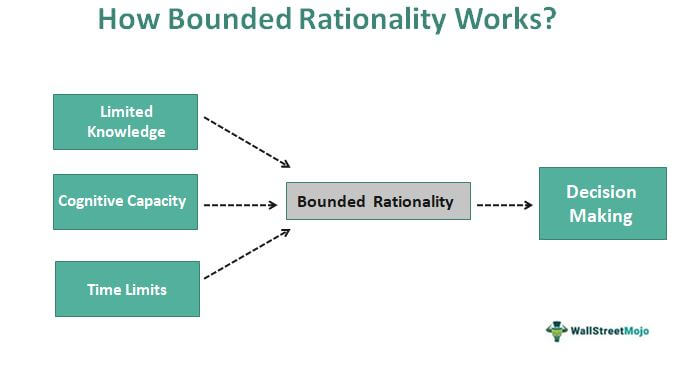
Instead, it posits that decision-makers face three core constraints:
- Finite computational ability: People can't solve complex optimization problems in their heads. As the number of alternatives or variables grows, the cognitive demands of finding the true optimum become unmanageable.
- Limited information access: Agents rarely have complete information about all options, prices, or quality levels. Gathering more information is itself costly, so the decision to acquire information is itself a bounded problem.
- Time and attention scarcity: Decisions must be made within time windows, and cognitive effort spent on one choice reduces capacity for others.
Because of these constraints, Simon argued that humans are better described as satisficers rather than optimizers. They don't search for the best possible outcome; they search for one that's good enough.
Impact on Decision-Making
These cognitive limits shape decision-making in predictable ways:
- People rely on heuristics (mental shortcuts) to simplify complex problems rather than performing full cost-benefit analyses.
- Decision-makers often evaluate alternatives sequentially rather than simultaneously, stopping once they find an acceptable option.
- Memory constraints mean that recent or vivid information gets disproportionate weight (a phenomenon closely tied to the availability heuristic, discussed below).
- Cognitive biases systematically distort how people interpret data, leading to errors that aren't random but patterned.
The key point for microeconomic theory is that these aren't occasional lapses. They're structural features of human cognition that produce consistent, predictable departures from the standard model's predictions. That predictability is what makes bounded rationality useful for modeling rather than just a critique.
Satisficing vs. Maximizing Behavior
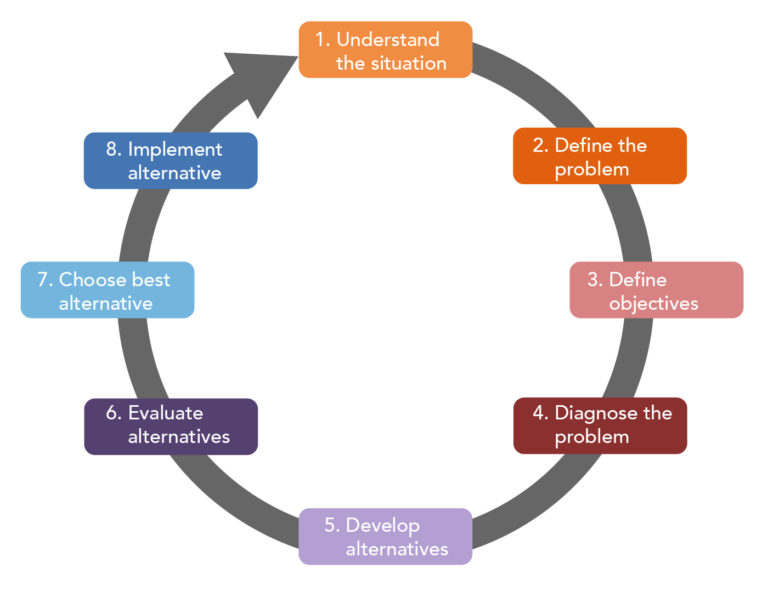
Satisficing Behavior
Satisficing is a decision strategy where the agent sets an aspiration level, a minimum threshold of acceptability, and then searches through options until finding one that meets or exceeds that threshold. Once a satisfactory option is found, the search stops.
You can think of the process in steps:
- The agent defines a set of criteria that an acceptable option must satisfy.
- The agent searches through available alternatives one at a time (sequential search).
- Each alternative is evaluated against the aspiration level.
- If the alternative meets or exceeds the threshold, the agent selects it and stops searching.
- If the search continues without success for long enough, the agent may lower the aspiration level. Conversely, if acceptable options appear quickly, the threshold may rise.
This dynamic adjustment of aspiration levels is a distinctive feature of satisficing. The threshold isn't exogenous and fixed; it responds to the agent's experience during the search process.
Consider apartment hunting. A satisficer sets criteria (under $1,200/month, within 20 minutes of campus, has laundry) and takes the first apartment that checks those boxes. They don't visit every listing in the city to ensure they've found the absolute best deal. The search cost of doing so would far exceed any likely gain. If after three weeks nothing meets those criteria, the satisficer might relax the commute requirement to 30 minutes.
Maximizing Behavior
Maximizing, by contrast, is the strategy assumed by standard rational choice theory. The agent evaluates all available alternatives and selects the one yielding the highest utility.
- This requires complete information about every option, unlimited time, and the cognitive capacity to compare them all.
- In practice, maximizing often leads to decision paralysis: the more options available, the harder it becomes to choose, and the less satisfied the agent feels with the eventual choice (because they keep wondering if something better existed). Research by Schwartz (2004) on the "paradox of choice" documents this pattern.
- Maximizing can also produce diminishing returns to search. Spending an extra 40 hours researching car models to save $200 is a poor allocation of time for most people, especially once you account for the opportunity cost of those hours.
The satisficing-maximizing distinction matters because it changes how you model consumer and firm behavior. If agents satisfice, demand curves, search behavior, and market equilibria all look different than the standard model predicts. For instance, price dispersion can persist in equilibrium because consumers stop searching once they find a "good enough" price rather than continuing until they find the lowest one.
Bounded Rationality in Economic Decisions
Market Implications
When economic agents satisfice rather than optimize, several consequences follow for markets:
- Persistent price dispersion and inefficiencies: Consumers may stick with familiar brands even when cheaper or higher-quality alternatives exist, reducing competitive pressure on incumbents. The law of one price, which standard theory predicts for homogeneous goods, frequently fails in practice partly for this reason.
- Information overload effects: In markets with many options (think mutual funds or insurance plans), more choice can actually reduce decision quality. Iyengar and Lepper's (2000) jam study found that consumers facing 24 jam varieties were far less likely to purchase than those facing 6. Investors facing hundreds of fund options often default to whatever's easiest rather than analyzing expected returns.
- Limited predictive power of standard models: If agents aren't optimizing, models built on optimization may systematically mispredict behavior. This is a core motivation for behavioral economics as a field.
- Behavioral anomalies become explicable: Phenomena like status quo bias (preferring the current state of affairs over switching), the endowment effect (valuing what you already own more than identical items you don't), and persistent brand loyalty all follow naturally from bounded rationality. These aren't puzzles to be explained away; they're expected outcomes of satisficing behavior.
Policy and Design Considerations
Recognizing bounded rationality has direct implications for how policies and institutions should be designed:
- Choice architecture matters enormously. The way options are presented affects which ones people choose, because boundedly rational agents are sensitive to framing, defaults, and complexity. Retirement savings plans with automatic enrollment (where the default is to participate) see participation rates around 90%, compared to roughly 50% for plans requiring active opt-in. The "rational" agent shouldn't be affected by which option is the default, but real agents clearly are.
- Simplification improves outcomes. Simplifying tax forms, insurance plan comparisons, or loan disclosures reduces cognitive burden and helps people make choices closer to what they'd prefer with full information. This is why standardized "nutrition label" formats for financial products have gained traction in policy discussions.
- Adaptive policy design: Because aspiration levels and heuristics shift as people learn, effective policies account for behavioral change over time rather than assuming static preferences.
The broader point is that if you're designing markets, regulations, or institutions, assuming perfect rationality can lead to policies that work beautifully in theory but fail in practice. Bounded rationality gives you a more reliable foundation for predicting how people will actually respond.
Heuristics in Bounded Rationality
Common Heuristics
Heuristics are the cognitive shortcuts that boundedly rational agents use to make decisions without full optimization. They're not inherently bad; they often produce reasonable outcomes quickly. But they can also generate systematic biases. Kahneman and Tversky's research program, starting in the 1970s, catalogued many of these.
- Availability heuristic: People estimate the probability of an event based on how easily examples come to mind. After seeing news coverage of a plane crash, people overestimate the risk of flying relative to driving, even though driving is statistically far more dangerous per mile traveled. The ease of recall substitutes for actual frequency data.
- Representativeness heuristic: People judge the probability that something belongs to a category based on how similar it looks to a typical member of that category, often ignoring base rates. An investor might assume a company with a charismatic CEO and sleek branding is a good investment because it resembles past successes, while ignoring the fact that the vast majority of startups fail.
- Anchoring and adjustment: People start from an initial reference point (the "anchor") and adjust insufficiently from it. In negotiations, the first number put on the table disproportionately influences the final outcome, even if that number was arbitrary. Experiments show that even random anchors (like spinning a wheel) affect subsequent numerical estimates.
- Affect heuristic: Emotional reactions substitute for careful analysis. If something feels risky or unpleasant, people avoid it regardless of the objective expected value. This helps explain why people simultaneously buy lottery tickets (low expected value, positive affect) and over-insure against vivid but rare risks.
- Recognition heuristic: When choosing between two options, people favor the one they recognize. This can actually be effective in some contexts (recognized brands may genuinely be higher quality on average) but fails when recognition is driven by advertising rather than quality signals.
Heuristics in Economic Behavior
From a microeconomic standpoint, heuristics explain several important phenomena:
- Reduced cognitive load: Heuristics allow agents to make decisions in environments where full optimization is computationally impossible. This is genuinely efficient in many cases, and some researchers argue heuristics can even outperform optimization in noisy, uncertain environments (Gigerenzer's "ecological rationality" framework).
- Systematic biases: Because heuristics follow predictable patterns, the errors they produce aren't random. Overconfidence, neglect of base rates, and anchoring effects show up consistently across populations, which means they can be modeled and, to some extent, predicted.
- Market anomalies: Heuristic-driven behavior contributes to phenomena like asset price bubbles (investors following trends via representativeness rather than analyzing fundamentals), brand premiums that exceed quality differences, and under-diversification in investment portfolios (investors over-weighting familiar domestic stocks).
- Context-dependent risk attitudes: Standard theory predicts consistent risk preferences, but heuristics explain why the same person might be risk-averse in one context and risk-seeking in another, depending on framing and which heuristic is activated. This connects directly to prospect theory, which you may encounter elsewhere in this unit.
Understanding heuristics doesn't mean dismissing economic agents as irrational. It means building more realistic models of how they actually process information and make choices under the constraints they face. The goal is better prediction, not judgment.
See Fiveable more often in Google
Mark Fiveable as a preferred source and Google is more likely to show you our guides in Top Stories, with a "preferred" badge in AI Mode and AI Overviews.