17.3 The Belt and Road Initiative and China's global strategy

🏓History of Modern China Unit 17 Review
17.3 The Belt and Road Initiative and China's global strategy
🏓 History of Modern China
China's Belt and Road Initiative (BRI)
Launched in 2013 by President Xi Jinping, the Belt and Road Initiative is the most ambitious infrastructure and development program of the 21st century. It connects China's domestic economic strategy to a broader vision of global influence, making it central to understanding how China's economic rise translates into geopolitical power.

Top images from around the web for Goals of Belt and Road Initiative
Connectivity Along Overland Corridors of the Belt and Road Initiative View original
Is this image relevant?
Belt and Road Initiative (BRI) of China: Connecting the World for Sustainable Economic Development View original
Is this image relevant?
China’s ‘Belt and Road’ Initiative: its strategic, trade, and fiscal implications - Research ... View original
Is this image relevant?
Connectivity Along Overland Corridors of the Belt and Road Initiative View original
Is this image relevant?
Belt and Road Initiative (BRI) of China: Connecting the World for Sustainable Economic Development View original
Is this image relevant?
Goals of the Belt and Road Initiative
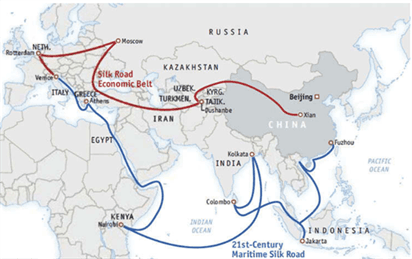
The BRI has two main components, both named to evoke the ancient Silk Road trade networks:
- Silk Road Economic Belt: Overland routes connecting China through Central Asia and the Middle East to Europe via railways, highways, and energy pipelines.
- 21st Century Maritime Silk Road: Sea routes linking China's coastal cities with Southeast Asia, South Asia, the Middle East, and East Africa through a network of ports and shipping lanes.
By 2023, over 150 countries had signed cooperation agreements with China under the BRI framework. The initiative's core objectives go beyond just building roads and ports. China aims to promote regional economic integration, facilitate cross-border trade and investment, and strengthen cultural and diplomatic ties with partner nations. At the same time, the BRI serves domestic goals: it channels China's surplus industrial capacity in sectors like steel and cement into overseas construction projects, and it promotes the internationalization of Chinese companies and the renminbi (RMB).

Geopolitical Implications of the BRI
The BRI is as much a geopolitical project as an economic one. By financing and building critical infrastructure in dozens of countries, China deepens its soft power, the ability to shape other countries' preferences through attraction rather than coercion.
This expansion of influence has real consequences for global power dynamics. Countries that rely on Chinese-built ports, railways, and power grids develop closer economic and political ties with Beijing. Critics argue this can translate into diplomatic leverage. Sri Lanka's Hambantota Port is a frequently cited example: after Sri Lanka struggled to repay Chinese loans, it leased the port to a Chinese state-owned company for 99 years in 2017.
The BRI also raises questions about whether it challenges the post-World War II international order, in which the United States and institutions like the World Bank have been the primary sources of development financing.

Benefits vs. Risks of the BRI
Benefits for China:
- Expands economic and political influence across multiple continents
- Secures access to new markets, resources, and investment opportunities
- Addresses domestic overcapacity by exporting surplus industrial production
Benefits for partner countries:
- Attracts large-scale Chinese investment and financing for infrastructure that might otherwise go unbuilt
- Enhances connectivity and trade access, particularly for landlocked nations in Central Asia
- Can stimulate economic growth and job creation
Risks for China:
- Financial exposure in politically and economically unstable regions (e.g., investments in Venezuela, Myanmar)
- Project failures or delays caused by local political opposition, corruption, or environmental challenges
- Reputational damage when projects are perceived as exploitative or as a form of neo-colonialism
Risks for partner countries:
- Debt sustainability is the most prominent concern. Countries like Pakistan, Laos, and several African nations have taken on significant BRI-related debt, raising fears of "debt-trap diplomacy," where inability to repay loans gives China leverage over a country's assets or policies
- Environmental costs from large-scale construction, including deforestation, habitat destruction, and increased carbon emissions
- Potential economic dependence on China, which can make smaller countries vulnerable to political pressure
International Responses to the BRI
Reactions to the BRI vary widely depending on a country's economic needs and strategic position.
Many developing nations have welcomed Chinese investment, viewing the BRI as a source of infrastructure funding that Western institutions have been slow to provide. At the same time, recurring concerns about transparency, labor practices, and debt sustainability have prompted pushback even among some participating countries.
Major powers have responded in distinct ways:
- United States: Has grown increasingly critical of the BRI, framing it as a vehicle for Chinese geopolitical expansion. In response, the U.S. launched the Partnership for Global Infrastructure and Investment (PGII) in 2022 as a competing initiative.
- European Union: Reactions are divided. Countries like Italy signed onto the BRI in 2019 (though Italy later withdrew in 2023), while others, particularly in Western Europe, have pushed for stricter investment screening of Chinese projects.
- India: Opposes the BRI outright, primarily because the China-Pakistan Economic Corridor (CPEC) runs through Pakistan-administered Kashmir, territory India claims as its own. India also views the BRI's port-building in the Indian Ocean as a strategic encirclement.
- Japan: Has promoted its own "Free and Open Indo-Pacific" strategy and expanded infrastructure investment through the Asian Development Bank as a direct alternative to BRI financing.
These competing initiatives highlight a broader pattern: the BRI has not only expanded China's global reach but has also prompted rival powers to develop their own infrastructure diplomacy, reshaping how development financing works worldwide.
See Fiveable more often in Google
Mark Fiveable as a preferred source and Google is more likely to show you our guides in Top Stories, with a "preferred" badge in AI Mode and AI Overviews.