11.2 Major campaigns and turning points of the Civil War

🏓History of Modern China Unit 11 Review
11.2 Major campaigns and turning points of the Civil War
🏓 History of Modern China
Key Campaigns and Battles
The Chinese Civil War (1946–1949) was decided by a series of major campaigns that progressively destroyed Nationalist military power and handed the Communists control of China's most strategically important regions. Understanding these campaigns shows how the war shifted from a contested struggle to a Communist rout in just a few years.

Top images from around the web for Key battles of Chinese Civil War
Pingjin campaign - Wikipedia View original
Is this image relevant?
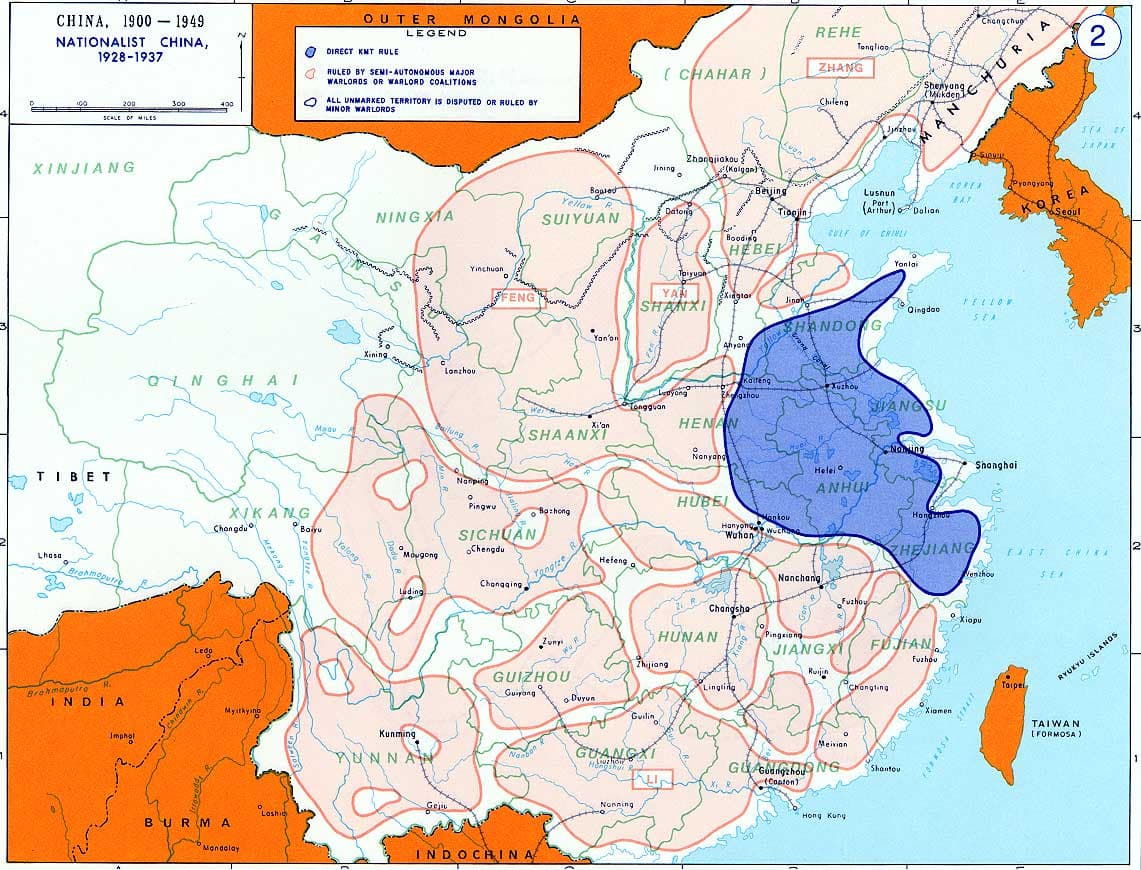
File:Chinese civil war map 02.jpg - Wikipedia View original
Is this image relevant?
Chinese Civil War - Wikipedia View original
Is this image relevant?
Pingjin campaign - Wikipedia View original
Is this image relevant?
File:Chinese civil war map 02.jpg - Wikipedia View original
Is this image relevant?
Key Battles of the Chinese Civil War
Manchurian Campaign (1945–1948) After Japan's surrender in 1945, both the Communists and Nationalists raced to occupy Manchuria, China's most industrialized region. Communist forces under Lin Biao gradually consolidated control of the countryside, cutting off Nationalist-held cities. By late 1948, the Nationalists had lost Manchuria entirely, giving the Communists a critical industrial base, Japanese-left military equipment, and a secure rear area for future operations.
The Three Great Campaigns (1948–1949) These three overlapping campaigns broke the back of Nationalist military strength. Together, they destroyed or captured roughly 1.5 million Nationalist troops in less than six months.
- Liaoshen Campaign (September–November 1948): Fought in the Liaoning-Shenyang region of Manchuria, this campaign finished off the remaining Nationalist presence in the northeast. Lin Biao's forces captured Shenyang and Changchun, seizing Manchuria's industrial resources and freeing Communist armies to move south.
- Huaihai Campaign (November 1948–January 1949): Centered around the Huai River region in east-central China, this was the largest and bloodiest of the three campaigns. Communist forces, coordinated by a committee including Chen Yi and Deng Xiaoping, destroyed over 550,000 Nationalist troops. The Nationalists lost their best remaining field armies, and the path into southern China lay open.
- Pingjin Campaign (November 1948–January 1949): This campaign targeted Beijing (then called Beiping) and Tianjin in North China. Tianjin fell to a Communist assault, while Beijing was surrendered peacefully by its Nationalist garrison commander, Fu Zuoyi, sparing the ancient capital from destruction. Communist control of North China was now complete.
Yangtze River Crossing Campaign (April 1949) The Yangtze River had long served as a natural defensive line separating north and south China. On April 21, 1949, Communist forces crossed the river on a broad front, meeting little effective resistance. Nanjing, the Nationalist capital, fell on April 23. This crossing marked the final stage of the war, as Communist armies swept through southern China and the Nationalist government retreated to Taiwan.
Significance of the Decisive Campaigns
The Three Great Campaigns were the true turning points of the Civil War. Before them, the Nationalists still held major cities and fielded large armies. After them, the Nationalist military was shattered.
- Liaoshen gave the Communists Manchuria's industry and a secure northern base, shifting the balance of resources decisively.
- Huaihai destroyed the Nationalists' best combat units. With over half a million troops lost, the Nationalists simply could not replace their losses or mount a credible defense of the south.
- Pingjin secured North China and dealt a severe blow to Nationalist morale. The peaceful surrender of Beijing also served as propaganda, showing that Nationalist commanders themselves had lost faith in their cause.
By early 1949, the question was no longer whether the Communists would win, but how quickly.
.png)
Factors Contributing to Communist Victory
The Communist victory wasn't just about winning battles. It resulted from a combination of political strategy, social policy, and Nationalist failures that together made the outcome almost inevitable by 1948.
Leadership and Organization
Mao Zedong provided strategic vision that adapted Marxist-Leninist theory to Chinese conditions. Rather than focusing on urban workers (as orthodox Marxism prescribed), Mao built a revolution around the peasantry, developing the concept of "People's War", in which the rural population served as the base of revolutionary power.
Beyond Mao, the Communist Party maintained a disciplined command structure. The People's Liberation Army (PLA) had clear chains of command and effective coordination between regional commanders like Lin Biao, Chen Yi, and Liu Bocheng. This stood in sharp contrast to the Nationalists, whose generals often refused to cooperate with one another.

Military Strategy
- Guerrilla warfare: In the war's early phase, Communist forces avoided pitched battles against the larger, better-equipped Nationalist army. They relied on hit-and-run attacks, ambushes, and sabotage to wear down Nationalist forces while preserving their own strength.
- Rural base areas: The Communists established self-sufficient base areas in the countryside, building local support networks that provided recruits, food, and intelligence. These bases proved nearly impossible for the Nationalists to root out.
- United front tactics: The Communists formed alliances with smaller political parties and exploited divisions within the Nationalist coalition, broadening their appeal beyond committed revolutionaries.
- Shift to conventional warfare: By 1948, as Communist strength grew, they transitioned to large-scale conventional operations, as seen in the Three Great Campaigns. This flexibility caught the Nationalists off guard.
Popular Support
This was arguably the Communists' greatest advantage.
- Land reform was the single most effective policy. The Communists redistributed land from landlords to poor peasants, addressing grievances that had festered for generations. In a country where roughly 80% of the population was rural, this won enormous support.
- Social policies further broadened the Communist base. Programs promoting women's rights, expanding literacy, and providing basic healthcare gave ordinary people tangible reasons to support the new order.
- Contrast with the Nationalists: The Nationalist government under Chiang Kai-shek was plagued by rampant corruption, hyperinflation, and heavy-handed treatment of civilians. By the late 1940s, even many urban Chinese who were not natural Communist supporters had lost faith in the Nationalist government. The Communists successfully positioned themselves as the honest, competent alternative.
International Factors
The Soviet Union provided the Chinese Communists with important early support, including allowing them to occupy parts of Manchuria after Japan's surrender and transferring captured Japanese weapons. However, Soviet aid was more limited than often assumed, and Mao's relationship with Stalin was complicated.
On the Nationalist side, the United States provided substantial military and financial aid, but American support came with growing frustration over Nationalist corruption and military incompetence. By 1949, the U.S. was unwilling to intervene directly to save Chiang's government.
The big picture: The Communists won because they combined effective military strategy with policies that earned genuine popular support, while the Nationalists undermined their own position through corruption, disunity, and failure to address the needs of ordinary Chinese people. The major campaigns of 1948–1949 were where these advantages translated into decisive military victory.
See Fiveable more often in Google
Mark Fiveable as a preferred source and Google is more likely to show you our guides in Top Stories, with a "preferred" badge in AI Mode and AI Overviews.