3.1 The Structure and Organization of the Medieval Church

🏰European History – 1000 to 1500 Unit 3 Review
3.1 The Structure and Organization of the Medieval Church
🏰 European History – 1000 to 1500
The Structure and Organization of the Medieval Church
The medieval Church was far more than a religious institution. It was the single most powerful organization in Western Europe, with a structured hierarchy that rivaled any kingdom. From the Pope down to village priests, the Church governed spiritual life, controlled vast wealth, and shaped politics across the continent.
Understanding the Church's structure helps explain why it could crown and depose kings, fund massive building projects, and regulate the daily behavior of millions of people. Its reach extended into education, social welfare, law, and economics.
Church Hierarchy
Papal Authority and Cardinals
The Pope (the Bishop of Rome) sat at the top of the entire Church structure. He held supreme spiritual authority over all Christians in Western Europe, with the power to appoint bishops, define matters of faith and morals, and settle disputes across the Church.
Cardinals were the Pope's senior advisors. They served two major functions:
- Advising the Pope on Church governance through the Papal Curia, the Church's central administrative body
- Electing new Popes when the office became vacant
- Cardinals were often appointed to lead important dioceses or sent as papal representatives to foreign courts
Archbishops, Bishops, and Dioceses
The Church divided its territory into administrative units. An ecclesiastical province contained several dioceses, each of which was a defined geographic area under Church administration.
- Archbishops governed entire provinces. They held authority over the bishops within their territory and could convene regional Church councils to address matters of faith and discipline.
- Bishops governed individual dioceses. Their responsibilities included ordaining priests, administering sacraments, managing Church property, and overseeing the spiritual welfare of everyone in their territory.
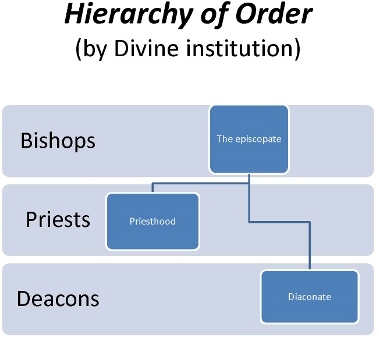
Priests, Deacons, and Local Clergy
For most medieval people, the local priest was the face of the Church. Priests served in parishes and were the primary link between the institution and ordinary Christians.
- Priests celebrated Mass, heard confessions, performed baptisms, marriages, and funerals, and provided religious instruction to their congregations.
- Deacons assisted priests, with a special focus on caring for the poor and sick. They could preach and baptize, but they could not celebrate Mass or hear confessions.
Monastic Orders
Monks and nuns lived apart from ordinary society in monasteries and convents, dedicating their lives to prayer, study, and service. They followed specific rules of conduct and answered to an abbot (for monks) or abbess (for nuns).
Notable monastic orders include:
- Benedictines, who followed the Rule of St. Benedict, emphasizing prayer, work, and communal living
- Cistercians, a reform movement that stressed simplicity and manual labor
- Franciscans, a mendicant (begging) order founded by St. Francis of Assisi in the early 13th century, focused on poverty and preaching
Clergy Roles and Responsibilities
Papal and Episcopal Duties
Each level of the hierarchy carried distinct responsibilities:
- The Pope made decisions on doctrine, appointed bishops, settled disputes, and played a major role in international diplomacy. He could crown rulers or excommunicate them.
- Cardinals advised the Pope, participated in papal elections, and served as legates (official representatives) at foreign courts or Church councils.
- Archbishops supervised bishops in their province, convened regional councils, and heard appeals from decisions made at the diocesan level.
- Bishops ordained priests, confirmed the faithful, consecrated churches, managed Church revenues, and represented the Church in dealings with secular authorities.
Priestly and Diaconal Ministries
Priests were the primary point of contact between the Church and the laity (non-clergy). Their daily work included:
- Celebrating Mass and administering the sacraments (especially the Eucharist and Penance)
- Hearing confessions and providing religious guidance
- Performing baptisms, marriages, and funeral rites
Deacons supported this work, focusing particularly on distributing alms to the poor and tending to the sick.
Monastic Life and Service
Monastic communities followed structured daily routines centered on prayer and contemplation, but they also served the wider world in concrete ways:
- Monks copied and preserved manuscripts in rooms called scriptoria, keeping classical and religious texts alive through centuries when literacy was rare.
- Monasteries ran schools that served as the primary centers of learning across much of Europe.
- Many monastic houses provided healthcare, shelter for travelers, and aid to the surrounding population.

Church Influence on Medieval Society
Education and Learning
The Church held a near-monopoly on education. Monastic schools and cathedral schools were the main institutions where people could learn to read, write, and study classical texts. Monastic libraries housed extensive manuscript collections and functioned as centers of scholarship. Without the Church's efforts, much of the classical knowledge from Greece and Rome would have been lost.
Social Welfare and Moral Regulation
The Church filled roles that governments handle today. Monasteries operated as hospitals, orphanages, and shelters for pilgrims. There was no comparable secular system of social services.
The Church also regulated moral behavior directly:
- Attendance at Mass was expected, and fasting was required during designated periods.
- Holy days had to be observed.
- Church teachings on sin, penance, and salvation shaped how people understood right and wrong in their daily lives.
Sacraments and Rituals
The sacraments gave the Church enormous influence over personal and family life. Baptism, marriage, and last rites marked the most important moments in a person's life, and only the Church could administer them. This meant that virtually no one could be born, married, or buried without Church involvement.
The liturgical calendar also structured daily and seasonal rhythms:
- Agricultural work and economic activity were organized around the religious calendar.
- Feast days like Christmas and Easter provided rest from labor and opportunities for communal celebration.
- The cycle of liturgical seasons (Advent, Lent, etc.) gave shape to the entire year.
Spirituality and Religious Practices
Church teachings on the afterlife drove much of medieval religious behavior. The concepts of heaven, hell, and purgatory (a place of temporary punishment where souls were purified before entering heaven) were deeply real to medieval people.
- Fear of damnation and desire for salvation motivated participation in Church activities, charitable giving, and moral conduct.
- Pilgrimages to holy sites like Jerusalem, Rome, and Santiago de Compostela were popular acts of devotion.
- The veneration of saints and relics was widespread. People believed that saints could intercede with God on their behalf, and relics (physical remains or objects associated with saints) were thought to carry spiritual power.
Church Power in the Middle Ages
Economic Influence
The Church was the largest landowner in medieval Europe, holding vast agricultural lands, forests, and urban properties. These holdings came from pious donations, purchases, and inheritances accumulated over centuries.
Revenue flowed to the Church from multiple sources:
- Tithes: mandatory contributions of one-tenth of a person's income or agricultural produce. This was the Church's most reliable income stream.
- Fees for celebrating Mass, administering sacraments, and granting indulgences (reductions of punishment for sins).
This wealth funded the construction of grand cathedrals and monasteries, such as Notre-Dame de Paris and Westminster Abbey, which served as visible symbols of the Church's power and prestige.
Political Involvement
The Church's economic power translated directly into political influence. Bishops and abbots served as key advisors to kings and nobles, and the Church's support or opposition could determine the success of political or military ventures.
Simony, the buying and selling of Church offices, further entangled the Church with secular politics. Wealthy individuals could purchase positions of power within the hierarchy, blurring the line between religious and political authority.
The Church also claimed the right to intervene in secular affairs when it perceived threats to its interests or to the spiritual welfare of Christians. This led to major conflicts with rulers, most notably the Investiture Controversy, a prolonged struggle over whether kings or the Pope had the authority to appoint bishops and abbots.
Ecclesiastical Sanctions
The Church enforced its authority through two powerful spiritual weapons:
- Excommunication cut an individual off from the sacraments and the spiritual community. For a ruler, this could undermine their legitimacy and release their subjects from obligations of loyalty.
- Interdict extended this deprivation to an entire community or kingdom, suspending most Church services for everyone in the affected area.
Two well-known examples show how these tools were used against the most powerful rulers in Europe:
- Pope Gregory VII excommunicated Holy Roman Emperor Henry IV during the Investiture Controversy (1076), forcing Henry to famously seek forgiveness at Canossa.
- Pope Innocent III placed all of England under interdict in 1208 during his dispute with King John, suspending Church services across the entire kingdom until John submitted.
See Fiveable more often in Google
Mark Fiveable as a preferred source and Google is more likely to show you our guides in Top Stories, with a "preferred" badge in AI Mode and AI Overviews.