13.4 Current Trends in Medieval Studies

🏰European History – 1000 to 1500 Unit 13 Review
13.4 Current Trends in Medieval Studies
🏰 European History – 1000 to 1500
Emerging Research in Medieval Studies
Medieval studies has shifted significantly in recent decades. Scholars now focus on marginalized groups, spatial perspectives, and global connections, challenging traditional narratives and building a more inclusive picture of medieval society. At the same time, interdisciplinary approaches and digital tools are uncovering insights that text-based history alone could never reach.

Top images from around the web for Marginalized Groups and Inclusive Histories
History of the Jews in France - Wikipedia View original
Is this image relevant?
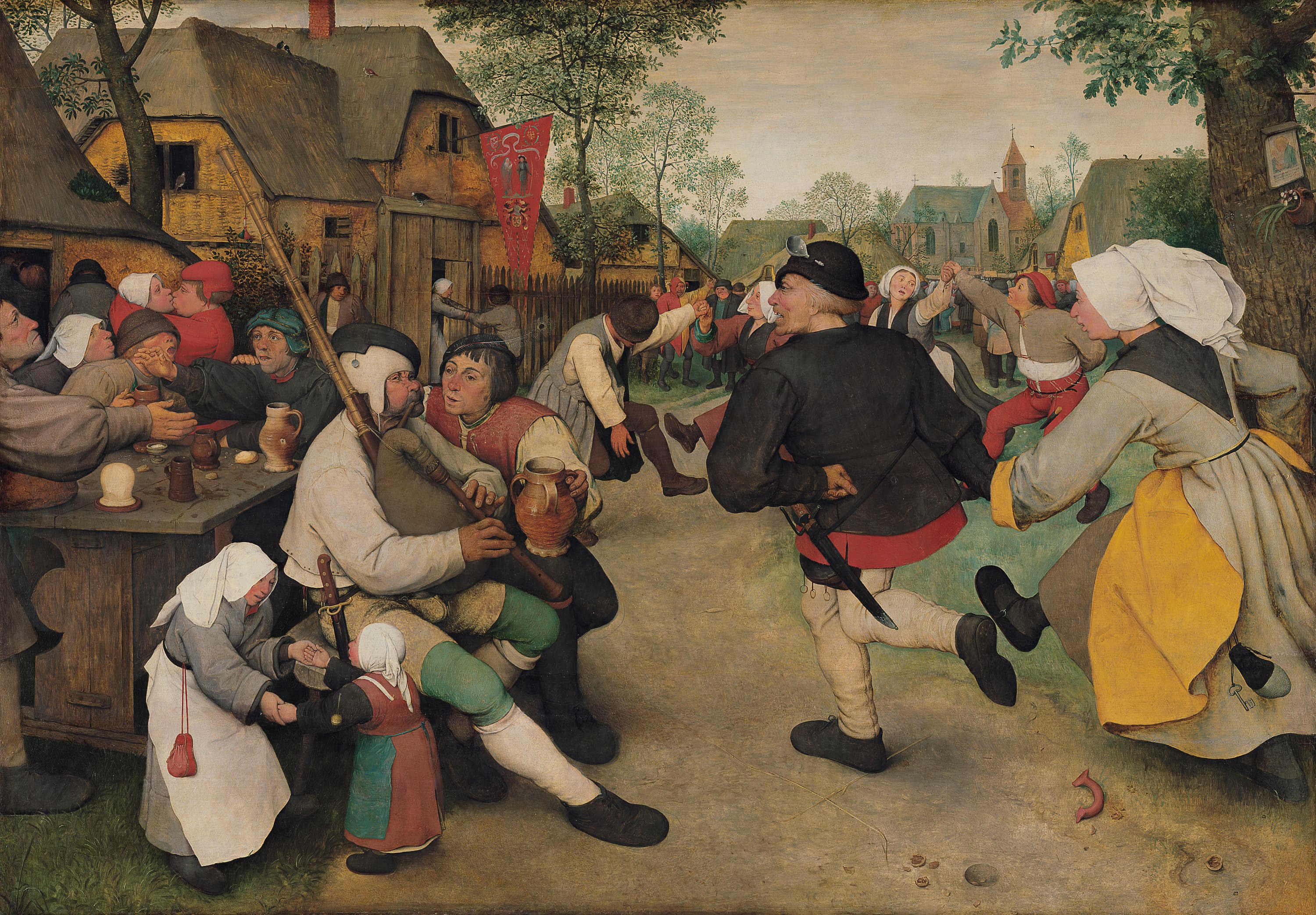
File:Pieter Bruegel The Peasant Dance.jpg - Wikipedia View original
Is this image relevant?
Peasants' Revolt - Wikipedia View original
Is this image relevant?
History of the Jews in France - Wikipedia View original
Is this image relevant?
File:Pieter Bruegel The Peasant Dance.jpg - Wikipedia View original
Is this image relevant?
Marginalized Groups and Inclusive Histories
A major trend in recent scholarship is the recovery of voices that older histories largely ignored. Rather than focusing only on kings, popes, and battles, historians now examine the experiences and contributions of groups that shaped medieval life from below and from the margins.
- Women are studied not just as passive figures but as writers, mystics, and political actors. Christine de Pizan wrote one of the earliest defenses of women's intellectual equality, while Margery Kempe produced what's considered the first autobiography in English.
- Religious minorities, particularly Jews and Muslims living in Christian-majority regions, are examined for how they navigated legal restrictions, contributed to intellectual life, and maintained their own communities.
- Lower classes like peasants and artisans receive attention for their economic agency, resistance movements (such as the English Peasants' Revolt of 1381), and cultural practices.
This inclusive approach challenges older narratives that treated medieval society as a simple top-down hierarchy. It reveals more complex power dynamics and a wider range of lived experiences.
Spatial and Environmental Perspectives
The "spatial turn" in medieval studies treats place and landscape as active forces in history, not just backdrops. Scholars ask how physical and imagined spaces shaped social, cultural, and political life.
- Urban centers like Paris and London functioned as hubs of commerce, governance, and intellectual exchange, each with distinct spatial organization that reflected power structures.
- Religious sites, especially pilgrimage destinations like Santiago de Compostela, created networks of travel, devotion, and economic activity that connected distant regions.
- Natural landscapes like forests and mountains carried legal, symbolic, and practical significance, serving as boundaries, resources, and settings for cultural imagination.
Environmental history adds another layer by investigating how human societies and the natural world interacted. This includes studying the impact of climate shifts (such as the Medieval Warm Period and the onset of the Little Ice Age), resource management practices, and epidemics on medieval communities. It also explores how medieval people understood their environment through agriculture, hunting, and land-use customs.
Digital Humanities and Material Culture
Digital humanities methods allow scholars to analyze large datasets and spot patterns that close reading alone would miss.
- GIS mapping visualizes spatial relationships, such as trade routes or the spread of monastic foundations across a region.
- Network analysis maps social and intellectual connections, revealing, for example, how correspondence networks linked scholars across Europe.
- Text mining identifies recurring themes and trends across large collections of documents, charters, or literary works.
Material culture studies complement this by using archaeological evidence and surviving artifacts to illuminate daily life across social strata. Pottery, jewelry, tools, and manuscripts reveal patterns of production, trade, and consumption. Objects like relics and devotional items also carry symbolic and cultural meanings that texts alone can't fully convey.
Global Connections and Interactions
The concept of the "Global Middle Ages" pushes back against the assumption that medieval Europe developed in isolation. Scholars now trace connections between Europe, Africa, Asia, and the Americas.
- Trade networks like the Silk Roads and Indian Ocean routes moved goods, ideas, and technologies across vast distances. Spices, textiles, and precious metals flowed alongside knowledge of mathematics, astronomy, and medicine.
- Cultural exchanges brought Islamic scientific and philosophical texts into European universities, while Chinese inventions like paper, gunpowder, and the compass gradually transformed European society.
- The Mongol Empire (13th-14th centuries) created a unified political space across much of Eurasia, facilitating unprecedented levels of contact and exchange between distant civilizations.
This research challenges Eurocentric narratives by showing that medieval Europe was one node in a much larger web of interconnected societies.

Interdisciplinary Impact on Medieval History
Collaboration and Multiple Perspectives
Collaborations between historians, archaeologists, art historians, and literary scholars provide multiple lenses for interpreting the past. Combining textual analysis with the study of visual and material culture has, for instance, revealed new insights into medieval religious practices: illuminated manuscripts and church architecture tell us things about devotion and belief that written records alone cannot.
Fields like gender studies, postcolonial studies, and disability studies have also reshaped medieval scholarship. These perspectives examine how gender, race, class, and ability intersected to shape individual lives and social structures. They challenge long-standing assumptions and biases, pushing scholars to ask whose stories have been told and whose have been left out.
Scientific Methods and Digital Tools
Scientific techniques now provide evidence that was previously inaccessible to historians.
- DNA analysis and isotope studies shed light on migration patterns, kinship ties, and dietary habits. Isotope analysis of skeletal remains, for example, can reveal where a person grew up based on the chemical signatures in their bones.
- Archaeobotanical and zooarchaeological analyses examine plant and animal remains to reconstruct agricultural practices, trade in foodstuffs, and local environmental conditions.
Digital tools make it possible to process vast amounts of data efficiently. Databases and digital archives have made medieval sources far more accessible and searchable than ever before. Data visualization techniques like network graphs and heat maps help researchers identify patterns and connections that would be nearly impossible to spot through traditional methods.
Challenging Traditional Boundaries and Narratives
Interdisciplinary work has blurred boundaries that earlier scholars took for granted. The sharp line between "medieval" and "early modern" periods looks less convincing when you trace continuities in social practices, economic structures, or cultural production across the conventional dividing line of 1500.
Similarly, studying medieval trade, migration, and diplomacy reveals a world that didn't respect modern national borders. The medieval Mediterranean, for instance, was a shared space of Christian, Muslim, and Jewish interaction that can't be understood through the lens of any single modern nation-state.
Social science theories have also given medievalists new analytical frameworks. Anthropological concepts like gift-giving, ritual, and kinship help interpret social interactions that don't fit neatly into modern categories. Sociological tools like social network analysis offer ways to map group dynamics and identity formation in medieval communities.

Contemporary Debates in Medieval Historiography
Reinterpreting Social and Political Transformations
The "feudal revolution" remains one of the most contested ideas in medieval history. Some scholars argue that the 11th and 12th centuries saw a fundamental transformation, with the emergence of a more hierarchical and militarized society centered on castles, vassalage, and local lordship. Others emphasize continuity and regional variation, questioning whether "feudalism" was ever a coherent, universal system rather than a patchwork of local arrangements.
The traditional narrative of the "Dark Ages" has also come under sustained criticism. Historians now highlight the cultural and intellectual achievements of the early medieval period, including the preservation and transmission of classical knowledge in monastic centers during the Carolingian Renaissance (8th-9th centuries) and the artistic innovations of Insular art and Anglo-Saxon literature.
Religion, Society, and Culture
The role of religion in medieval society remains a lively area of debate. Scholars disagree about the extent to which religious beliefs and practices permeated daily life versus being confined to formal institutions. The complex relationships between the Church, secular authorities, and lay piety resist simple generalizations.
The "Twelfth-Century Renaissance" is another point of contention. Some historians see this period as a distinct intellectual and cultural revival, marked by the rediscovery of classical texts (especially Aristotle, transmitted through Arabic translations) and the rise of scholasticism in the new universities. Others argue this overstates the break from earlier developments, pointing to the Carolingian and Ottonian renaissances as evidence of ongoing intellectual vitality throughout the medieval period.
Gender, Agency, and Marginalized Voices
Medieval gender roles and women's agency continue to generate productive debate. Scholars explore how women navigated and sometimes challenged patriarchal structures, asserting influence in religious, political, and cultural spheres. Hildegard of Bingen (1098-1179) composed music, wrote theological and scientific works, and corresponded with popes and emperors. Eleanor of Aquitaine (1122-1204) wielded political power as queen of both France and England.
Research into other marginalized groups, including LGBTQ+ individuals and people with disabilities, seeks to uncover experiences that surviving sources often obscure or distort.
The impact of the Black Death (1347-1351) on medieval society is also debated. Some scholars argue the pandemic fundamentally transformed labor relations, social mobility, and religious attitudes, as massive population loss gave surviving workers greater bargaining power. Others emphasize regional variations and long-term continuities, cautioning against treating the plague as a single, uniform turning point.
Legacies and Contemporary Resonances
The legacy of the Crusades remains complex and controversial. Scholars examine the motivations, experiences, and consequences of the Crusades for soldiers, pilgrims, merchants, and non-combatants alike. Discussions address the long-term effects on interreligious relations, cultural exchange, and the construction of identity and "otherness" between Christian and Islamic worlds.
Medievalists also increasingly study how the medieval past resonates in the present. Medieval themes, symbols, and narratives appear throughout modern popular culture in films, video games, and fantasy literature. More troublingly, the medieval past has been appropriated by contemporary political movements, including nationalist and white supremacist groups, who selectively invoke a distorted version of medieval history to support their ideologies. Understanding how and why these appropriations happen is now a significant area of scholarly attention.
See Fiveable more often in Google
Mark Fiveable as a preferred source and Google is more likely to show you our guides in Top Stories, with a "preferred" badge in AI Mode and AI Overviews.