1.1 Defining the Middle Ages: Chronology and Geographical Scope

🏰European History – 1000 to 1500 Unit 1 Review
1.1 Defining the Middle Ages: Chronology and Geographical Scope
🏰 European History – 1000 to 1500
The Middle Ages spans roughly 1,000 years of European history, from the fall of Rome to the Renaissance. This period saw the rise of feudalism, the dominance of the Catholic Church, and cultural and intellectual achievements that laid the groundwork for modern Europe.
Defining the Middle Ages involves more than just setting dates. It requires understanding diverse regions, from Western Europe to Byzantium, and recognizing the period's global connections. Recent scholarship challenges the "Dark Ages" stereotype, highlighting medieval innovation and cultural richness.
Boundaries of the Middle Ages

Top images from around the web for Chronological Span
World History Maps by Thomas Lessman View original
Is this image relevant?
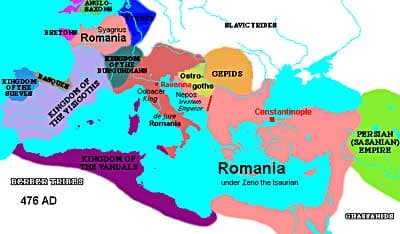
6f. The Fall of the Roman Empire | HUM 101 Introduction to Humanities View original
Is this image relevant?
File:Europe at the fall of the Western Roman Empire in 476.jpg - Wikipedia View original
Is this image relevant?
World History Maps by Thomas Lessman View original
Is this image relevant?
6f. The Fall of the Roman Empire | HUM 101 Introduction to Humanities View original
Is this image relevant?
Chronological Span
The medieval period (also called the Middle Ages) is generally considered to span from the 5th century to the 15th century CE. The fall of the Western Roman Empire in 476 CE is the most common starting marker. Roman authority had been crumbling for decades, but 476 is when the last Western emperor was deposed, leaving political power fragmented among new Germanic kingdoms.
The end of the Middle Ages doesn't have a single clean date. Instead, several overlapping developments signal the transition:
- The fall of Constantinople in 1453, which ended the Byzantine Empire and marked the rise of the Ottoman Empire as a major power
- The invention of the printing press by Johannes Gutenberg in the 1440s, which transformed how knowledge spread across Europe
- The Italian Renaissance, beginning in the late 14th century, which revived classical learning and shifted cultural priorities toward humanism and individual achievement
Alternative Periodizations
Not all historians agree on these boundaries. Some extend the Middle Ages into the late 15th or early 16th century, arguing that medieval institutions and cultural patterns persisted well into the Age of Discovery. From this view, European exploration and colonization of the Americas, Africa, and Asia grew directly out of medieval expansionism and trade networks.
Other scholars define the period around different markers entirely:
- Some use the rise and fall of specific dynasties, such as the Carolingian Empire or the Holy Roman Empire, as organizing frameworks
- Others treat intellectual turning points as the key dividers, pointing to the Carolingian Renaissance (8th–9th centuries) or the 12th-century Renaissance as moments that reshaped medieval culture from within
The takeaway: periodization is a tool, not a fact. The dates you use depend on what questions you're asking.
Regions of Medieval Europe
Western and Central Europe
Medieval Europe stretched across Western, Central, and Southern Europe, with significant developments in Eastern Europe as well.
The Frankish Empire was central to the political landscape. Under the Carolingian dynasty, especially Charlemagne (r. 768–814), the Franks built a vast empire that established the foundations of feudalism and the idea of a unified Christendom. When the empire divided in the 9th century, it produced the distinct French and German kingdoms that would define Western European politics for centuries.
The Italian Peninsula served as a hub of trade, culture, and religious authority. Powerful city-states like Venice, Genoa, and Florence drove the growth of commerce and banking, and became major patrons of art and learning. Meanwhile, the Papal States centered in Rome gave the Pope both spiritual and territorial power that extended across the continent.

British Isles and Iberia
The British Isles saw transformative events during the medieval period. The Norman Conquest of 1066 reshaped England's political, social, and cultural order, importing French-speaking aristocratic culture and a new feudal structure. In the 13th century, the development of the English Parliament and the Magna Carta (1215) planted early seeds for representative government and the principle that even kings were subject to law.
The Iberian Peninsula had a distinctive medieval experience shaped by centuries of Muslim and Christian coexistence and conflict. After the Muslim conquest in the 8th century, the Umayyad Caliphate of Córdoba became one of the most culturally advanced states in Europe. The Christian kingdoms of Castile, Aragon, and Portugal gradually reclaimed territory through the Reconquista, a process that culminated in the fall of Granada in 1492.
Scandinavia and the Byzantine Empire
Scandinavia (Norway, Sweden, and Denmark) was home to the Vikings, whose raids on monasteries and towns spread fear across Europe from the 8th to 11th centuries. But Vikings were more than raiders. They established far-reaching trade routes, founded settlements in England, Ireland, and Normandy, and shaped the political development of those regions.
The Byzantine Empire, centered in Constantinople, was the continuation of the Eastern Roman Empire and remained a major cultural and economic power throughout the medieval period. Byzantium preserved much of the classical heritage of Greece and Rome while developing its own distinct artistic and intellectual traditions. The fall of Constantinople to the Ottoman Turks in 1453 ended the empire and sent Greek scholars westward, contributing to the Renaissance.
Significance of the Middle Ages
Feudalism and the Catholic Church
Feudalism was the dominant social, economic, and political system across much of medieval Europe. It was built on hierarchical relationships between lords and vassals: a lord granted land (a fief) in exchange for military service and loyalty. This system provided a degree of stability in a politically fragmented landscape, but it also entrenched social inequality and severely limited upward mobility.
The Roman Catholic Church was the single most powerful institution of the period. The Pope claimed authority over secular rulers, and the Church controlled much of Europe's education, healthcare, and social services. It was also the primary patron of art, architecture, and music.
Monasticism played a crucial role in preserving knowledge. Monks in monasteries copied and illustrated manuscripts, developed agricultural techniques, and maintained centers of learning during periods of political instability. In the 13th century, new mendicant orders like the Franciscans and Dominicans shifted emphasis toward poverty, preaching, and direct service to the poor.

Cultural and Intellectual Achievements
Medieval Europe produced major cultural and intellectual developments that are easy to overlook if you buy into the "Dark Ages" narrative.
- Universities emerged as formal institutions of higher learning. Bologna (founded c. 1088), Paris, and Oxford created a new framework for advancing knowledge and training professionals in law, medicine, and theology.
- Scholasticism, a method of rigorous debate and critical reasoning developed in the universities, pushed forward theology, philosophy, and early natural science. Figures like Thomas Aquinas used scholastic methods to reconcile Christian doctrine with Aristotelian philosophy.
- Gothic architecture introduced pointed arches, ribbed vaults, and large stained-glass windows, creating structures that emphasized height, light, and engineering innovation. Cathedrals like Notre-Dame de Paris and Chartres remain iconic examples.
The Crusades (1096–1291) had far-reaching consequences beyond their religious aims. They brought Europeans into sustained contact with the sophisticated civilizations of the Middle East, sparking exchanges of ideas, technologies, and cultural practices. Italian city-states like Venice and Genoa established trading posts in the eastern Mediterranean, fueling commercial growth.
Foundation for the Modern Era
The late Middle Ages set the stage for the modern world in several concrete ways.
Royal authority grew as kings built bureaucratic institutions like the English Exchequer and Chancery. The Hundred Years' War (1337–1453) between England and France accelerated state formation and the development of national identity in both countries.
The cultural ferment of the late medieval period fed directly into the Renaissance. The rediscovery of classical texts, the emphasis on individual achievement, and the spread of vernacular literature all challenged the traditional authority of the Church and the feudal order. Gutenberg's printing press (c. 1440) made books far cheaper and more accessible, helping to create a literate middle class.
Debates about the Middle Ages
Challenging the "Dark Ages" Stereotype
The term "Middle Ages" is itself a later invention. Renaissance humanists coined it to describe what they saw as a gap between the classical brilliance of Greece and Rome and their own era of cultural revival. This framing cast the medieval period as a time of intellectual darkness, a view that has persisted in popular culture.
Modern historians have largely rejected this characterization. Recent scholarship highlights the creativity and innovation of medieval art, literature, and science, as well as the complexity of medieval political and social structures. The term "Dark Ages" is now generally avoided in academic writing, though you'll still encounter it in popular media.
Eurocentric Perspectives and Global Interactions
Because the term "Middle Ages" was created by and for Europeans, it naturally centers Europe. This can obscure the fact that other civilizations were thriving during the same centuries:
- The Islamic world, particularly the Abbasid Caliphate and the Umayyad Caliphate of Córdoba, was a major center of scientific, cultural, and economic activity
- The Mongol Empire (13th–14th centuries) connected China to Europe, facilitating trade and cultural exchange across Eurasia
- West African kingdoms like Ghana, Mali, and Songhai were important centers of trade, learning, and political power
Recent scholarship emphasizes placing medieval Europe in a global context. The Silk Roads connected Europe and Asia through networks of trade in goods, ideas, and technologies. The spread of Islam brought new intellectual influences to Europe. The Crusades and Mongol invasions forced Europeans into contact with the wider world, generating new forms of exchange that shaped both sides.
Diversity and Complexity of Medieval Societies
The label "Middle Ages" can make a thousand years of history across an entire continent sound uniform. It wasn't.
Medieval Europe was a patchwork of kingdoms, principalities, and city-states, each with distinct political, social, and cultural traditions. The daily experience of a Florentine merchant looked nothing like that of a Norwegian farmer or a Castilian knight. Social groups like peasants, artisans, merchants, and nobles lived vastly different lives depending on their location, status, and economic circumstances.
The role of women was more varied than stereotypes suggest. Some women wielded significant power as queens, abbesses, and mystics, while others faced severe patriarchal constraints. Similarly, the experiences of marginalized groups like Jews, Muslims, and those labeled heretics reveal social and cultural dynamics that a top-down political narrative misses.
Historians now use interdisciplinary approaches (archaeology, art history, literary studies) to build a richer picture of medieval life. The recognition of regional and local variation has challenged the idea of a single "medieval experience," pushing the field toward more nuanced, contextualized study.
See Fiveable more often in Google
Mark Fiveable as a preferred source and Google is more likely to show you our guides in Top Stories, with a "preferred" badge in AI Mode and AI Overviews.