2.1 Plot Structure and Development

📚English 10 Unit 2 Review
2.1 Plot Structure and Development
📚 English 10
Plot Structure in Short Stories
Plot structure is the framework that organizes a story's events from beginning to end. Understanding how plots work gives you the tools to analyze why a story feels tense, satisfying, or surprising, not just what happens in it.
Key Elements of Plot Structure
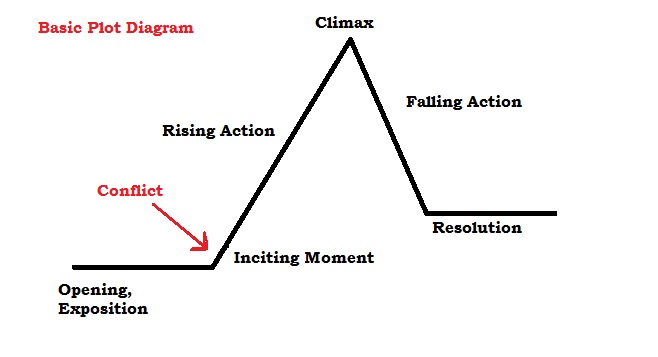
Most short stories follow a five-part structure. Think of it as a map for how tension builds and resolves:
- Exposition introduces the characters (protagonist, antagonist), the setting (time and place), and the initial situation or conflict that gets the story moving.
- Rising action is where complications pile up. Characters face obstacles related to the central conflict, and tension steadily increases.
- Climax is the turning point, the moment of highest tension. This often involves a confrontation or a critical decision. In "The Most Dangerous Game," for example, it's the final showdown between Rainsford and Zaroff.
- Falling action shows the consequences of the climax. The conflict starts to unravel as characters deal with the fallout.
- Resolution (denouement) provides closure. Loose ends get tied up, and the final outcome of the central conflict is revealed.
Why Plot Structure Matters
A well-structured plot does more than just organize events in order. It creates a sense of progression that keeps readers engaged, building tension and anticipation toward a payoff. The way an author arranges plot elements can also reinforce themes and shape character development. When you can identify these structural choices, you can start analyzing how a story achieves its effects rather than just summarizing what happens.
Manipulating Plot for Engagement
Creating Tension and Anticipation
Authors use specific techniques to keep you turning pages:
- Foreshadowing hints at future events. A seemingly unimportant detail early on (a locked drawer, a character's offhand comment) later turns out to be significant. This creates a feeling of unease or anticipation even before you know why.
- Suspense comes from withholding information or placing characters in uncertain, high-stakes situations. A ticking clock, an unanswered question, a character entering a dark room: these all keep readers on edge because the outcome is unclear.
- Plot twists are unexpected turns that subvert your expectations. A trusted ally revealed as the villain, or a goal that suddenly shifts, adds complexity and forces you to re-evaluate everything that came before.
Pacing and Narrative Structure
Pacing is the speed at which events unfold, and authors control it deliberately:
- Fast pacing (short sentences, rapid action, cliffhangers) ramps up urgency. A cliffhanger ends a scene at a crucial moment, like a character in danger, so you feel compelled to keep reading.
- Slow pacing (longer descriptions, reflective passages) gives breathing room. These moments allow for character development or thematic exploration, like a character reflecting on a past mistake.
- In medias res means starting the story in the middle of the action. Instead of building up slowly, the reader drops into a chase scene or a heated argument already in progress. This creates immediate urgency and makes you want to piece together what led to this moment.
Plot and Other Story Elements
Character Development and Motivation
Plot and character are deeply connected. Characters' desires, flaws, and decisions are what actually drive the plot forward. A character's quest for revenge creates the conflict; a character's fear of failure shapes how they respond to obstacles.
Character arcs (the internal changes a character undergoes) often mirror the plot's progression. As the external conflict intensifies during rising action, the character's internal struggle intensifies too. By the resolution, the character has typically changed in some meaningful way, for better or worse.
Themes and Message
The plot serves as a vehicle for a story's themes, the deeper ideas it explores (love, identity, justice, power). Characters navigate conflicts that connect to these ideas, and the resolution often reveals what the story is ultimately saying about them.
Pay attention to recurring motifs and symbols throughout the plot. A storm that appears during moments of emotional turmoil, or a journey that mirrors a character's personal growth, reinforces the theme without stating it outright. The events of the story communicate meaning just as much as the dialogue or narration.

Effectiveness of Plot Structures
Linear and Non-Linear Narratives
- Linear plots present events in chronological order. The cause-and-effect chain is clear, making the story's progression easy to follow.
- Non-linear plots use techniques like flashbacks or parallel storylines to jump around in time. A flashback to a character's traumatic childhood can explain their present behavior. Two separate storylines might converge at a critical moment, creating a powerful connection the reader didn't see coming.
Unconventional Plot Structures
Not every story follows the standard five-part model:
- Circular structures end where they began, emphasizing themes of repetition or inevitability. If a character ends up in the same situation they started in, the story might be commenting on how hard it is to break patterns.
- Episodic structures are made up of loosely connected scenes or vignettes rather than one continuous arc. These can highlight how a theme (like identity or belonging) plays out across different situations.
- Open-ended or ambiguous resolutions leave the outcome uncertain on purpose. The story asks you to interpret the ending yourself, which can make the themes feel more personal and thought-provoking.
Evaluating Plot Effectiveness
When you're asked to evaluate a plot structure, consider these questions:
- Does the structure support the story's themes? A story about chaos might benefit from a non-linear structure, while a story about fate might work well as circular.
- Does the pacing maintain engagement? Are tense moments given enough space, and do slower moments earn their place?
- Does the resolution feel earned? A satisfying ending doesn't have to be happy, but it should feel like a natural consequence of everything that came before.
The goal is to connect the author's structural choices to the story's overall effect. A plot isn't just a sequence of events; it's a deliberate design.
See Fiveable more often in Google
Mark Fiveable as a preferred source and Google is more likely to show you our guides in Top Stories, with a "preferred" badge in AI Mode and AI Overviews.