1.1 Definition and scope of climatology

🌡️Climatology Unit 1 Review
1.1 Definition and scope of climatology
🌡️ Climatology
Climatology examines long-term atmospheric patterns and the interactions between Earth's major systems. It provides the scientific foundation for understanding natural climate variability and human-induced climate change, using tools like statistical analysis and computer modeling to explain past climates and project future ones.
Weather describes short-term atmospheric conditions; climate describes the long-term averages and variability of those conditions. Climatology branches into physical, dynamic, applied, and specialized subfields, drawing on knowledge from physics, chemistry, biology, geology, and the social sciences.
Climatology: Focus on Long-Term Patterns
Definition and Scope
Climatology is the study of climate, meaning the long-term patterns of atmospheric conditions measured over extended periods (typically 30 years or more, as defined by the World Meteorological Organization). It goes well beyond just the atmosphere, though.
Climate is shaped by interactions among five interconnected components of the Earth system:
- Atmosphere (air and its circulation)
- Hydrosphere (oceans, rivers, lakes)
- Cryosphere (ice sheets, glaciers, sea ice)
- Biosphere (living organisms and ecosystems)
- Lithosphere (land surface and geological features)
Climatology addresses both natural climate variability (shifts caused by volcanic eruptions, solar cycles, or ocean oscillations) and anthropogenic climate change (changes driven by human activities like fossil fuel combustion and deforestation). The field studies causes, observed effects, and potential future scenarios.
Key Phenomena and Methods
Climatologists examine recurring large-scale patterns that shape regional and global climate:
- Monsoons drive dramatic seasonal rainfall shifts in regions like South Asia, where summer monsoon rains supply roughly 70% of India's annual precipitation.
- El Niño/La Niña (ENSO) cycles alter global temperature and precipitation. During El Niño events, equatorial Pacific sea surface temperatures rise, disrupting weather patterns worldwide.
- Jet streams are fast-moving air currents in the upper atmosphere that steer weather systems across mid-latitude regions, influencing storm tracks and temperature extremes.
To study these phenomena, climatologists rely on several core methods:
- Statistical analysis processes large datasets of temperature, precipitation, and other variables to identify trends and recurring patterns.
- Computer modeling simulates the physics of climate systems using numerical equations, allowing researchers to test hypotheses and project future scenarios under different emissions pathways.
- Paleoclimate reconstruction uses proxy data like ice cores, tree rings, and ocean sediment layers to extend the climate record back thousands or even millions of years before instrumental measurements existed.
Weather vs. Climate: Temporal Scales
Defining Characteristics
Weather is the day-to-day state of the atmosphere at a specific place and time. It includes temperature, precipitation, humidity, wind speed, and cloud cover. Weather varies over short periods (hours to days) and can change rapidly.
Climate is the statistical summary of weather conditions over an extended period, usually 30 years or more, for a given region. Climate captures averages, variability, and extremes. A useful shorthand: "Climate is what you expect; weather is what you get."
For example, you expect Miami to be warm and humid in July (that's climate). But on any given July afternoon, a sudden thunderstorm dropping temperatures by 10°F is weather.
Data and Measurement
Weather data and climate data come from many of the same instruments, but they're used differently:
- Weather data focuses on current and near-term conditions. Meteorologists use real-time measurements from surface weather stations, satellites, radiosondes (weather balloons), and radar to produce daily forecasts and severe weather warnings.
- Climate data aggregates weather measurements over time. It includes statistical measures like means, variances, and extremes of temperature, precipitation, and other variables. This long-term perspective reveals trends (such as a region warming by 1.2°C over 50 years) and supports projections of future conditions.
Branches of Climatology

Physical and Dynamic Climatology
Physical climatology examines the energy and moisture processes that drive the climate system:
- The radiation balance between incoming solar energy and outgoing terrestrial radiation, which determines Earth's overall energy budget
- Heat transfer mechanisms including conduction, convection, and radiation that redistribute energy through the atmosphere and surface
- The hydrological cycle, covering evaporation, condensation, precipitation, and runoff, and how these processes shape regional climates
Dynamic climatology focuses on the motion and circulation patterns of the atmosphere and oceans:
- Global wind patterns like the trade winds (tropical easterlies) and westerlies (mid-latitude winds)
- Major ocean currents such as the Gulf Stream and Kuroshio Current, which transport enormous amounts of heat and strongly influence the climates of nearby landmasses
- Atmospheric waves (like Rossby waves) that influence the development and movement of weather systems
Applied and Specialized Climatology
Applied climatology puts climate knowledge to practical use across sectors:
- Agriculture: guiding crop selection, planting schedules, and irrigation planning based on regional climate data
- Urban planning: designing climate-resilient cities that account for heat islands, flood risk, and ventilation
- Energy: optimizing wind farm placement and assessing solar energy potential using long-term wind and radiation data
Paleoclimatology reconstructs past climates using indirect evidence (proxy data):
- Ice cores trap ancient air bubbles and contain isotope ratios (like ) that reveal past temperatures and atmospheric composition going back hundreds of thousands of years.
- Tree rings record annual growth patterns that reflect temperature and moisture conditions.
- Sediment cores from ocean and lake floors contain microfossils and chemical signatures that indicate past climate states.
Bioclimatology explores interactions between climate and living organisms:
- How climate shapes ecosystem structure and function
- How species distributions shift in response to changing climate (for example, tree lines moving to higher elevations as temperatures warm)
- Climate impacts on human health, including heat stress, air quality, and the geographic range of disease vectors like mosquitoes
Interdisciplinary Nature of Climatology
Scientific Foundations
Climatology draws on multiple scientific disciplines because the climate system is inherently complex:
- Meteorology provides the foundation for understanding atmospheric processes like convection, fronts, and storm development.
- Oceanography contributes knowledge of ocean-atmosphere interactions, thermohaline circulation, and heat storage in the deep ocean.
- Geology informs understanding of long-term Earth system changes, including plate tectonics, volcanic forcing, and the rock cycle's role in the carbon cycle.
Physics and mathematics are central to climate analysis and modeling:
- Fluid dynamics principles govern atmospheric and oceanic circulation.
- Statistical methods are essential for identifying trends, quantifying uncertainty, and testing significance in climate datasets.
- Numerical models translate physical laws into systems of equations that simulate climate behavior on supercomputers.
Interdisciplinary Connections
Climatology intersects with atmospheric chemistry to study how the composition of the atmosphere affects climate. Greenhouse gases like (currently above 420 ppm) and (methane) trap outgoing longwave radiation and drive global warming. Aerosols (tiny suspended particles) influence cloud formation and the radiation balance, sometimes cooling and sometimes warming the climate.
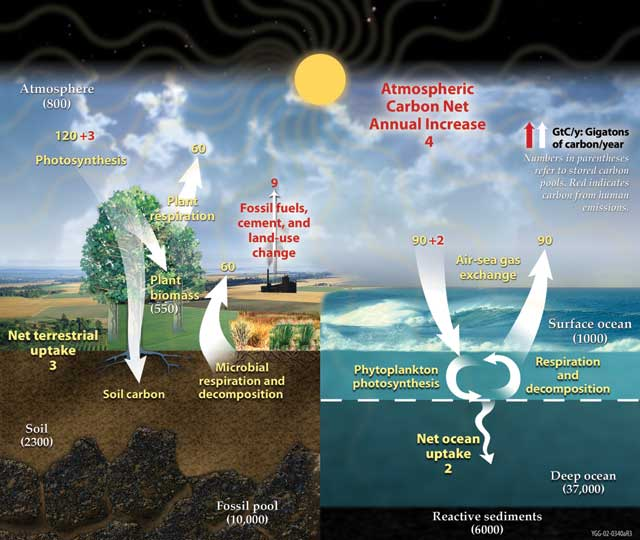
Connections with ecology and biogeography are equally important. Climatologists and ecologists together assess how climate change affects biodiversity, species migration, and ecosystem resilience. The carbon cycle, which involves exchanges of carbon between the atmosphere, oceans, soils, and living organisms, sits at the intersection of these fields.
Climatology also incorporates the social sciences:
- Economics helps evaluate the costs of climate change impacts and the cost-effectiveness of mitigation strategies.
- Policy studies inform the development of adaptation measures and international climate agreements.
- Sociology examines how communities perceive, respond to, and are disproportionately affected by climate change.
See Fiveable more often in Google
Mark Fiveable as a preferred source and Google is more likely to show you our guides in Top Stories, with a "preferred" badge in AI Mode and AI Overviews.