1.3 Climate system components and interactions

🌡️Climatology Unit 1 Review
1.3 Climate system components and interactions
🌡️ Climatology
Climate systems are complex networks of interconnected components. The atmosphere, hydrosphere, cryosphere, lithosphere, and biosphere all work together to shape Earth's climate through various interactions and feedback loops.
Energy balance drives climate dynamics, with solar radiation, heat transfer, and the greenhouse effect as key factors. External forces like solar variability, volcanic activity, and human actions also significantly impact global climate patterns.
Components of the Climate System
Atmospheric Composition and Structure
The atmosphere is the gaseous envelope surrounding Earth. It's primarily composed of nitrogen (78%) and oxygen (21%), with trace gases like carbon dioxide, water vapor, and methane making up the remainder. Those trace gases may be small in concentration, but they have an outsized role in regulating temperature through the greenhouse effect.
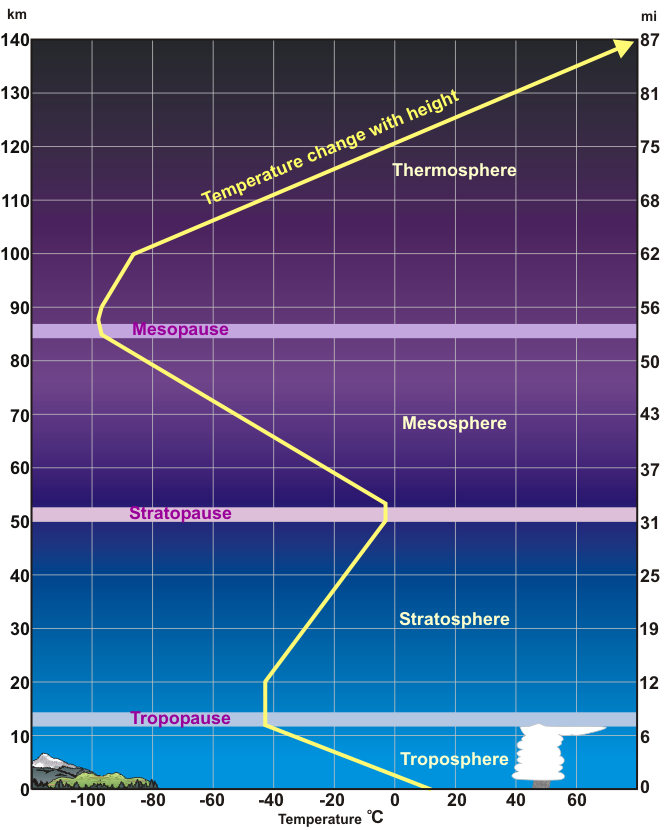
The atmosphere is divided into vertical layers, each with distinct characteristics:
- Troposphere (0–10 km): Where virtually all weather occurs. Temperature decreases with altitude here.
- Stratosphere (10–50 km): Contains the ozone layer, which absorbs UV radiation. Temperature actually increases with altitude in this layer.
- Mesosphere (50–85 km): Where meteors burn up. The coldest temperatures in the atmosphere are found at its upper boundary.
- Thermosphere (85–600 km): Where auroras occur. Extremely thin air but very high temperatures from absorbed solar radiation.
Atmospheric circulation patterns distribute heat and moisture globally through three major cells in each hemisphere:
- Hadley cells in the tropics: Warm air rises near the equator and sinks around 30° latitude
- Ferrel cells in the mid-latitudes: Driven partly by the Hadley and polar cells, moving air poleward at the surface
- Polar cells at high latitudes: Cold, dense air sinks at the poles and flows toward the mid-latitudes
Water in the Earth System
The hydrosphere encompasses all liquid water on Earth. Oceans cover about 71% of Earth's surface and contain roughly 97% of all water. The remaining freshwater is found in lakes, rivers, and underground aquifers. The water cycle (hydrologic cycle) continuously moves water between these reservoirs through evaporation, condensation, precipitation, and runoff. This cycling is a major mechanism for transferring energy around the planet, since water absorbs heat when it evaporates and releases it when it condenses.
The cryosphere includes all frozen water on Earth:
- Ice sheets in Antarctica and Greenland, which together hold enough ice to raise sea levels by about 65 meters if fully melted
- Mountain glaciers found on every continent
- Sea ice in polar regions, which expands and contracts seasonally
- Permafrost in Arctic regions, where ground remains frozen year-round
The cryosphere has several important climate effects. Snow and ice have high albedo, meaning they reflect a large fraction of incoming solar radiation back to space. When ice melts, it contributes directly to sea level rise. Thawing permafrost is a growing concern because it releases stored greenhouse gases, particularly methane, which accelerates warming.
Solid Earth and Biosphere Interactions
The lithosphere is Earth's solid outer layer, consisting of the crust and uppermost mantle. Tectonic processes influence climate over very long timescales. Mountain building (orogeny) can redirect atmospheric circulation patterns and create rain shadows. Volcanic activity releases gases and aerosols that affect both short-term weather and long-term atmospheric composition.
The biosphere encompasses all living organisms, from terrestrial ecosystems like forests and grasslands to marine ecosystems like coral reefs and kelp forests, down to soil microorganisms.
Biosphere-climate interactions run in both directions:
- Photosynthesis removes from the atmosphere, acting as a carbon sink
- Respiration and decomposition release back into the atmosphere
- Biogeochemical cycles move carbon, nitrogen, and phosphorus between living and non-living reservoirs, regulating atmospheric composition over time
Interactions within the Climate System
Atmosphere-Ocean Coupling
The atmosphere and ocean constantly exchange heat, moisture, and gases. Evaporation from the ocean surface cools the water while adding heat and moisture to the air above. Precipitation returns that water to the ocean and transfers latent heat in the process.
Ocean currents act as a global heat conveyor. The Gulf Stream, for example, carries warm tropical water northward and is a major reason why Western Europe has milder winters than other regions at the same latitude. On shorter timescales, the El Niño-Southern Oscillation (ENSO) shifts warm water across the tropical Pacific, affecting weather patterns worldwide.
Gas exchange between the atmosphere and ocean is also critical. The ocean absorbs roughly 25–30% of human-emitted , which helps regulate atmospheric concentrations. The tradeoff is ocean acidification: as dissolved increases, seawater becomes more acidic, threatening marine organisms that build calcium carbonate shells.

Cryosphere-Climate Feedbacks
The ice-albedo feedback is one of the most important positive feedback loops in the climate system. Here's how it works:
- Warming temperatures cause ice and snow to melt.
- Melting exposes darker surfaces underneath (ocean water, bare rock, soil).
- These darker surfaces have lower albedo, so they absorb more solar radiation.
- Greater absorption causes further warming.
- That additional warming melts even more ice, and the cycle continues.
This feedback is a key reason why polar regions are warming faster than the global average.
Sea ice also interacts with the ocean in important ways. When sea ice forms, it expels salt into the surrounding water, increasing its density. This dense, salty water sinks and helps drive thermohaline circulation, the large-scale "conveyor belt" of deep ocean currents that redistributes heat globally.
Changes in glaciers and ice sheets affect both sea level and ocean circulation. Freshwater from melting ice can disrupt thermohaline circulation by reducing the density of surface water at high latitudes.
Land-Atmosphere Interactions
Land surface properties strongly influence the local energy balance. Forests have lower albedo than grasslands or deserts, so they absorb more solar radiation. Urban areas, with their concrete and asphalt, absorb and retain heat, creating urban heat islands where city temperatures can be several degrees warmer than surrounding rural areas.
Soil moisture creates its own feedback loop with precipitation. Wet soils increase local evaporation, which can enhance cloud formation and rainfall. Conversely, dry soils reduce evaporation, potentially reinforcing drought conditions.
Vegetation plays a direct role too. Through transpiration, plants release water vapor into the atmosphere, contributing to local humidity and precipitation. Large-scale deforestation disrupts this process and can alter regional climate patterns significantly.
Energy Balance and Earth's Climate
Radiation and Heat Transfer
Solar radiation is the primary energy source driving Earth's climate. The sun emits shortwave radiation, which passes through the atmosphere and is absorbed by Earth's surface. The surface then emits longwave (infrared) radiation back upward.
At equilibrium, the energy balance can be expressed as:
If more energy comes in than goes out, Earth warms. If more goes out, it cools. Any factor that disrupts this balance is called a radiative forcing.
Heat moves through the climate system by three mechanisms:
- Conduction: Direct transfer through contact. This plays a minimal role in the atmosphere but matters at the ground surface.
- Convection: Vertical motion of air and water. Rising warm air and sinking cool air drive weather systems and ocean mixing.
- Radiation: Transfer of energy via electromagnetic waves. This is how energy travels from the sun to Earth and from Earth back to space.
The greenhouse effect is what makes Earth habitable. Greenhouse gases (, water vapor, methane, and others) absorb outgoing longwave radiation and re-emit it in all directions, including back toward the surface. Without this natural greenhouse effect, Earth's average surface temperature would be about instead of the current .
Albedo and Surface Energy Budget
Albedo is the fraction of incoming solar radiation that a surface reflects. It ranges from 0 (absorbs everything) to 1 (reflects everything). Fresh snow has an albedo around 0.8–0.9, while ocean water can be as low as 0.06. This is why changes in ice cover have such a large effect on the energy balance.
The surface energy budget breaks down into four components:
- Net radiation: The balance of all incoming and outgoing radiation at the surface
- Sensible heat flux: Energy transferred from the surface to the air by conduction and convection (you feel this as warmth)
- Latent heat flux: Energy used for evaporation and released during condensation
- Ground heat flux: Energy conducted into or out of the ground
Several factors alter the surface energy budget, including land cover changes (deforestation, urbanization), changes in snow and ice cover, and variations in soil moisture and vegetation. Each of these shifts how incoming solar energy is partitioned among the four fluxes.
Global Energy Transport
Earth receives far more solar energy at the equator than at the poles, but the tropics don't keep getting hotter and the poles don't keep getting colder. That's because the climate system actively redistributes heat.
Atmospheric circulation is one major pathway. The Hadley cell transports heat from the equator to the subtropics. Jet streams steer weather systems and influence heat exchange in the mid-latitudes.
Ocean currents are the other major pathway. The Gulf Stream warms Western Europe, while the Antarctic Circumpolar Current circles Antarctica and thermally isolates it, helping keep the continent extremely cold.
Latent heat transport by water vapor is a third, often underappreciated mechanism. Evaporation in the tropics absorbs enormous amounts of energy. When that moisture-laden air moves poleward and condenses, it releases that stored energy at higher latitudes. This is one of the most efficient ways the climate system moves heat from low to high latitudes.
External Forcings on Climate
Solar Variability
Changes in the sun's energy output directly affect Earth's energy balance. The 11-year sunspot cycle causes small variations in solar irradiance (about 0.1%), which produce minor but detectable climate effects. Longer-term changes, like the Maunder Minimum (1645–1715), when sunspot activity was unusually low, coincided with cooler temperatures in parts of Europe.
On much longer timescales, Milankovitch cycles alter how solar energy is distributed across Earth's surface:
- Eccentricity (~100,000-year cycle): Changes in the shape of Earth's orbit from more circular to more elliptical
- Obliquity (~41,000-year cycle): Changes in the tilt of Earth's axis (currently ~23.5°), which affects the intensity of seasons
- Precession (~26,000-year cycle): The wobble of Earth's rotational axis, which shifts the timing of when Earth is closest to the sun relative to the seasons
These orbital variations are the pacemakers of the ice ages, controlling the timing of glacial and interglacial periods over hundreds of thousands of years.
Volcanic Activity
Large volcanic eruptions can inject massive amounts of aerosols into the stratosphere. Sulfur dioxide () from eruptions forms sulfate aerosols, which reflect incoming solar radiation and cool Earth's surface. This cooling effect can last 1–3 years, since stratospheric aerosols take time to settle out.
Two well-documented examples:
- The 1815 eruption of Mount Tambora injected so much material into the stratosphere that 1816 became known as the "Year Without a Summer," with widespread crop failures across Europe and North America.
- The 1991 eruption of Mount Pinatubo cooled global average temperatures by approximately 0.5°C for about two years.
Volcanic gases also affect atmospheric composition in other ways. emissions from volcanism contribute to long-term warming (though current volcanic output is far smaller than human emissions). Sulfur dioxide can also form acid rain, affecting ecosystems downwind.
Anthropogenic Forcings
Human activities have become a dominant force shaping the climate system, particularly since the Industrial Revolution.
Greenhouse gas emissions are the most significant anthropogenic forcing. Burning fossil fuels has increased atmospheric from about 280 ppm (pre-industrial) to over 420 ppm today. Agriculture and waste management are major sources of methane (), which is a more potent greenhouse gas than per molecule, though shorter-lived in the atmosphere.
Land use changes alter surface properties in ways that affect climate. Deforestation removes carbon sinks and changes surface albedo. Urbanization creates heat islands and alters local hydrology.
Aerosol emissions from industrial activities have complex climate effects. Sulfate aerosols reflect sunlight and produce a net cooling effect, while black carbon (soot) absorbs radiation and has a warming effect. These opposing influences make aerosols one of the largest sources of uncertainty in climate projections.
Ozone depletion in the stratosphere is another human-caused forcing. Chlorofluorocarbons (CFCs) break down ozone molecules, and the resulting ozone hole over Antarctica has altered wind patterns and temperatures across the Southern Hemisphere. International action through the Montreal Protocol (1987) has slowed ozone destruction, and the ozone layer is gradually recovering.
See Fiveable more often in Google
Mark Fiveable as a preferred source and Google is more likely to show you our guides in Top Stories, with a "preferred" badge in AI Mode and AI Overviews.