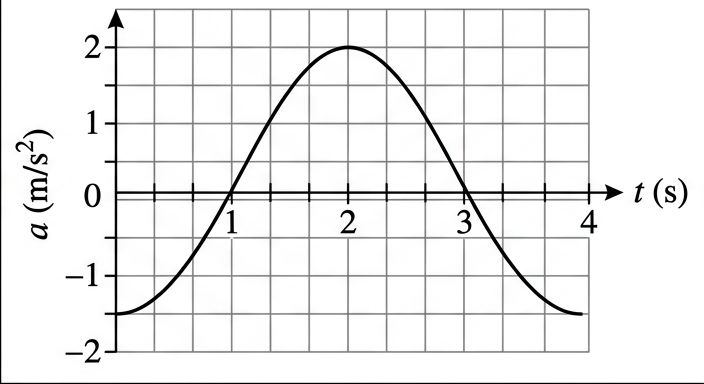
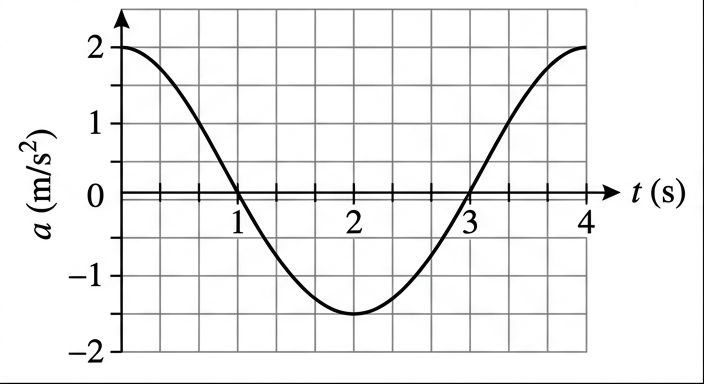
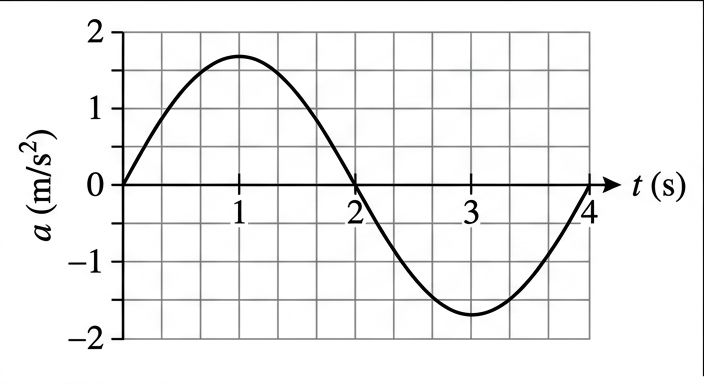
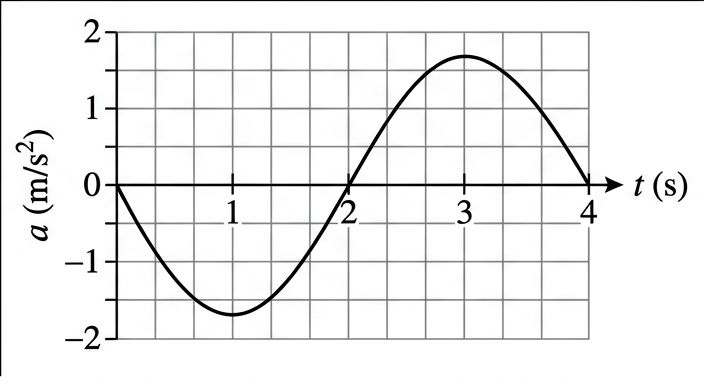
The total mechanical energy of an SHM system is constant: E_total = U + K. For a spring-mass system, E_total = (1/2)kA^2. At the turning points, all energy is stored as spring potential energy U = (1/2)kx^2 and kinetic energy is zero. At equilibrium, all energy is kinetic and speed is at its maximum, v_max = A*sqrt(k/m). Because E_total scales with A squared, doubling the amplitude quadruples the total energy. This energy framework lets you find the speed of the object at any position using (1/2)kA^2 = (1/2)mv^2 + (1/2)kx^2.
- E_total = (1/2)*k*A^2: Total mechanical energy of a spring-mass oscillator; set by the amplitude and spring constant, not by position or time.
- U = (1/2)*k*x^2: Elastic potential energy at displacement x; maximum at the turning points and zero at equilibrium.
- K = (1/2)*m*v^2: Kinetic energy; maximum at equilibrium and zero at the turning points.
- v_max = A*sqrt(k/m): Maximum speed, reached when the object passes through equilibrium; increases with amplitude and decreases with more mass.
- Energy and amplitude: Total energy is proportional to A squared, so a larger amplitude means more total energy stored in the system.
A spring with k = 200 N/m oscillates with amplitude 0.04 m. What is the total mechanical energy, and what is the speed of the mass at x = 0.02 m if the mass is 0.5 kg?
| Position | Kinetic energy | Potential energy | Total energy |
|---|
| x = A (turning point) | Zero | Maximum = (1/2)*k*A^2 | (1/2)*k*A^2 |
| x = 0 (equilibrium) | Maximum = (1/2)*k*A^2 | Zero | (1/2)*k*A^2 |
| x between 0 and A | Partial | Partial | (1/2)*k*A^2 |