← back to ap physics 1

ap physics 1 unit 7 study guides

oscillations

unit 7 review

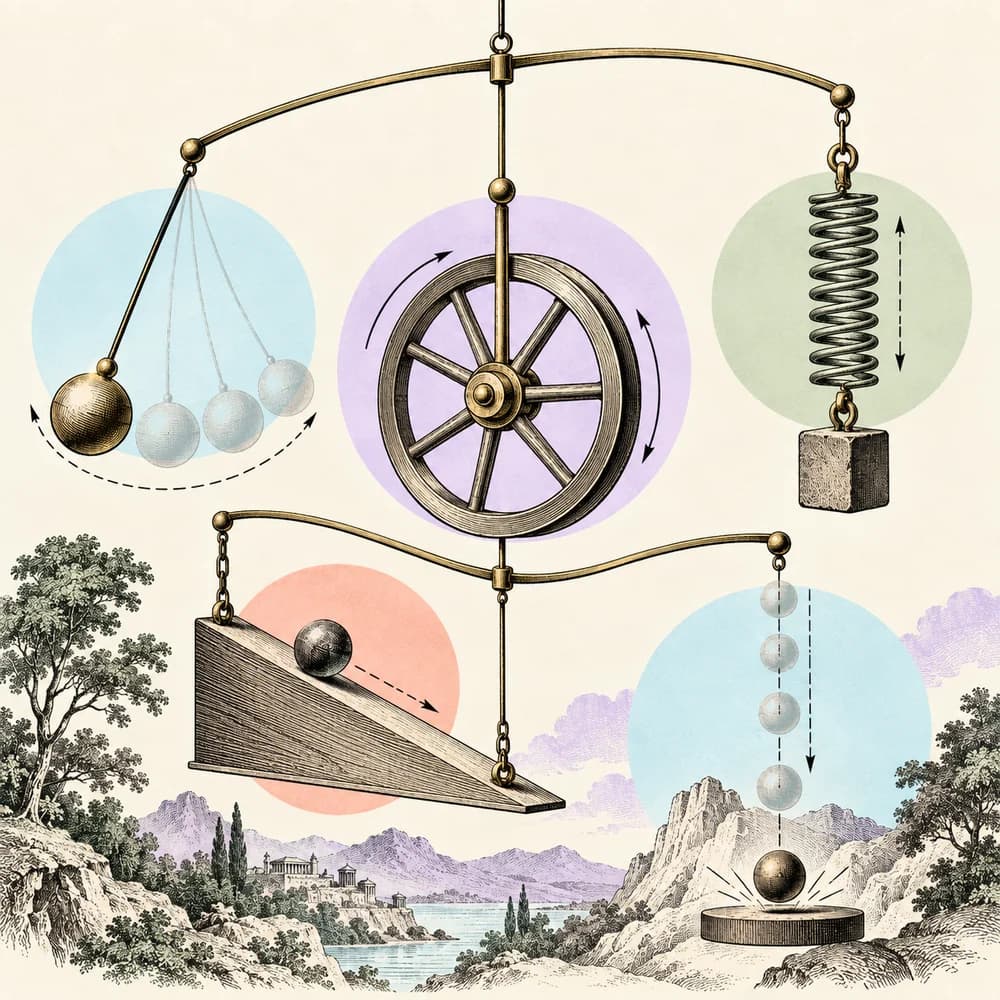
Oscillations are all about repetitive motion around a central point. This unit explores key concepts like frequency, period, and amplitude, as well as different types of oscillations including simple harmonic motion, damped oscillations, and forced oscillations. We'll dive into the physics of oscillating systems, from springs and pendulums to energy conservation and real-world applications. Understanding these principles is crucial for grasping more complex topics in physics and engineering.

Key Concepts

  • Oscillations involve periodic motion or fluctuations around an equilibrium point
  • Frequency (ff) represents the number of oscillations per unit time, measured in hertz (Hz)
  • Period (TT) is the time required for one complete oscillation, measured in seconds (s)
    • Relationship between frequency and period: f=1Tf = \frac{1}{T}
  • Amplitude (AA) is the maximum displacement from the equilibrium position
  • Phase is the position of an oscillating object at a specific time, often measured in radians or degrees
  • Restoring force acts to return the oscillating object back to its equilibrium position
    • Strength of the restoring force determines the frequency and period of the oscillation

Types of Oscillations

  • Simple harmonic motion (SHM) is a type of oscillation where the restoring force is directly proportional to the displacement from equilibrium
    • Examples of SHM include a mass on a spring and a simple pendulum
  • Damped oscillations occur when the amplitude of the oscillation decreases over time due to energy dissipation (friction, air resistance)
  • Forced oscillations happen when an external periodic force drives the oscillating system
    • Resonance occurs when the frequency of the external force matches the natural frequency of the system, leading to large amplitude oscillations
  • Coupled oscillations involve the interaction between two or more oscillating systems, such as connected pendulums or springs

Simple Harmonic Motion

  • In SHM, the acceleration of the oscillating object is directly proportional to its displacement from equilibrium and always directed towards the equilibrium position
  • The equation of motion for SHM is a=kmxa = -\frac{k}{m}x, where aa is acceleration, kk is the spring constant, mm is mass, and xx is displacement
  • The period of SHM is given by T=2πmkT = 2\pi\sqrt{\frac{m}{k}}, which depends on the mass and the spring constant
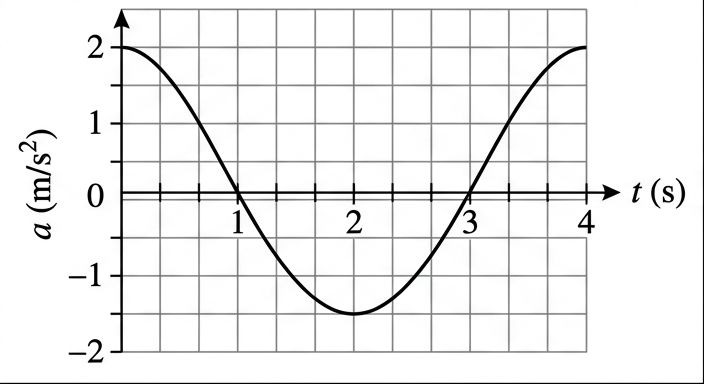
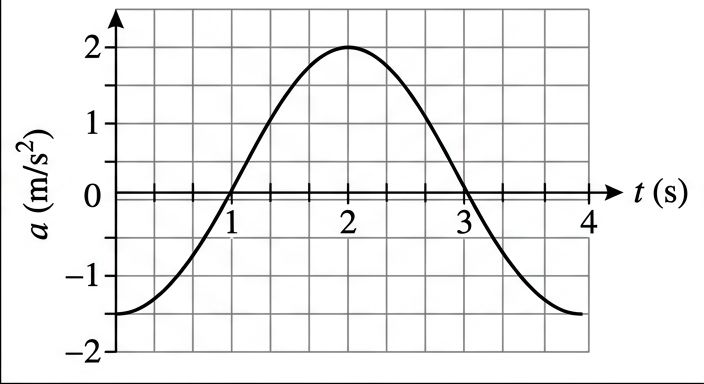
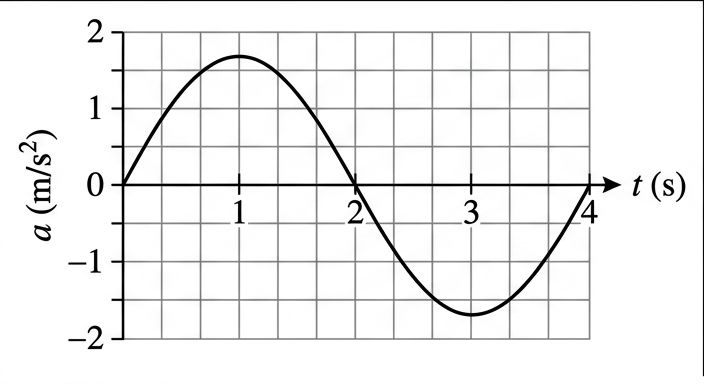
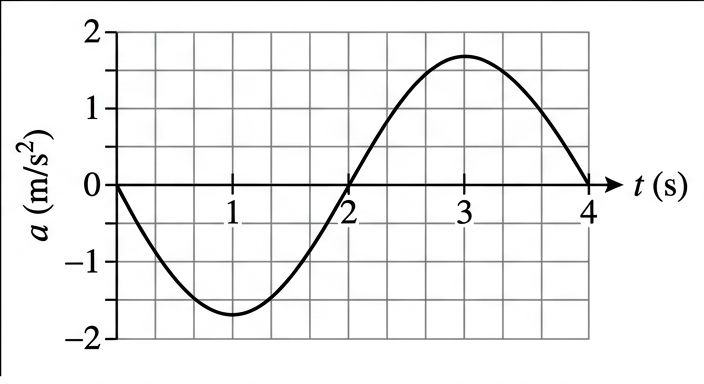
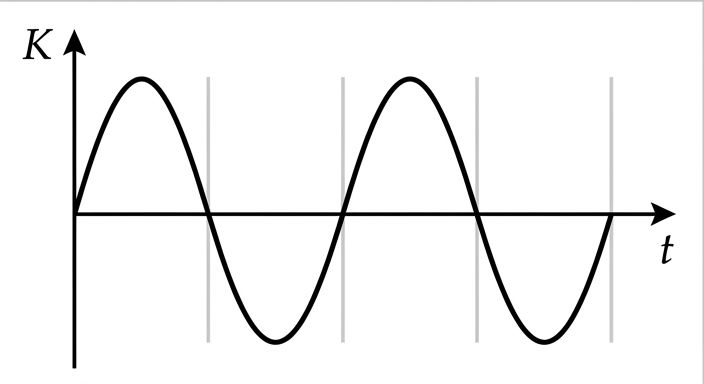
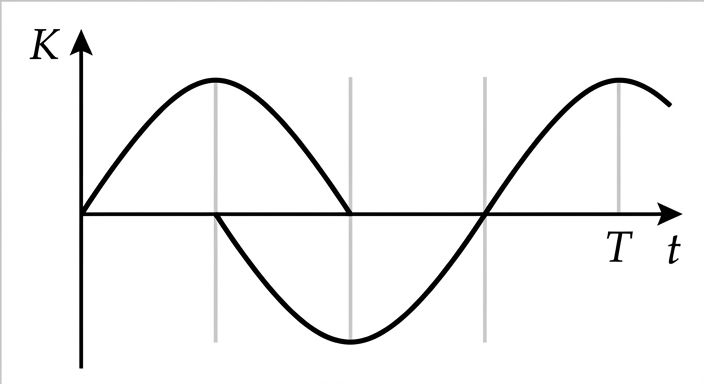
  • Velocity and acceleration in SHM vary sinusoidally with time
    • Maximum velocity occurs at the equilibrium position, while maximum acceleration occurs at the extremes of the motion
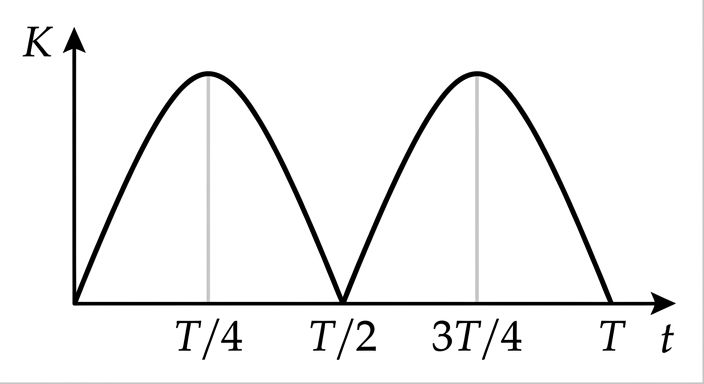
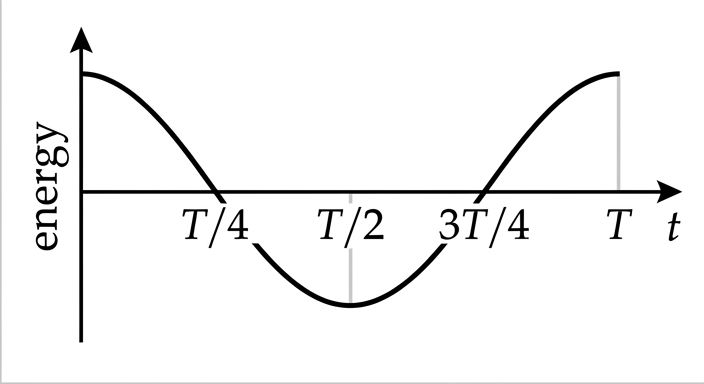
  • Energy in SHM is conserved, continuously converting between kinetic and potential energy

Energy in Oscillating Systems

  • Total energy in an oscillating system is the sum of kinetic energy (KE) and potential energy (PE)
    • KE is associated with the motion of the oscillating object, given by KE=12mv2KE = \frac{1}{2}mv^2
    • PE is associated with the position of the oscillating object relative to its equilibrium, given by PE=12kx2PE = \frac{1}{2}kx^2 for a spring
  • In the absence of damping, the total energy remains constant throughout the oscillation
  • Energy is continuously converted between KE and PE during the oscillation
    • At the equilibrium position, KE is maximum and PE is minimum
    • At the extremes of the motion, KE is minimum and PE is maximum

Pendulums

  • A simple pendulum consists of a mass (bob) suspended by a lightweight string or rod from a fixed point
  • The period of a simple pendulum depends on its length (LL) and the acceleration due to gravity (gg), given by T=2πLgT = 2\pi\sqrt{\frac{L}{g}}
    • The period is independent of the mass of the bob and the amplitude of the oscillation (for small angles)
  • The restoring force for a pendulum is the component of the gravitational force tangential to the arc of motion
  • Pendulums exhibit SHM for small angles of displacement (less than about 15 degrees)
  • Physical pendulums are rigid objects that oscillate about a fixed axis (a swinging door, a metronome)

Springs and Hooke's Law

  • Hooke's Law states that the force exerted by a spring is directly proportional to its displacement from equilibrium, given by F=kxF = -kx
    • The negative sign indicates that the force is always directed opposite to the displacement
  • The spring constant (kk) is a measure of the stiffness of the spring, with units of N/m
    • Stiffer springs have higher kk values and oscillate with higher frequencies
  • The potential energy stored in a stretched or compressed spring is given by PE=12kx2PE = \frac{1}{2}kx^2
  • The period of a mass-spring system is given by T=2πmkT = 2\pi\sqrt{\frac{m}{k}}, which depends on the mass and the spring constant

Damped Oscillations

  • Damping is the dissipation of energy from an oscillating system, causing the amplitude to decrease over time
  • Damping can be caused by various factors, such as friction, air resistance, or electrical resistance
  • The equation of motion for a damped oscillator includes a damping term proportional to the velocity, given by a=kmxbmva = -\frac{k}{m}x - \frac{b}{m}v, where bb is the damping coefficient
  • Critical damping is the minimum amount of damping required to prevent oscillation
    • An overdamped system returns to equilibrium without oscillating
    • An underdamped system oscillates with decreasing amplitude before reaching equilibrium

Real-World Applications

  • Seismic waves generated by earthquakes are an example of oscillations in the Earth's crust
  • Shock absorbers in vehicles use damped oscillations to reduce the effect of bumps and vibrations on the ride quality
  • Resonance is used in musical instruments to amplify sound (strings, wind instruments, percussion)
  • Atomic force microscopes (AFMs) use the oscillations of a cantilever to map the surface of materials at the nanoscale
  • Clocks and watches use the regular oscillations of pendulums or quartz crystals to keep time
  • Electrical circuits with inductors and capacitors can exhibit oscillating currents and voltages (LC circuits)
  • Bridges and buildings are designed to avoid resonance with common oscillation sources (wind, earthquakes, traffic) to prevent structural damage

Frequently Asked Questions

What topics are covered in AP Physics 1 Unit 7?

Unit 7 (Oscillations) focuses on simple harmonic motion and the energy of oscillators. You’ll find the full breakdown and resources on Fiveable’s unit page (https://library.fiveable.me/ap-physics-1-revised/unit-7). It covers 7.1–7.4: 7.1 Defining Simple Harmonic Motion (SHM) — what SHM is and the restoring-force idea (e.g., ma_x = -kΔx, small-angle pendulum approximation). 7.2 Frequency and Period — relationships T = 1/f, T_s = 2π√(m/k), and T_p = 2π√(ℓ/g). 7.3 Representing and Analyzing SHM — displacement, velocity, acceleration equations (x = A cos(2πft) or x = A sin(2πft)), extrema/zeros, and that amplitude doesn’t change period. 7.4 Energy of Oscillators — KE/PE interchange, total energy E_total = U + K, conservation, and E_total = 1/2 k A^2 for springs. For guided notes, practice questions, cheatsheets, and cram videos, check the Fiveable unit page above.

How much of the AP Physics 1 exam is Unit 7 (rotational motion and oscillations)?

Expect Unit 7 (Oscillations) to make up about 5–8% of the AP Physics 1 exam; Fiveable’s unit guide lays this out (https://library.fiveable.me/ap-physics-1-revised/unit-7). That’s a small but meaningful slice, so you’ll see a few multiple-choice and possibly one free-response question targeting simple harmonic motion, period/frequency, SHM representations, and oscillator energy. Because it’s narrower in scope, be fluent with the core SHM equations and energy relationships so you can answer those targeted questions quickly. For focused review and practice problems, Fiveable’s Unit 7 study guide and practice bank are handy resources (https://library.fiveable.me/ap-physics-1-revised/unit-7).

What's the hardest part of Unit 7 in AP Physics 1?

Most students find the trickiest part is linking the math (sinusoidal functions, amplitude, phase) to the physical motion and energy in SHM — see the unit page (https://library.fiveable.me/ap-physics-1-revised/unit-7). Translating between position/velocity/acceleration graphs, understanding the phase constant, and tracking how kinetic and potential energy trade off during oscillations often trips people up. Problems that mix trig, derivatives (v = dx/dt), and energy conservation are hardest because you need to switch representations quickly. Practice sketching motion and energy versus time, work on sign conventions for restoring forces, and memorize key SHM formulas like x(t)=Acos(ωt+φ) and ω=√(k/m). Targeted practice builds that flexible intuition.

How should I study Unit 7 (torque, rotational dynamics, oscillations) for AP Physics 1?

Start with the Unit 7 study guide (https://library.fiveable.me/ap-physics-1-revised/unit-7) to learn SHM definitions, period/frequency formulas, representations, and energy of oscillators. Spend a session deriving 1 cos(ωt+φ), T=2π/ω, and the small-angle pendulum approximation. Practice translating between graphs, equations, and phase relationships. Do timed problem sets focused on period/frequency, energy exchange (KE↔PE), and amplitude/phase shifts — aim for 20–30 targeted problems and carefully review mistakes. Use short, spaced retrieval quizzes and one cumulative mixed set to connect units. Finish with a cram video or cheatsheet refresher the day before the test. For organized notes, step-by-step practice, and cram videos, try Fiveable’s Unit 7 guide, practice bank, and cheatsheets.

Where can I find AP Physics 1 Unit 7 practice problems and FRQs?

You’ll find Unit 7 practice and study materials on Fiveable’s Unit 7 page (https://library.fiveable.me/ap-physics-1-revised/unit-7) and additional topic practice at the practice hub (https://library.fiveable.me/practice/physics-1-revised). For official past FRQs and scoring guidelines, use the College Board’s AP Central (look for “AP Physics 1 free-response questions”). Fiveable’s Unit 7 page has focused review, cheatsheets, and practice sets aligned to Topics 7.1–7.4 (SHM definitions, period/frequency, representations, and energy). Combine those targeted problems with College Board FRQs to get both skill practice and real exam-style free-response experience.

What equations and formulas do I need to memorize for AP Physics 1 Unit 7?

For Unit 7 (Oscillations), the key formulas you should memorize are listed (https://library.fiveable.me/ap-physics-1-revised/unit-7). Memorize the restoring-force form and SHM definitions: $$m a_x = -k\Delta x$$. Period/frequency relations: $$T=\frac{1}{f}$$, spring oscillator $$T_s = 2\pi\sqrt{\frac{m}{k}}$$, simple pendulum (small angle) $$T_p = 2\pi\sqrt{\frac{\ell}{g}}$$. Position/kinematics for SHM: $$x=A\cos(2\pi f t)\;\text{or}\;x=A\sin(2\pi f t)$$. Energy relations: $$E_{\text{total}}=U+K$$ and for a spring $$E_{\text{total}}=\frac{1}{2}kA^{2}$$. Also be comfortable with $$K=\tfrac{1}{2}mv^{2}$$ and spring potential $$U=\tfrac{1}{2}kx^{2}$$ and the idea that amplitude doesn’t change period. Fiveable’s unit guide, practice questions, cheatsheets, and cram videos at the above URL are useful for review.

How long should I spend reviewing Unit 7 before the AP Physics 1 exam?

Aim for about 3–6 total hours on Unit 7, spread over a week — roughly 30–60 minutes a day for 4–7 days (see the unit study guide: https://library.fiveable.me/ap-physics-1-revised/unit-7). Unit 7 (Oscillations) is only 5–8% of the exam, so prioritize accuracy on core ideas: simple harmonic motion, period/frequency, representations (graphs/equations), and energy in oscillators. Do one solid pass that mixes concept review with example problems, then one timed practice set that includes at least one FRQ-style problem. If oscillations feel weak, add another 1–2 focused sessions on damping/energy and graph interpretation. For structured practice and quick refreshers, try Fiveable’s Unit 7 study guide, cheatsheets, and related practice questions (https://library.fiveable.me/practice/physics-1-revised).

Are there common free-response question types from AP Physics 1 Unit 7 (rotational motion/oscillations)?

Yes — common FRQ types for Unit 7 focus on simple harmonic motion (springs and small-angle pendulums). Review unit material (https://library.fiveable.me/ap-physics-1-revised/unit-7). Expect Translation Between Representations (TBR) prompts asking for free-body diagrams, energy bar charts, and sketches of displacement/velocity/acceleration vs. time. Quantitative parts often ask for period/frequency using $$T_s=2\pi\sqrt{m/k}$$ or $$T_p=2\pi\sqrt{\ell/g}$$, and use conservation of mechanical energy (e.g., $$E=\tfrac{1}{2}kA^2$$) to relate amplitude, max potential, and kinetic energy. Typical tasks: identify extrema and zeros of x, v, a; compute periods or energies; justify why amplitude doesn’t change period; and connect graphs to equations. For extra practice and worked problems, see Fiveable’s Unit 7 guide and its practice set (https://library.fiveable.me/practice/physics-1-revised).