AP English Literature Prose Analysis Essay Practice
49 prose fiction analysis prompts written in the AP format. Pick one, read the full passage, and write your analysis. Fiveable scores each Prose Analysis Essay response part by part on the AP rubric.
Your first scored response is included. A plan unlocks unlimited scoring.
49 questions
sorted by unit
Jake's fascination and disillusionment amid Harlem nightlife's violence and racial conflict
In this excerpt from Claude McKay's novel Home to Harlem, published in 1928, the protagonist Jake navigates the vibrant but volatile nightlife of Harlem. Read the passage carefully. Then, in a well-written essay, analyze how McKay uses literary elements and techniques to convey Jake's complex attitude toward his surroundings.
Respond to the prompt with a thesis that presents a defensible interpretation.
Select and use evidence to support your line of reasoning.
Explain how the evidence supports your line of reasoning.
Use appropriate grammar and punctuation in communicating your argument.
Jake was going crazy. A hot fever was burning him up. … Where was the singing gal that had danced to him? That dancing was for him all right. …
A crash cut through the music. A table went jazzing into the drum. The cabaret singer lay sprawling on the floor. A raging putty-skinned mulattress stamped on her ribs and spat in her face! “That’ll teach you to leave mah man be every time.” A black waiter rushed the mulattress. “Git off’n her. ’Causen she’s down.”
A potato-yellow man and a dull-black were locked. The proprietor, a heavy brown man, worked his elbow like a hatchet between them.
The antagonists glowered at each other.
“What you want to knock the gal down like that for, I acks you?”
“Better acks her why she done spits on mah woman.”
“Woman! White man’s wench, you mean. You low-down tripe. …”
The black man heaved toward the yellow, but the waiters hooked and hustled him off. … Sitting at a table, the cabaret singer was soothing her eye.
“Git out on the sidewalk, all you troublemakers,” cried the proprietor. “And you, Bess,” he cried to the cabaret singer, “nevah you show your face in mah place again.”
The cabaret was closed for the rest of the night. Like dogs flicked apart by a whipcord, the jazzers stood and talked resentfully in the street.
“Hi, Jake”—Zeddy, rocking into the group with a nosy air, spotted his buddy—“was you in on the li’l fun?”
“Yes, buddy, but I wasn’t mixed up in it. Sometimes they turn mah stomach, the womens. The same in France, the same in England, the same in Harlem. White against white and black against white and yellow against black and brown. We’s all just crazy-dog mad. Ain’t no peace on earth with the womens and there ain’t no life anywhere without them.”
“You said it, boh. It’s a be-be itching life”—Zeddy scratched his flank—“and we’re all sons of it. … But what is you hitting round this joint? I thought you would be feeding off milk and honey tonight?”
“Hard luck, buddy. Done lose out counta mah own indiligence. I fohgit the street and the house. Thought I’d find her heah but. …”
“What you thinking ’bout, boh?”
“That gal got beat up in the Baltimore. She done sings me into a tantalizing mood. Ahm feeling like.”
“Let’s take a look in on the Congo, boh. It’s the best pick-me-up place in Harlem.”
“I’m with you, buddy.”
“Always packed with the best pickings. When the chippies1 come up from down home, tha’s where they hangs out first. You kain always find something that New York ain’t done made a fool of yet. Theah’s a high-yaller entertainer there that I’se got a crush on, but she ain’t nevah gived me a encouraging eye.”
“I ain’t much for the high-yallers after having been so much fed-up on the ofays2,” said Jake. “They’s so doggone much alike.”
“Ah no, boh. A sweet-lovin’ high-yaller queen’s got something different. K‑hhhhhhh, K‑hhhhhhh. Something nigger.”
The Congo was thick, dark-colorful, and fascinating. Drum and saxophone were fighting out the wonderful drag “blues” that was the favorite of all the low-down dance halls. In all the better places it was banned. Rumor said it was a police ban. It was an old tune, so far as popular tunes go. But at the Congo it lived fresh and green as grass. Everybody there was giggling and wriggling to it.
And it is ashes to ashes and dust to dust,
Can you show me a woman that a man can trust?
Source: Claude McKay, Home to Harlem, 1928
1 chippies: a slang term for young women
2 ofays: a slang term for white people
What the Prose Analysis Essay asks
The prose fiction analysis essay is FRQ 2 on the AP English Literature exam. You read a passage of prose fiction and write an essay analyzing how the author uses literary elements and techniques to develop a complex effect.
- 40 min
- suggested time
- 6 points
- across rows A to C
- 55%
- of your score, across all three essays
Part A: Thesis
A defensible interpretation of the passage that answers the prompt
1 pt
Part B: Evidence and commentary
Quotes from the passage, with commentary on how several techniques work together
4 pts
Part C: Sophistication
A complex reading, sustained across the essay
1 pt
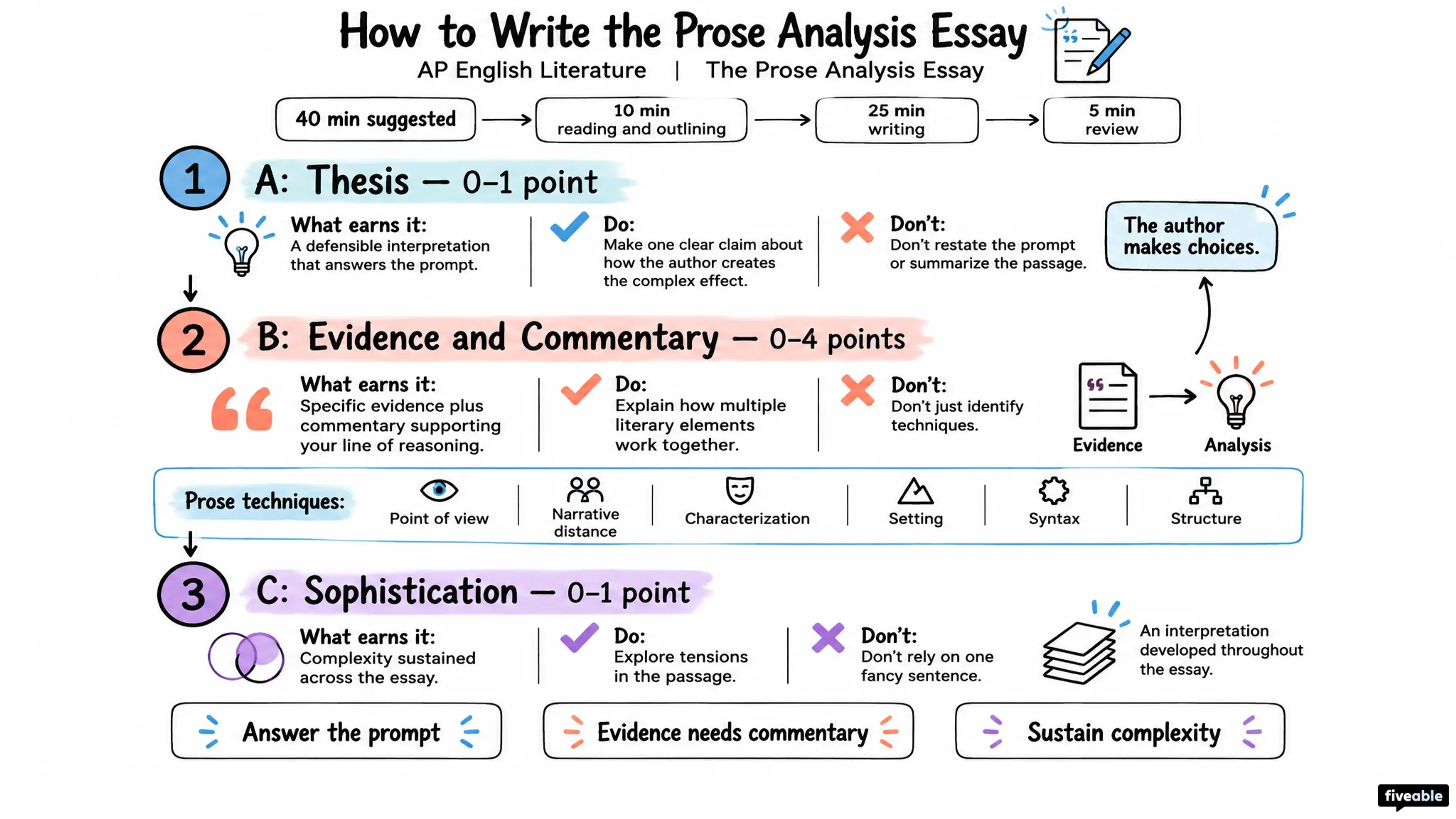
Prose Analysis Essay skill sheet
Every rubric point on one page: what earns it, what to do and what to avoid. Tap the sheet to see it full size.
How Prose Analysis Essay practice works
Each question follows the exam’s format, from the full prompt to a score on every part.
Read the full passage
The prompt and the full prose passage, laid out the way the exam shows them.
Write on a 40-minute timer
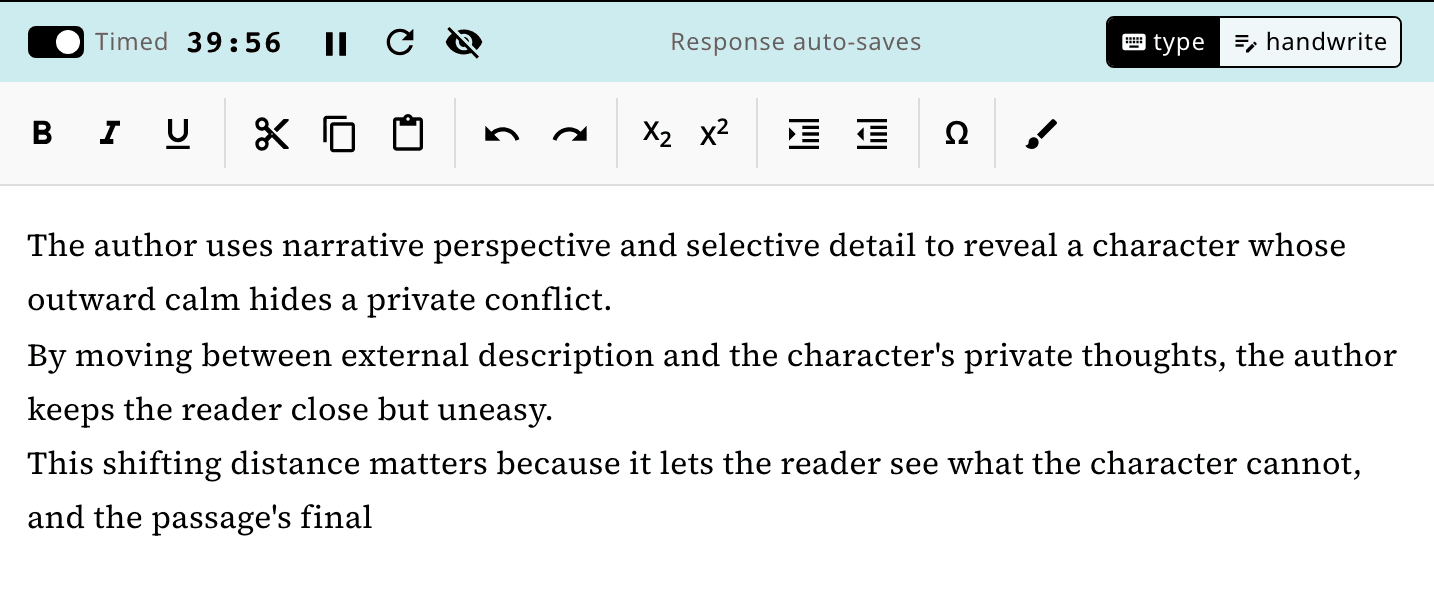
The time to plan for on exam day. Pause it or turn it off, and your response saves as you go.
Submit for a score out of 6
Your response is scored against the scoring guidelines written for that question. Your first score is included.
Feedback on every part
A summary at the top tells you what to work on next. Below it, each part shows whether you earned the point and what the scoring guidelines were looking for.
Detailed Feedback
Part A: 1/1 point
Earned the point. You provided a defensible thesis that responds to the prompt by claiming Ishmael's motivation is influenced by the sea being a place of competition and conflict rather than just a physical space.
Part C: 0/1 point
Did not earn the point. To earn the sophistication point, the essay needs to demonstrate a complex understanding of the text, such as exploring tensions within Ishmael's motivations or situating the analysis in a broader context, and this complexity must be consistently maintained throughout the argument.
Questions about the Prose Analysis Essay
How many responses can I get scored?
You can read every question without a plan. Your first scored response is included. A plan unlocks unlimited scoring.
What should I analyze in a prose passage?
Point of view, narrative distance, characterization, syntax, and structure come up most. Tie each choice to the effect the prompt names.
How is the prose essay different from poetry analysis?
Both use the same 6-point rubric. The prose passage is longer, so the work is covering more of the text while keeping your commentary specific.
Are these real College Board questions?
No. We wrote them in the AP format, with the same 6-point rubric, and wrote scoring guidelines for each one.
Can I write my answer by hand?
Yes. Switch the editor to handwrite, write on paper, and add a photo of your page.
More AP English Literature practice
Poetry Analysis Essay practice
Poetry analysis prompts with the full poem and its context.
Literary Argument Essay practice
Literary argument prompts with the full list of suggested works.
AP English Literature FRQs
Every FRQ type for AP English Literature, with practice for each.
See the Prose Analysis Essay rubric points students miss most, from responses scored on Fiveable.
Write your first Prose Analysis Essay
Pick one from the list, or let us choose for you.
Teaching AP English Literature? Assign these Prose Analysis Essays to your class